SPRINGDALE, Utah — Towering 1,500 feet over the floor of Zion National Park, Angels Landing is one of the most recognizable rock formation in the American West. Famous for its steep grades, sheer cliffs and razor thin paths, it draws hundreds of thousands of thrill-seeking hikers each year. Yet, long before it became an internet sensation and arguably the “deadliest hike” in America’s National Park system, it was a summit deemed entirely unreachable by humans.
The trail enjoyed by modern hikers is the result of a century old historical gamble, a wandering Methodist minister, and a pioneering engineer who believed regular people deserved access to the heavens no matter the risk.
A Minister’s Vision and the Birth of a Holy Metaphor
For thousands of years, the towering vertical walls of Zion Canyon were known as Mukuntuweap—a Southern Paiute word meaning “straight canyon.” It was under this moniker that President William Howard Taft first designated the area as a federally protected National Monument in 1909. However, fearing that American tourists would struggle to pronounce the Indigenous name, the National Park Service officially rebranded the sanctuary as Zion in 1918.
Two years before that name change, a 50-year-old traveling motivational speaker and Methodist minister from Ohio named Frederick Vining Fisher stepped off a stagecoach into the region. Seeking pristine landscapes to anchor his popular illustrated travel lectures, Fisher spent two weeks exploring the canyon floor in October 1916 alongside two local Mormon teenagers who served as his guides.

Gazing up at a massive, light-reflecting monolith on the east side of the canyon, Fisher famously declared, “Boys, I have looked at this mountain all my life but I never expected to find it in this world. This mountain is the Great White Throne” referencing the judgment seat of God.
Turning his eyes across the canyon to a narrower, sharper sandstone ridge with a dizzying 1,500-foot drop, Fisher added that while the angels would never dare land directly on God’s throne, they might just pause at the foot of “Angels Landing.”
The names stuck. Fisher featured them in his cross-country lectures, and by the time Zion achieved full National Park status, his biblical nomenclature had been codified into official federal records.

Engineering the Impossible: Walter Ruesch’s 1925 Gamble
While Fisher gave the peak its heavenly identity, it was Walter Ruesch (Zion’s first official superintendent) who truly brought it down to earth.
In the early 1920s, visitors flooded into the newly minted national park, eager to see the majestic peaks Fisher had described. The problem was that they couldn’t actually reach them; the summit of Angels Landing was entirely inaccessible without technical rock-climbing gear.
In 1925, Ruesch partnered with landscape architect Thomas Vint to execute a radical blueprint by building a trail that allowed everyday citizens wearing ordinary boots to ascend a 1,500-foot vertical precipice.
The engineering feat remains a marvel. To scale the steep canyon, crews hand-laid native sandstone to construct “Walter’s Wiggles” a dizzying series of 21 tight, stacked switchbacks carved directly into the mountain face.
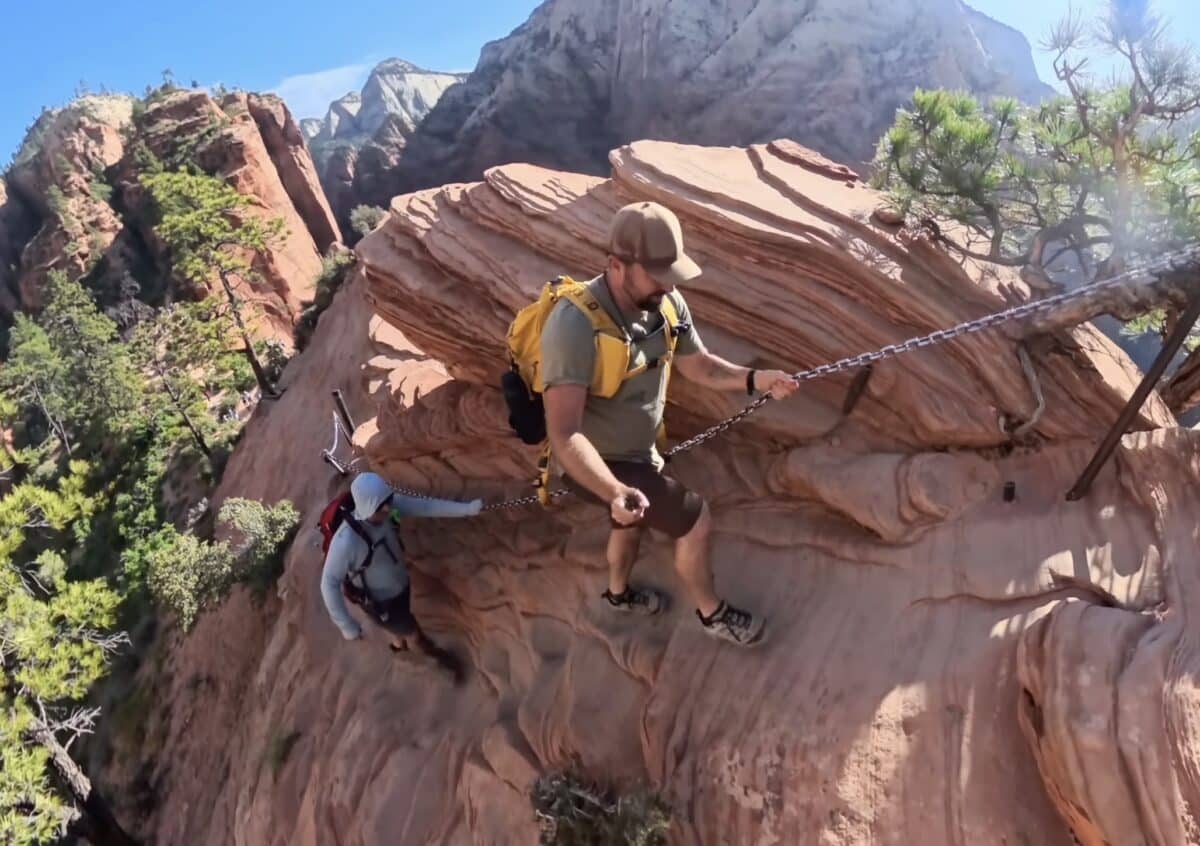
For the final, treacherous half-mile stretch along the mountain’s spine, crews chiseled footholds directly into the slick Navajo sandstone. Working without modern safety harnesses on a knife-edge ridge only four to five feet wide, Ruesch’s men bolted heavy iron chains directly into the rock to serve as handholds. The trail officially opened to the public on July 11, 1926.

The Mathematical Reality of “America’s Deadliest Hike”
Nearly a century later, Ruesch’s original iron anchor points still hold the chain system in place. However, the explosive rise of travel documentation on platforms like Instagram and YouTube has transformed this once-remote challenge into a bucket-list phenomenon, reigniting fierce debates over public safety.
Since records began, roughly 20 people have fallen to their deaths along this single route, with over half of those fatalities occurring since the year 2000.
Experts emphasize that the dangers are often weather dependent. The 180-million-year-old compressed Jurassic sand dunes that form the trail provide excellent traction when dry acting much like fine sandpaper. But when a sudden rainstorm hits, the top layer of sand liquefies into a frictionless film, turning the path into a trap where a single misstep can mean a 1,500-foot fall.
Despite its grim reputation, park officials note that the danger must be weighed against the sheer volume of visitors. In 2019 alone, more than 300,000 hikers successfully completed the trail. With roughly one fatality occurring every few years, the statistical mathematical risk sits at an incredibly low 0.003%.
Regulating the Chaos: The Modern Permit System
The true threat to Angels Landing in recent decades wasn’t the geometry of the cliffs, but the sheer chaos of overcrowding. By the late 2010s, the narrow spine routinely choked with massive crowds, forcing hikers to let go of the safety chains to squeeze past two-way traffic on four-foot-wide ledges.
To curb this hazard, the National Park Service took a historic step in April 2022 by instituting a strict seasonal lottery permit system. Today, hundreds of thousands of hopeful hikers apply annually, but only a fraction are allocated specific time slots to access the spine, successfully capping the congestion that once threatened lives.
Angels Landing stands as a monument to human ambition. It is a legendary landscape forged by a wandering minister’s imagination and a builder’s audacity—proving that sometimes, the most magnificent views are reserved for those willing to hold onto a chain over the abyss.