

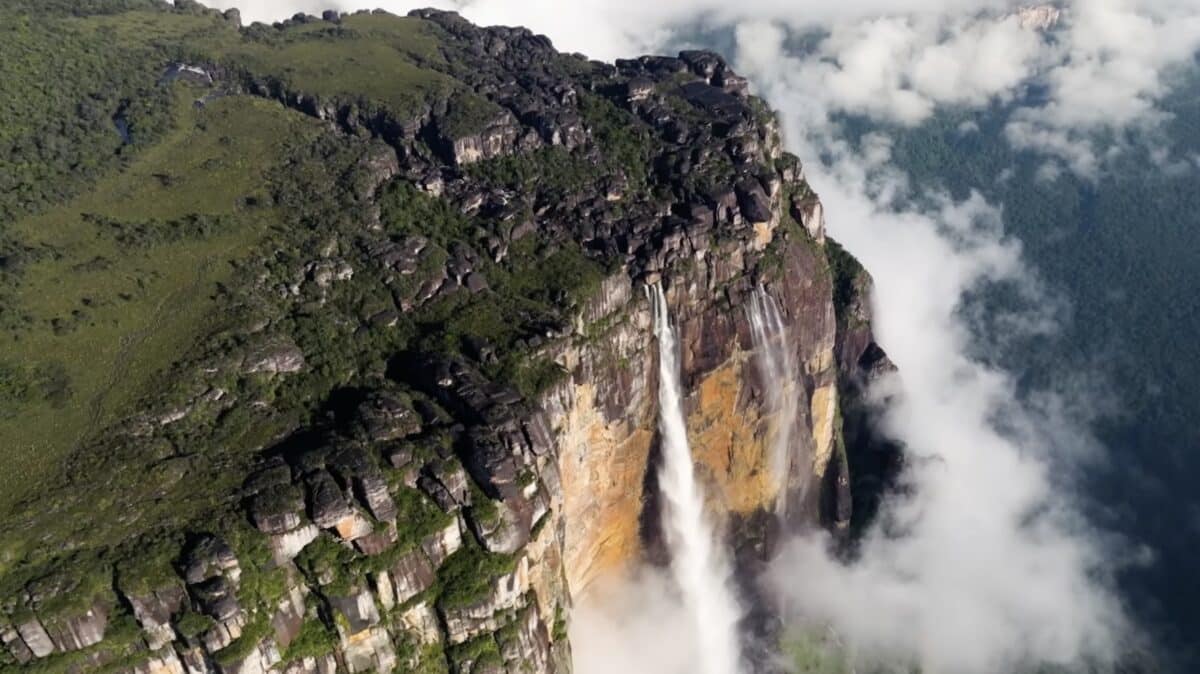
Most people recognize Angel Falls as the tallest waterfall on Earth, plunging 979 meters, or around 3,212 feet, off a cliff face in southern Venezuela. But far less people know the geological story behind it, and that story turns out to be one of the wildest on the planet.
Angel Falls drops from the edge of a formation called Auyán-Tepui, one of roughly 115 flat-topped mountains scattered across the Guiana Highlands of Venezuela, Guyana, and Brazil. These formations, known as tepuis, rise more than 9,800 feet above the surrounding jungle. They aren’t mountains that were built up through volcanic or tectonic activity, rather they’re what remains after billions of years of erosion stripped away the softer rock around them.
The rock that makes up the tepuis was laid down as sediment on the floor of an ancient sea approximately 1.7 billion years ago, predating complex animal life by more than a billion years.
Because the cliff faces are sheer and hundreds of meters tall, the summits have functioned as isolated biological islands for millions of years. The result is an extraordinary concentration of endemic species. Plants, insects, and amphibians found nowhere else on Earth have evolved on individual tepui summits. The region is estimated to harbor nearly 1,300 endemic plant species alone, and many tepuis have never been visited by biologists. Each new expedition seems to return with species new to science.
The Pemón people, an indigenous group of roughly 30,000 to 40,000 living across the Grand Sabana region, have inhabited this landscape for thousands of years. In their stories, the tepuis are sacred places and home to ancient ancestral spirits called Mawari.
Exploration of the tepuis remains genuinely incomplete, and cave systems carved into the sandstone add yet another unexplored frontier. The Cueva del Fantasma, one of the largest quartzite caves in the world, was only recently discovered and has already yielded new species of poison dart frogs. Angel Falls may be the attraction that draws attention to this region, but the tepuis themselves are the real story.