

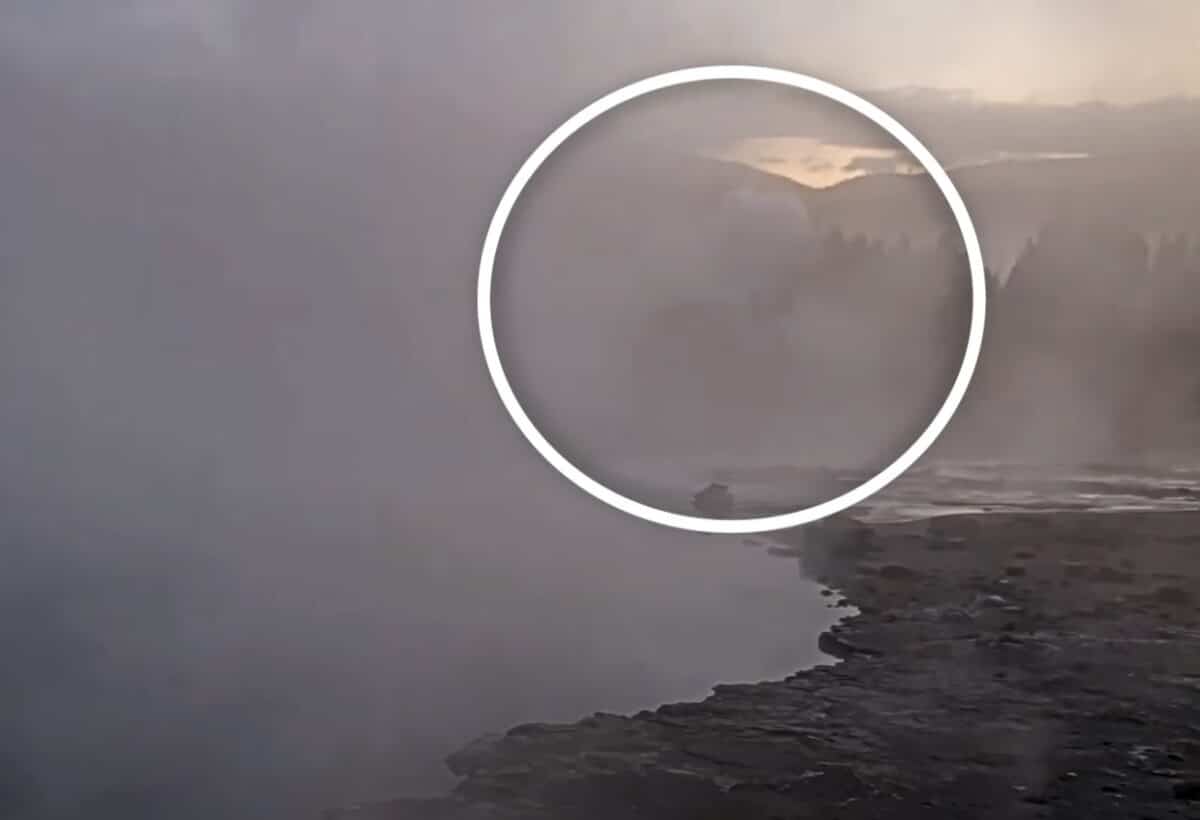
On July 23, 2024, Biscuit Basin inside Yellowstone National Park was the site of a significant hydrothermal explosion. Just before 10:00 am that day, an explosive event from Black Diamond Pool sent rocks flying into the air and destroyed a nearby boardwalk. Thankfully no one was injured but it was a close call.
The explosion was caused by pressure changes in the hot water plumbing system just beneath the surface, with hot water flashing to steam and driving the activity. To monitor the Biscuit Basin area, the Yellowstone Volcano Observatory installed several new sensors after the explosion. On June 13, 2026, that monitoring equipment detected significant seismic and acoustic energy and their video cameras caught a jet of steam coming from new features that opened several hundred feet to the north of Black Diamond Pool.
The explosion wasn’t nearly as large as the 2024 event but still had enough energy to throw rocks several 10s of feet and break open the earth. One crack was 60 feet long and full of boiling water. A day or two later, a portion of the ground in the vent area had collapsed into a circular pool that was filled with boiling water. On June 18th, the camera caught that pool spouting almost like a geyser, and on June 23rd it erupted in a single burst that sent steam and boiling water up several tens of feet.
During the month of June 2026, the University of Utah Seismograph Stations, which monitors and operates the Yellowstone seismic network, located 118 separate earthquakes (the largest was a Magnitude 2.4). There has been no significant uplift or subsidence of the caldera since January 2026. Echinus Geyser had one water eruption in June, Giant Geyser erupted for the first time since last October, and Fan and Mortar Geyser had its first eruption in about 3 years. Yellowstone volcano remains at normal, background levels of activity.
Biscuit Basin remains closed to visitors because of the damage to the boardwalk and the potential for hazardous and unpredictable activity.

About Biscuit Basin:
***Biscuit Basin is closed until further notice due to a hydrothermal explosion that occured July 23, 2024.
Biscuit Basin is located three km (two mi) northwest of Old Faithful Village on the western side of the Grand Loop Road. The basin is within the Yellowstone Caldera and hosts numerous hot pools and geysers. One of the most famous features is a gradationally deepening, blue-colored hot spring named Sapphire Pool. The pool is an alkaline-chloride hot spring with water that’s constantly about 200℉ (93℃), which is near the boiling point for the pool’s elevation (7200 ft, 2195 m).
Before 1959, Sapphire Pool erupted several times per hour, but never more than a few feet (about one meter) high. The pool was a destination for visitors, not just for its crystal-clear blue water and spouting eruptions, but because it was surrounded by hundreds of unusual knobby features dubbed “biscuits.” These features formed as hot silica-rich water washed outward from the pool during geysering events. As the waters cooled and evaporated, silica deposited into layers that eventually built up the silicious geyserite mounds. These biscuit-shaped features at Sapphire Pool became the namesake for Biscuit Basin. Today, the biscuit batches are few and far between, with only a few scone-shaped mounds on the southern rim of Sapphire Pool. So, where did they go?
The 1959 magnitude 7.3 Hebgen Lake earthquake epicenter was about 25 miles from Yellowstone National Park’s large geyser basins on the Firehole River. The energy released was so intense that it jarred the volcano’s hydrothermal systems, causing hundreds of geyser eruptions in the following days. Many thermal features in Yellowstone changed behavior entirely—new thermal areas cropped up, springs that never erupted suddenly began erupting, and some thermal features shut down entirely.

Sapphire Pool was one of the thermal features that changed dramatically. Major eruptions grew in intensity and became more spaced out in time. About four days after the earthquake, Sapphire Pool began erupting water jets that reached 150 feet (45 m) high and 500 feet (150 m) wide. Episodes of major geysering were followed by steady boiling in the pool. The power of the eruptions tore away layers of sinter that surrounded the rim and destroyed the biscuit-like formations. The force of water erupting and flowing away from the vent washed the sinter fragments 60 to 100 feet (18 to 30 m) away and eventually into the Firehole River. The water became murky and lost its sapphire-colored hue. These large eruptions continued through 1961, and the pool’s diameter nearly doubled as major eruptions broke the rim. During this three-year phase of massive geysering, a ring of broken geyserite shards about 3 feet (1 m) high formed around Sapphire Pool. It has since eroded away.
Sapphire Pool, in Biscuit Basin, steams on a stormy morning. A few “biscuits” remain along the pool’s southern edge (center right of photo) – violent geyser eruptions destroyed hundreds of the features when the pool’s plumbing system changed after being jarred by the 1959 Hebgen Lake earthquake. National Park Service photo by Jacob W. Frank, July 20, 2020.
Geyser eruptions at Sapphire Pool continued with decreasing intensity and frequency for many years. In 1968, true geyser activity ceased, and by 1971 the murky water cleared, giving way to the deep blue color once again. Sapphire Pool last erupted in 1991, though the crystal-clear water still boils and surges; however, it does not have minor geyser activity like it did before 1959. The earthquake clearly had a marked impact to the plumbing system beneath Sapphire Pool.

