

Hawai‘i Volcanoes National Park is home to some incredibly unique landscapes and geology, spanning from sea level to 13,680 feet. It features the summits of two of the world’s most active volcanoes, Mauna Loa and Kīlauea. Kīlauea is the youngest volcano on Hawai’i, forming underwater roughly 280,000 years ago. Its surface alone is just slightly smaller than the island of O’ahu.
Along with its youth, Kīlauea is also the most active volcano on the island and it’s one of the busiest in the world. Throughout recorded history the volcano has only had short periods of repose, with nearly 90% of its surface being covered in laval flows within the last 1,000 years. Two rift zones stretch out to the east and southwest from the summit, hosting most eruptions that occur beyond the peak.
Kīlauea’s latest eruption episode wrapped up abruptly on the afternoon of June 14th, 2026, after about 7.5 hours of lava fountaining from the north vent at Halema’uma’u crater. The fountains topped out around 700 feet tall and sent a plume reaching 18,000 feet into the sky. All told, roughly 6.5 million cubic yards of lava poured out and blanketed 40 to 50 percent of the crater floor before the volcano went quiet again.
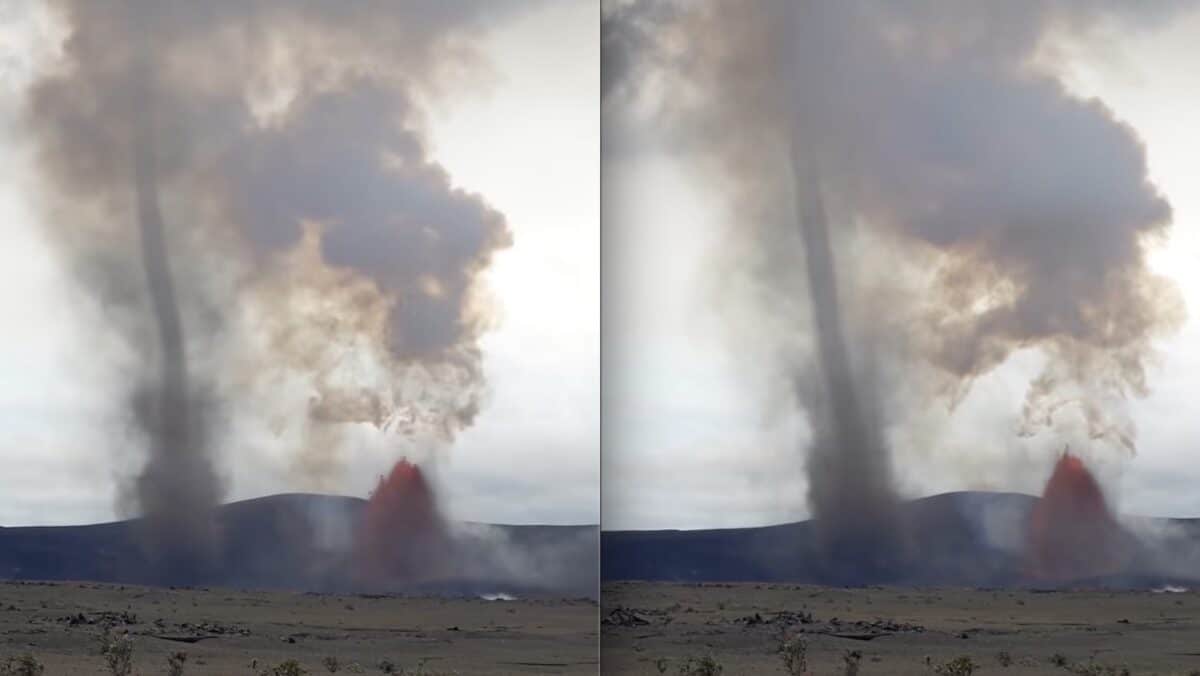
Before the episode closed out, Volcano Hideaways managed to capture some truly stunning footage of a tornado-like phenomenon touching down right next to the spouting lava.
Whirlwinds spotted near active lava fountains at Hawaii Volcanoes National Park aren’t necessarily uncommon. They’re technically a form of dust devil, driven by volcanic heat rather than sunlight. Known in Hawaiian as puahiohio, they form when extreme surface heat from lava or fresh tephra causes air to rise rapidly into cooler air above.
If that rising air carries any initial rotation, the spin accelerates as the column tightens, pulling in debris from below and creating the visible swirling structure. Depending on what they carry, scientists refer to them as lava devils, ash devils, or tephra devils. Though they’re a good bit smaller than tornadoes, they can generate concentrated winds strong enough to hurl hot debris. The USGS shared footage of one of these whirlwinds striking a livecam on Kīlauea. It did occur during the same episode, but it’s not clear if this is the same whirlwind as the one captured by Volcano Hideaways.
The eruption episodes are absolutely stunning, but they can also be incredibly dangerous if they aren’t respected. That means staying on marked trails and staying out of closed or restricted areas. Read more on volcano viewing safety in Hawai’i Volcanoes National Park below.
Safety Tips for Volcano Viewing
Viewing an eruption is a once in a lifetime experience, but it comes with risks. By being prepared, following safety guidelines, and staying in designated areas, you can safely enjoy this incredible natural phenomenon.
- Never enter closed or restricted areas—established eruption viewing overlooks are in place for your safety. Entering closed areas can cause serious injury or death.
- Stay on marked trails and overlooks.
- Stay informed about current volcanic activity.
- Hazardous volcanic gases pose a risk, especially to those with heart or respiratory issues, infants, children, and pregnant women; check air quality alert before visiting.
- Both Pele hair and volcanic ash are abrasive and can irritate eyes, skin and the respiratory system. The best protection is to limit exposure. Do not handle Pele hair. Consider wearing protective clothing and equipment, like a brimmed hat, gloves, long sleeves, pants, eye protection, and a face mask if you cannot limit your exposure. Rinse off surfaces like vehicles to prevent damage. Pele’s Hair Safety Fact Sheet (93 KB)
- Wear appropriate clothing and sturdy footwear. If you are visiting at night, bring warm clothes and raingear; check the weather before visiting.
- Keep a safe distance from earth cracks, cliff edges, vents, fumaroles, and lava flows.
- Carry a first aid kit, flashlight, and extra water.
- Use protective gear such as masks and goggles during ashfall.
- Follow ranger guidelines and evacuation routes during unsafe volcanic activity.