

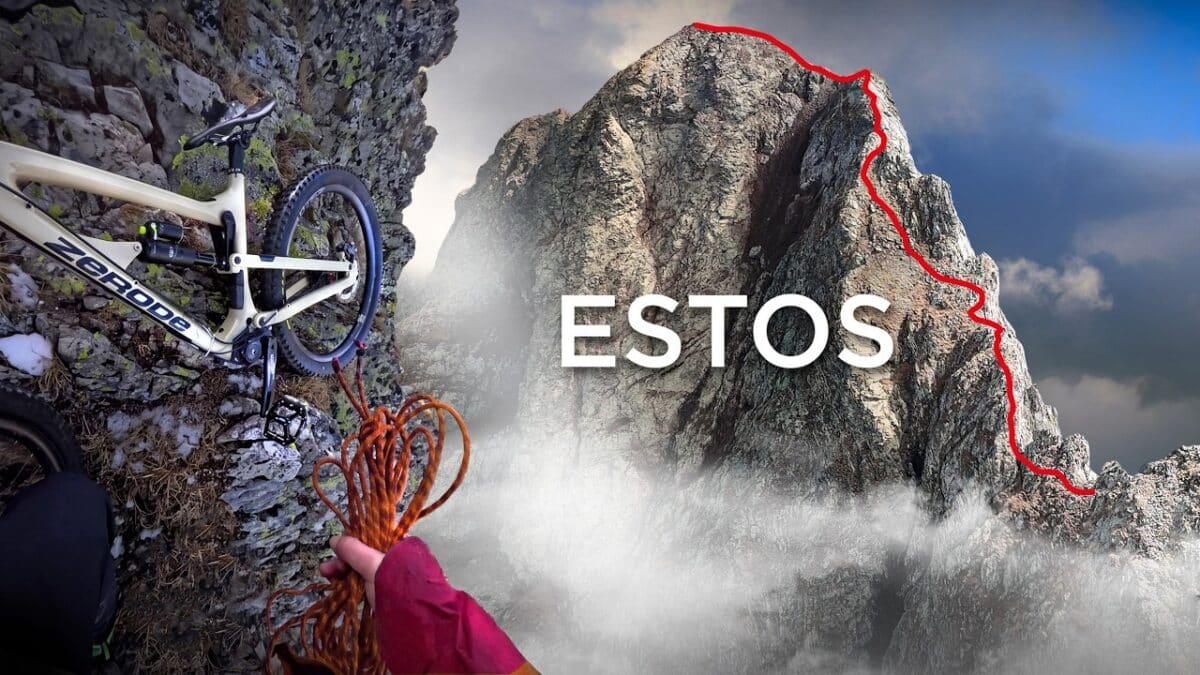
A new mountain bike film follows Alexis Righetti and Bertran Montoya into terrain where riding a bike starts to look a lot more like mountaineering.
“ESTOS: Riding The Ultimate Line” documents their attempt to descend Pic d’Estos in the French Pyrenees, a massive high-alpine face that had occupied Righetti’s imagination for years. The project ultimately required four attempts, multiple turnarounds and mountaineering equipment to move the riders and their bikes through sections of the mountain.
The full 1-hour, 25-minute film is now available to watch for free online after premiering in French theaters earlier this summer. Righetti first screened ESTOS at Cinema Veo in Muret on June 5.
Four Attempts at a Line That Barely Looked Rideable
Pic d’Estos sits in the Louron Valley of the Pyrenees.
Righetti had spent years looking at the mountain and wondering whether its enormous face and knife-edge terrain contained a line that could actually be descended on a mountain bike.
Finding out took considerably more than bike-handling ability.
The film follows four separate attempts to complete the descent. Previous trips ended in turnarounds as the riders encountered exposed terrain, questionable rock and sections requiring rope work. French reporting on the film describes the final objective as a line that seemed almost impossible to ride, with the project mixing technical riding, rope maneuvers, fatigue and repeated decisions to retreat.
Righetti describes it as the most involved mountain bike descent he has attempted.
“This descent is probably the most complex and committing I have ever attempted on a mountain bike.”
The difficulty was not simply about clearing technical features. Exposure, cold, unstable rock and the consequences of a mistake changed how the riders had to evaluate every section.
At points, they used mountaineering gear to negotiate the terrain with their bicycles.
Mountain Biking Meets Mountaineering
That crossover is really what separates ESTOS from a traditional mountain bike film.
Righetti approaches steep mountain terrain in a way that has obvious parallels with freeride skiing. Rather than following an established bike trail, the riders study an entire mountain face, identify a possible line and then determine whether that imagined route actually works once they are standing on it.
Sometimes it does not.
Righetti says turning around became an important part of the project rather than a failure. The film focuses as much on recognizing when conditions or terrain make continuing unreasonable as it does on eventually completing the descent.
The two riders had already spent years training, scouting mountains and completing other high-alpine projects together before making Estos their main objective.
A Different Kind of Freeride Line
Righetti has built much of his riding around taking bicycles into places that look more appropriate for climbing, skiing or mountaineering.
Unofficial Networks previously covered his descent of a steep snow-covered couloir in the French Pyrenees, where he rode a line he had previously skied.
He also spent years trying to complete a descent of Pic de Montfaucon. Unofficial Networks covered Righetti finally riding the mountain after seven attempts.
Another previous project took him onto extremely exposed terrain near the border between France and Spain, where the consequences of a fall left essentially no margin for error.
ESTOS pushes that same philosophy farther.
Rather than treating the mountain as a bike trail, the riders approach it as mountaineers who happen to be carrying bicycles.
The Film Took the Story Beyond the Descent
ESTOS premiered in Muret in June before additional theatrical screenings in France. Righetti said the project represented the culmination of years spent developing both his filmmaking and high-alpine mountain biking.
Camera operator Fanny Boissieras filmed the riders close to the exposed terrain, with the production designed to communicate the scale and consequences of the route rather than simply assemble a highlight reel of successful riding.
That distinction matters because the finished descent is only part of the story.
The four attempts, failed approaches, uncertainty and decision-making are what eventually make the riding possible.
For Righetti, the goal was not simply to prove that a mountain bike could descend Pic d’Estos. It was to explore how far the boundary between mountain biking and mountaineering can be pushed while still knowing when the right decision is to turn around.
