

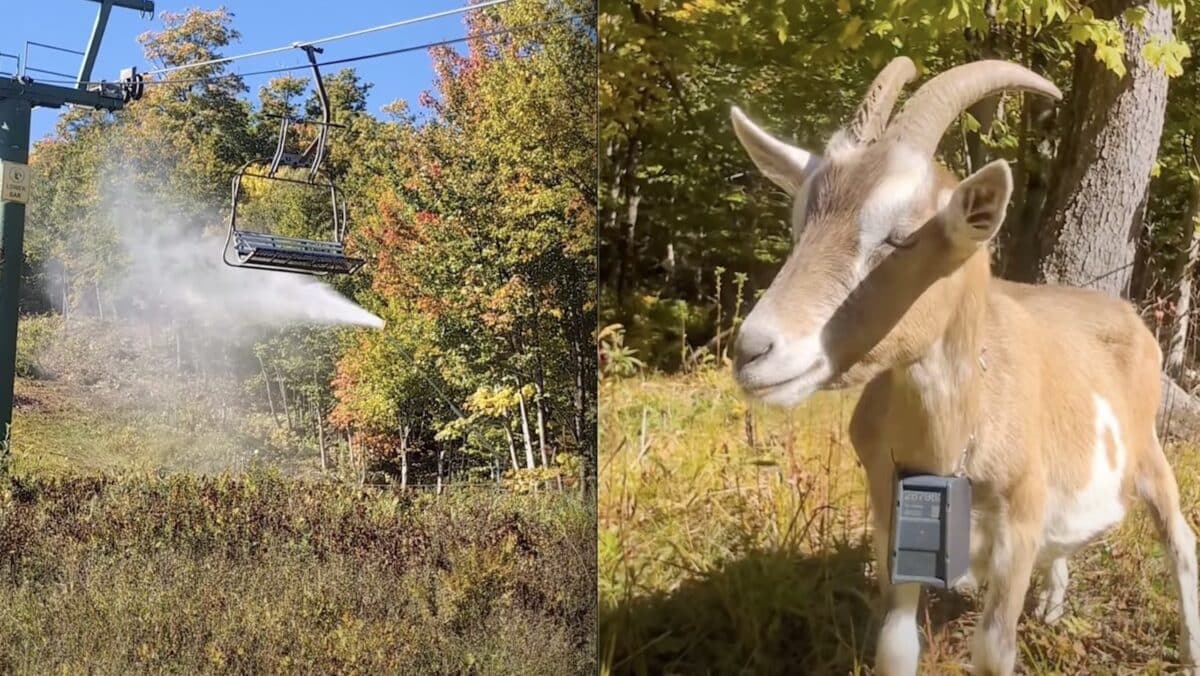
It is hard to find a better snapshot of the transition from fall to winter than what is happening at Jay Peak right now.
The northern Vermont ski resort is testing snowguns ahead of the 2026-27 season while its herd of goats and sheep continues to graze the ski trails as the surrounding trees begin turning red, orange and yellow.
All three are signs that winter preparation is well underway at one of the snowiest ski areas in the East.
Snowguns Are Getting Ready for Winter
The snowgun testing comes as Jay Peak continues a major modernization of its snowmaking system.
Jay Peak has invested more than $1.5 million in snowmaking improvements, including 49 new HKD Low E air-water guns. Thirty-two were installed on Queen’s Highway and another 17 on Perry Merrill.
The Perry Merrill system also includes automated HKD Klik hydrants with built-in weather stations. The equipment can automatically begin operating when temperatures reach suitable snowmaking conditions and adjust water flow as conditions change.
That matters because Perry Merrill and Queen’s Highway help connect Jay Peak’s Tramside and Stateside areas.
The resort also replaced roughly 2,600 feet of aging snowmaking pipe along Queen’s Highway, increasing the water line from 10 inches to 12 inches. Jay Peak says the change increases water flow toward Stateside by about 20%.
Snowmaking has become increasingly important even at a mountain famous for natural snowfall. Jay Peak received more than 400 inches last winter, but the resort still turned its snowguns back on in April in an effort to extend skiing deeper into spring.
The Goats Are Still Working
While mountain operations crews prepare the snowmaking system, another maintenance crew is still eating its way across the slopes.
Jay Peak’s “Chew Crew” a herd of Vermont-raised goats and sheep, returned this summer after the resort successfully tested the unusual vegetation-management program in 2025.
The animals graze sections of ski and Nordic terrain, eating grass, brush and invasive vegetation that would otherwise require mechanical trimming.
Each animal wears a radio collar connected to a cellular geofencing system, allowing the herd to move through designated sections of the mountain without traditional fencing. A livestock guardian dog stays with the animals to protect them from predators.
The program has grown considerably since its first season. The goats and sheep returned to Jay Peak earlier this summer after the project received a National Ski Areas Association Golden Eagle Award for environmental stewardship.
Jay Peak traditionally maintains roughly 340 acres of ski trails and glades each fall, work that typically requires crews using gas-powered trimmers.
The Chew Crew does part of that job by simply eating.
Fall Color Is Starting to Arrive
The backdrop is changing almost as quickly as the resort is preparing for snow.
The Vermont Department of Forests, Parks and Recreation’s Sept. 23 foliage report says the Northeast Kingdom, where Jay Peak is located, currently has some of the most advanced fall color in Vermont.
Peak color has not arrived yet, but reds, oranges and yellows are becoming increasingly visible across northern Vermont.
The timing lines up with Jay Peak’s new Scenic Route Weekends, scheduled for Sept. 26, Oct. 3 and Oct. 10. The resort plans to operate its aerial tram for scenic rides while offering guided foliage walks, cider pressing, carriage rides and other fall activities.
For the moment, Jay Peak is sitting in that brief window when several seasons seem to overlap.
The leaves are changing, goats are still grazing the ski trails and the snowguns are being readied for the moment temperatures finally allow the mountain to turn white again.
Peak Fall Foliage @ Jay Peak Ski Resort
