

Long range winter forecast discussions continue to point toward an active cold season across much of the United States. In a recent seasonal outlook, Direct Weather highlighted the latest guidance from the Japanese JAMSTEC climate model, comparing it with several other major forecasting systems. While temperature forecasts still vary from model to model, precipitation projections are showing unusually strong agreement.
According to Direct Weather, the latest data supports the development of a strong El Niño through the fall and winter, with a weather pattern that could bring frequent storms to the southern United States and the East Coast while keeping much of the West Coast relatively mild.
Western United States Could Stay Mild
The JAMSTEC model suggests sea surface temperatures associated with a strong El Niño will remain in place through the winter, though the warmest waters shift farther west across the Pacific compared to early fall. Direct Weather notes this resembles more of a Modoki style El Niño, which can sometimes favor colder conditions farther east across North America than a traditional eastern Pacific event.
At the same time, unusually warm waters off the West Coast could help reinforce a ridge of high pressure over western North America. That setup would likely keep much of the Pacific Coast, western Canada, and the northwestern United States warmer than average throughout winter.
Other seasonal models examined by Direct Weather including the European, CFS, and Canadian CanSIPS forecasts also indicate above average temperatures across much of the western United States.
Central And Eastern States Show Greater Cold Potential
While the western forecast is relatively consistent, the central and eastern United States present a more interesting picture.
The latest JAMSTEC outlook projects below average temperatures across much of the South Central and Southeastern United States during winter. Other seasonal models show similar ideas, although the exact placement and intensity of the colder air varies.
The Canadian CanSIPS model is the coldest of the group, bringing widespread Arctic air into portions of the central and northeastern United States. Meanwhile, the European seasonal model remains the warmest, though Direct Weather notes that model has a known warm bias in long range forecasts.
Despite those differences, multiple forecast systems continue to suggest colder air could reach the eastern half of the country more often than typically expected during a strong El Niño winter.
Southwest And East Coast Stand Out For Heavy Precipitation
Where the models show the strongest agreement is precipitation.
According to Direct Weather, JAMSTEC, CanSIPS, the European seasonal model, and the CFS model all depict a very wet pattern stretching from California and the Desert Southwest through the Gulf Coast and northward along the East Coast.
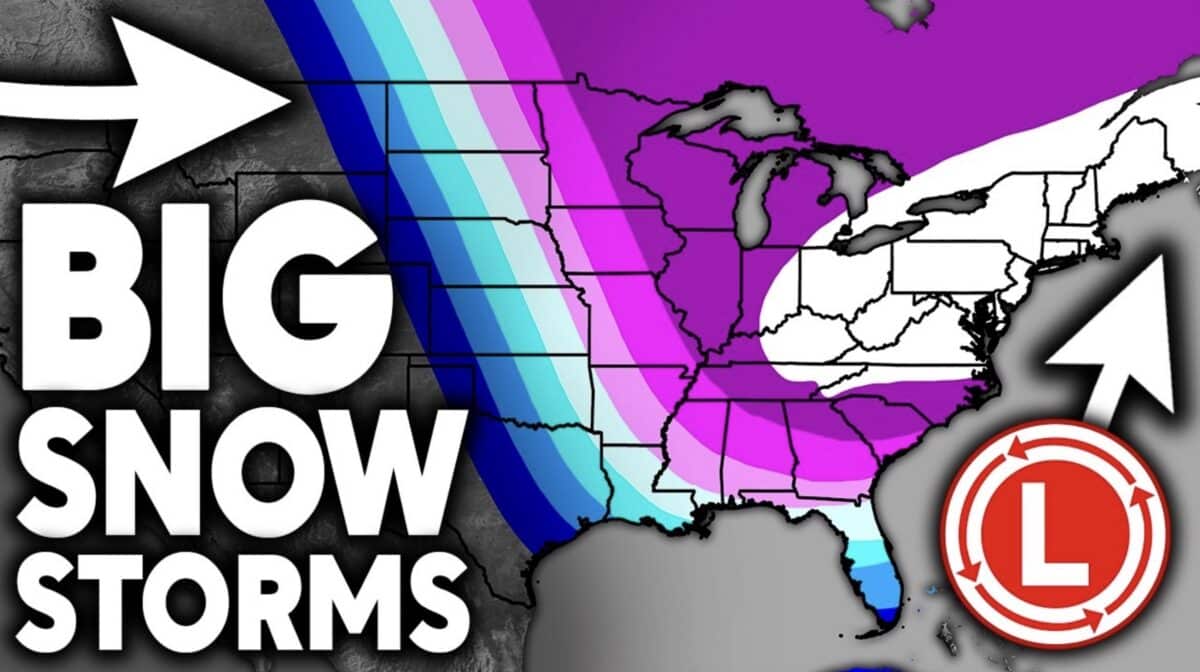
That storm track would favor repeated low pressure systems moving across the southern United States before strengthening along the Atlantic Coast. If enough cold air is present, those systems could produce significant snowfall across parts of the Ohio Valley, Mid Atlantic, Northeast, and Great Lakes.
Direct Weather also compared the current projections with several historic strong El Niño winters including 1997 through 1998, 2009 through 2010, and 2015 through 2016. Those seasons showed similarly wet conditions across California, the Deep South, and much of the East Coast.
While winter temperature forecasts still carry uncertainty, Direct Weather emphasized that precipitation signals remain remarkably consistent across nearly every major seasonal forecasting model. If that agreement continues in future monthly updates, parts of the United States could be in line for an especially active fall and winter storm season.
