

Fairplay, Colorado – Colorado’s moose population is around the 7th or 8th highest in the lower 48 states, with Maine, Idaho, and Washington topping the list (Maine is home to an estimated 60,000 moose, a truly staggering number). However, Colorado is home to one of the fastest-growing moose populations in the lower 48.
Historical records dating back to the 1850s show that moose wandered into northern Colorado from Wyoming, but never established a stable breeding population. In the 1950s, wildlife officials began considering bringing the massive animals into the state, and the first 24 were transplanted from Utah and Wyoming in 1978. Today, Colorado’s population exceeds 3,000, and it continues to grow.
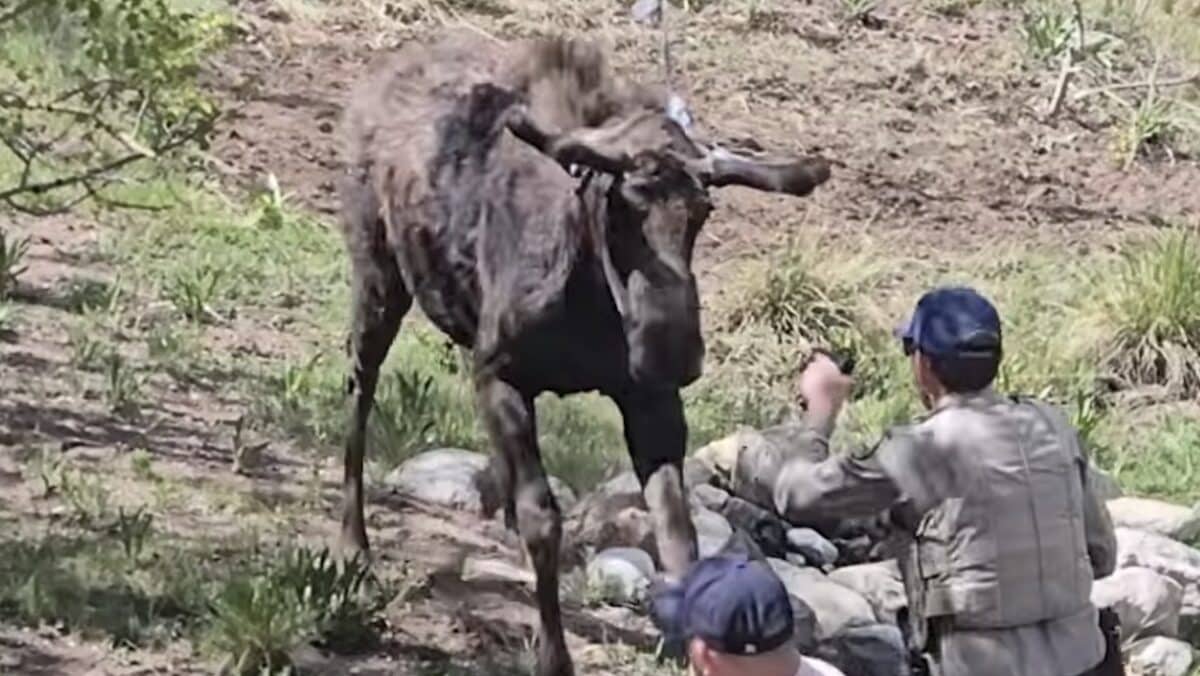
With the rapidly growing population, interactions between moose and people are becoming increasingly common, including in people’s yards. This moose managed to get tangled in a backyard swing, requiring intervention by Colorado Parks and Wildlife. One used a taser to temporarily immobilize the animal, while the other cut its antlers free. It seems and sounds remarkably harsh, but both the officers and the moose escaped without injury.
According to CBS News, Colorado Parks and Wildlife did confirm that tranquilizing the moose was not the best move in this case, as they can overheat while sedated, and officers only needed a quick moment to free the animal.
Moose, elk, and other animals frequently become entangled in ropes, nets, fencing, and other obstacles, requiring response from Colorado wildlife officers. Tessie and Jason Nay, who found the moose in their backyard, removed the rope feature immediately after the rescue.
“Everyone wants to have nice things in their yard for the kids to play on. And they don’t realize that we’re in the animal kingdom, too.” – Josh Nay
If you encounter a moose in your yard or in the wild, it’s vital that you give them plenty of space at all times. They can move up to 35 miles per hour, far faster than people, and they can get quite aggressive during breeding season or while protecting their young. Read more on moose safety in Colorado below.
Colorado Parks and Wildlife Moose Safety Guidelines:
Signs of Aggression
- Laid back ears
- Raised hairs on the neck
- Lowered head
- Swaying back and forth
- Licking of the snout
- Cocking of the head
- Rolling eyes and ears back
- If a moose reacts to your presence, you are too close.
What do I do if a moose displays signs of aggression?
If a moose displays aggressive behavior or begins to charge, run as fast as you can and try to put a large object between you, such as a boulder, car, or tree. Avoid animals that are behaving belligerently or abnormally. Moose that exhibit dangerous behavior towards people should be reported to Colorado Parks and Wildlife.