

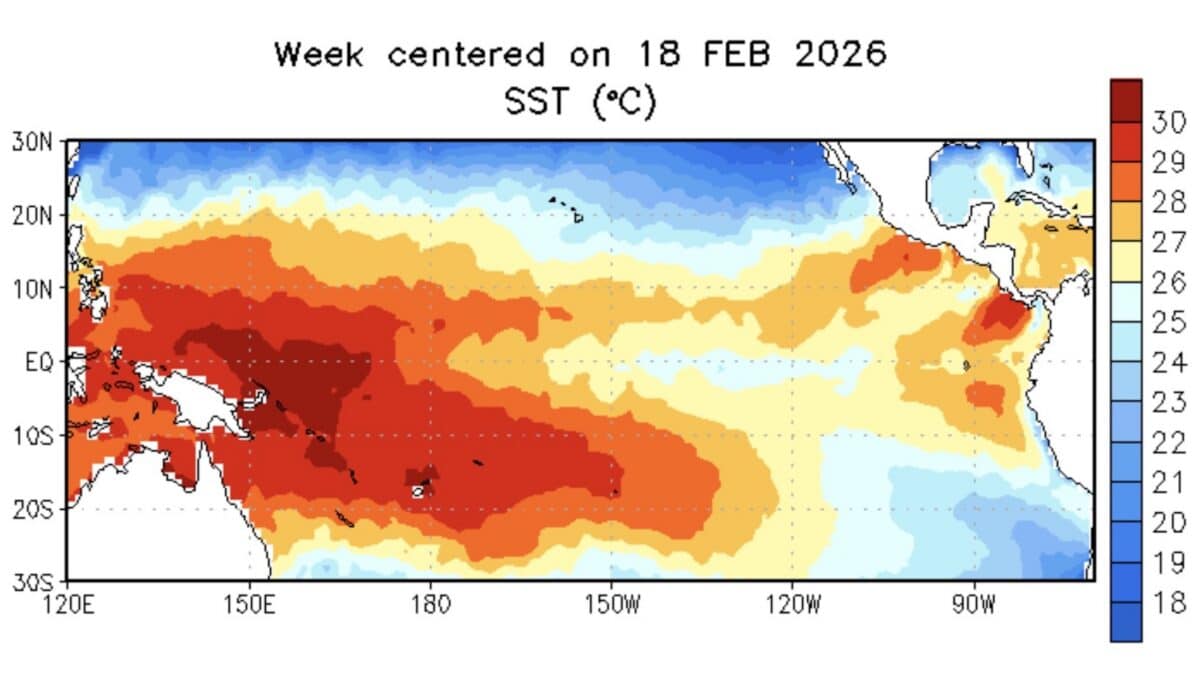
Federal climate scientists are signaling that El Niño is likely just around the corner, with an 82% probability of developing between May and July 2026 and a 96% chance of persisting through the December 2026 to February 2027 winter period.
The Climate Prediction Center’s latest assessment, a joint effort from the National Oceanic and Atmospheric Administration, NOAA’s National Weather Service, and affiliated research institutions, shows that while ocean and atmosphere conditions currently remain in ENSO-neutral territory, the underlying trends point strongly toward a shift.
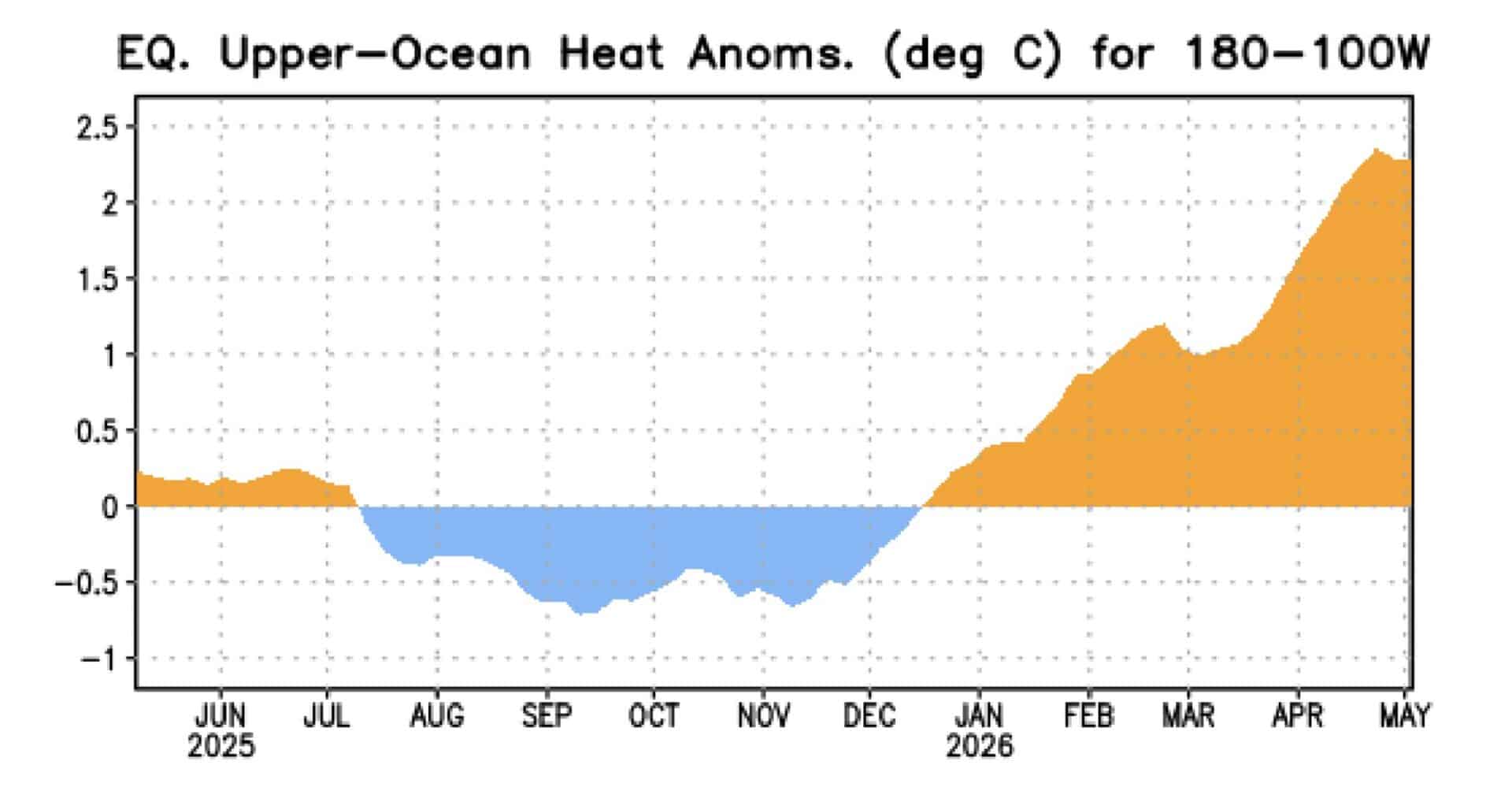
Sea surface temperatures in the east-central equatorial Pacific are running near average, with the weekly Niño-3.4 index sitting at +0.4°C. However, subsurface ocean temperatures have risen for six consecutive months, a signal forecasters watch closely as a leading indicator of El Niño development. Westerly wind anomalies are also present across the western and central equatorial Pacific, another sign the system may be priming for a transition.
The North American Multi-Model Ensemble, which aggregates projections from multiple leading climate models, supports El Niño forming as soon as next month and lasting through next winter.
Despite growing confidence in El Niño’s arrival, forecasters are cautioning that its intensity remains highly uncertain. No strength category currently exceeds a 37% probability. Scientists note that the most powerful El Niño events on record are defined by sustained ocean-atmosphere coupling through the summer months, and whether that unfolds in 2026 is still an open question.


Forecasters are also pushing back against a common misconception: a stronger El Niño does not guarantee stronger impacts on weather patterns. Intensity can raise the likelihood of certain outcomes but is not a reliable predictor of on-the-ground effects.
The next ENSO Diagnostics Discussion is scheduled for June 11, 2026. For mountain communities and winter recreation interests, the development of El Niño this summer will be worth watching closely heading into next ski season.