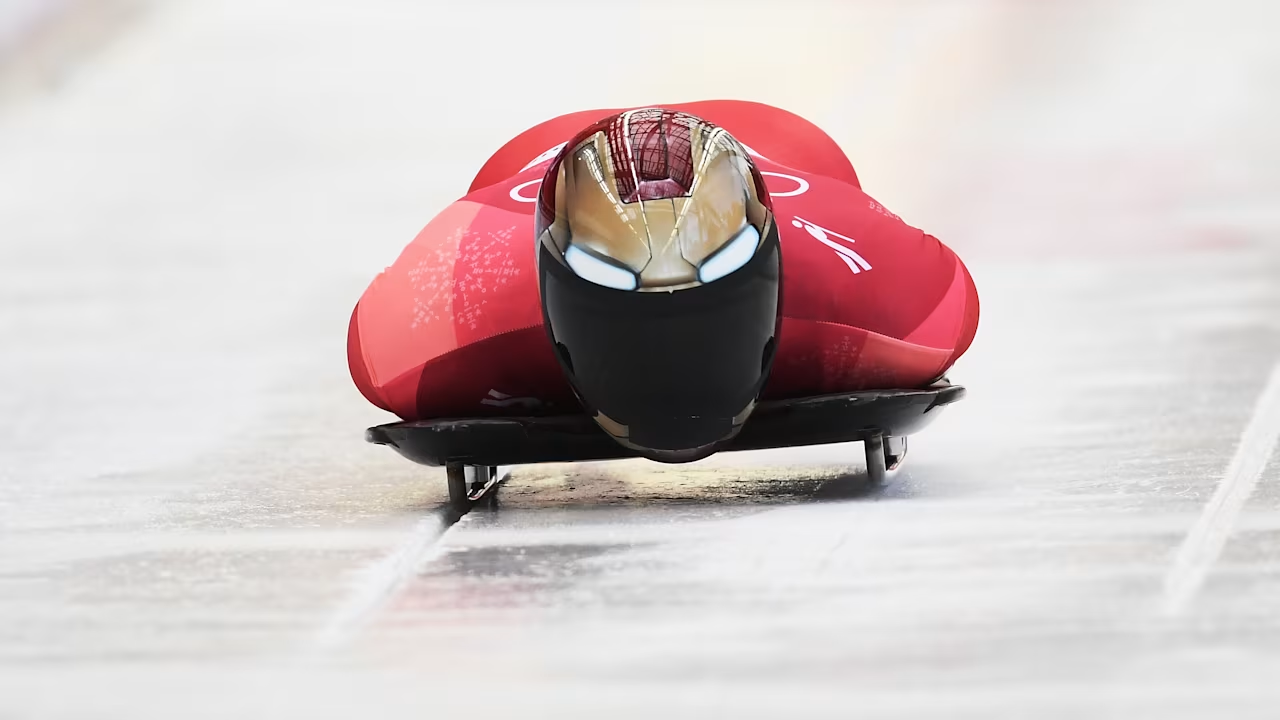

Just recalling this wild moment in winter sports when Katie Tannenbaum, a skeleton slider from the U.S. Virgin Islands, struck a broom at top speed during a World Cup run in Igls, Austria. Brooms are regularly used to sweep snow off tracks on race days and officials said this particular broom was blown into the track by the wind. Katie is okay but her sled is “chunked”:

“I’ll save you all the sweeping puns. My helmet and mouth guard did their jobs wonderfully. My new white helmet has a tiny broom colored scratch for me to remember this day by (how could I forget?). And my jaw is a little tight. My sled, however, took on some serious damage. The carbon fiber pod that covers the underside of my sled has a big chunk missing and a crack running down the front-center. It’s pricey and will take a while to get a replacement, but it’s fixable.”
This wasn’t the first time a skeleton slider has punched through a broom. In 2015, Canadian Jane Channell was struck in the left shoulder by a broom that slipped out of a track worker’s hands at a World Cup event.
About skeleton
Skeleton is one of the oldest winter sports in existence. Unlike luge, where athletes lay on a sledge on their backs, skeleton racers tackle the track face down. Here’s everything you need to know about the skeleton competition at Milano Cortina 2026.
Olympic history
The origins of skeleton dates to the late 19th century in St. Moritz, Switzerland. Here, the Cresta Run was built in 1885. This natural ice track, 1214 metres long, is still considered a legendary run in the sport. In 1887, participants began to slide down the course face first. Skeleton was born.
The discipline was named in retrospect. It dates to 1892 when a new type of sledge was introduced, which was a metal frame resembling the structure of the human skeleton —hence the name.
For decades, skeleton competitions were only held in St. Moritz. It’s no coincidence, therefore, that skeleton was included in the Olympic programme for both editions of the Games hosted by the Swiss resort (1928 and 1948). Due to its dangers and the lack of suitable tracks, the sport remained absent from the Olympic scene for over fifty years, but was reintroduced to the Olympic programme at Salt Lake City 2002 with the men’s and women’s competitions. At Milano Cortina 2026, the mixed team event will be added to the program.
Basic rules
In skeleton races, the athlete starts in a standing position, as is the case in bobsleigh and luge. At the green light, they have 30 seconds to start their run. After the initial 25 to 40-metre sprint, where they push the sledge by its special handles, the athlete jumps onto the sledge, guiding it through the course solely through slight bodily shifts. Skeleton athletes can reach speeds of up to 130–140km/hr.
Races take place on the same ice track that is used for luge and bobsled. The length of the track ranges from 1200 metres to 1650 metres, with a maximum slope of 12%. The skeleton track at Beijing 2022 featured the first 180° turn in the history of the Olympic Winter Games.
Competition events
Skeleton, like bobsleigh and luge, is one of the oldest winter sports. The athlete starts standing, just like in bobsleigh, and after the initial push, jumps face down onto the sled, descending the icy track at 130-140 km/hr and guiding the equipment using body movements. Unlike luge, the skeleton racer lies face down.
Competitions at Milano Cortina 2026 will consist of three events, Men’s, Women’s and Mixed Teams.