

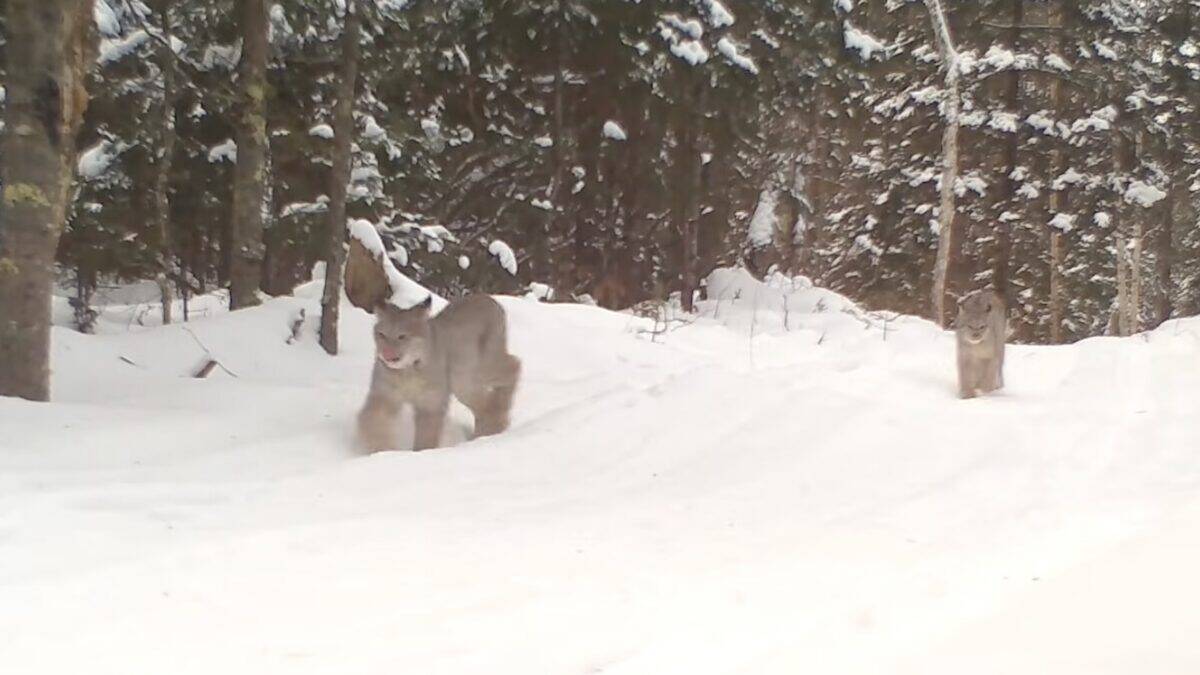
For the first time on record, researchers have documented a Canada lynx mother raising kittens inside Voyageurs National Park in Minnesota. New footage from the Voyageurs Wolf Project suggests that both kittens survived through their first winter, offering new fascinating insight into the elusive animals and their potential to reproduce in the park.
Lynx Family Spotted Across Three Seasons
According to the Voyageurs Wolf Project, researchers documented the mother and her two kittens in fall 2025. Additional footage captured the trio in November 2025, February 2026, and on March 31st, 2026. The observations suggest both kittens survived to approximately their first birthday.
Biologists have long questioned whether Canada lynx could successfully raise young in Voyageurs National Park. Although the animals have been spotted in and around the park for decades, researchers had not previously documented kittens within its boundaries.
New Evidence Challenges Earlier Research
Earlier studies offered limited evidence of lynx activity in the park. Between 2000 and 2004, National Park Service biologists documented just one male and one female, concluding that lynx were either transient or present at low densities.
A subsequent study conducted in 2007 and 2008 failed to detect lynx using trail cameras and snow tracking. Researchers also questioned whether the region’s snowshoe hare population could support resident lynx over the long term. By 2015, park researchers had concluded that there did not appear to be a resident lynx population.
A Rare but Important Discovery
Modern trail camera technology has helped the Voyageurs Wolf Project document numerous lynx observations each year, although many sightings may involve the same animals moving across large areas.
The discovery of a mother with two kittens demonstrates that lynx can reproduce in the Voyageurs region. However researchers caution that one successful breeding event does not establish a self-sustaining population.