

Most skiers spend plenty of time staring at a chairlift cable without giving much thought to how several tons of steel actually get strung up a mountain or how the two ends are ultimately joined into one continuous loop.
A new video from lift manufacturer Doppelmayr provides a remarkably detailed look at that process during construction of the new Tressdorfer Almbahn at Nassfeld in Austria. The video follows crews as they pull increasingly heavy ropes over each tower, install the final haul rope and then perform the highly specialized hand splice that permanently joins its two ends without tying anything resembling a conventional knot.
The work is part of a €13 million project to build a new detachable six-person chairlift at Nassfeld, one of Austria’s largest ski areas. The new lift is scheduled to begin operating in December for the 2026-27 season.
The Massive Cable Doesn’t Start Out Massive
Getting a chairlift haul rope onto the towers involves a process that starts with something considerably smaller.
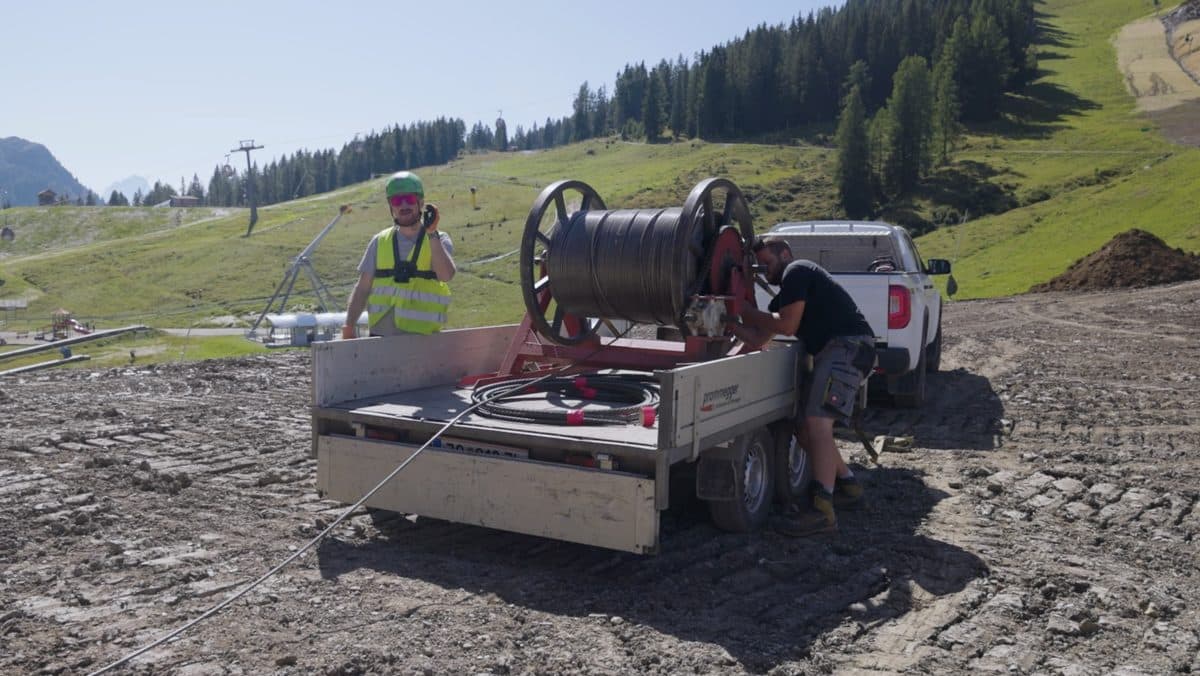
In the video, workers begin by manually pulling a roughly half-inch pilot rope over the sheave assemblies on each tower. Around 3,300 to 3,900 feet of that initial rope is moved by hand across sections of the lift before it is used to pull a larger rope into place.
That heavier rope then becomes the pulling line for the next one. Crews essentially repeat the process with progressively stronger ropes until the system is capable of pulling the massive final haul rope through the entire lift alignment.
A winch does much of the heavy pulling once the larger ropes come into play. On the opposite end, workers use a braking system on the enormous cable reel to control how quickly it unwinds. Without that resistance, the reel could accelerate as more weight comes off it, making a carefully controlled cable pull considerably more difficult.
The video shows workers constantly monitoring the rope as it passes through towers and sheave assemblies. Once the main haul rope has traveled around the entire lift, however, there is still one major problem: the cable has two loose ends.
That’s where one of the most interesting parts of chairlift construction begins.
Chairlift Haul Ropes Aren’t Tied Together
The two ends of a chairlift cable cannot simply be tied into a giant knot. Instead, crews use a process known as splicing to turn the rope into a continuous loop.
The Tressdorfer Almbahn haul rope contains six major steel strands wrapped around a central core. Before the splice begins, crews bring the two cable ends together, secure them under tension and create enough slack in the middle to work.
Workers then open approximately 56 feet of cable in each direction, creating a splice area roughly 112 feet long. Three strands are unwound from one end and three from the other, while sections of the central core are removed.
The real craftsmanship comes next. Individual steel strands from one end are gradually woven into the opposite section of cable. Where sections of the original core have been removed, the incoming steel strands take their place inside the rope. The process is repeated at six different locations along the splice until the two ends have effectively become one continuous haul rope.
It is meticulous work performed largely by hand, and the finished connection does not resemble a knot at all. The enormous length of the splice allows the load to be distributed gradually through the interwoven strands rather than concentrated at a single connection point.
You Can Actually Spot The Splice From The Chairlift
One of the more interesting details in the Doppelmayr video is that the finished splice does not completely disappear.
Most of the haul rope has six large outer strands. Around portions of the splice, however, the way the strands overlap temporarily changes the visible profile of the cable. The video points out that attentive passengers can sometimes identify where a haul rope was spliced while riding a lift…new game to pass the time will looping your fav lift? keep an eye out ya’ll.
Once the Tressdorfer Almbahn splice was completed, crews still had to raise the rope into its final position on the towers and properly tension the entire system. From there, installation could move on to the components skiers actually interact with, including the chairs.
New Lift Will Carry Up To 2,500 Skiers Per Hour
The Tressdorfer Almbahn project has been under construction since May and is designed to replace three older surface lifts while improving access between Tressdorfer Alm and Sonnleitn.
The detachable six-person chairlift will carry as many as 2,500 people per hour with a ride time of just under four minutes. It will feature weather-protection bubbles, heated seats, a conveyor-assisted loading system and automatic safety-bar locking and opening.
The roughly 2,950-foot lift will also improve access to Nassfeld’s YoungStars beginner area and several easier ski runs. It is expected to open for winter operations in December, with summer operations and mountain bike transport scheduled to begin in June 2027.
Chairlift construction involves plenty of components that are more immediately noticeable, from helicopters flying towers into place to terminals full of complicated machinery. But the new Doppelmayr video provides a reminder that one of the most important pieces of the entire system ultimately relies on an old-school process involving specialized tools, experienced hands and dozens of feet of carefully interwoven steel.
The next time you’re sitting on a chairlift, it might be worth looking up. Somewhere along that seemingly endless steel cable is a hand-built splice holding the loop together.
