

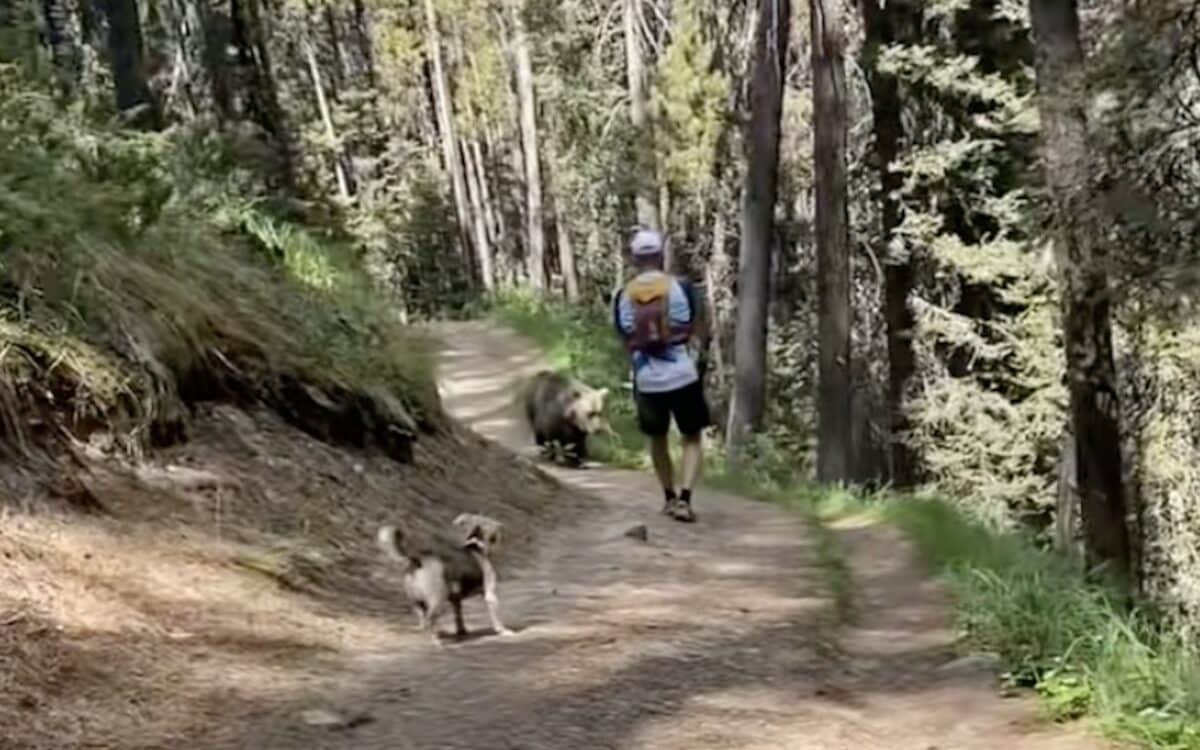
Banff, Canada’s first national park, is arguable among the most beautiful places on Earth. It’s Rocky Mountain peaks, glacier lakes, and surrounding landscapes are home to a wide range of wildlife and offers some of the most incredible hiking trails in North America. Of course hiking in the area comes in responsibilities including, but not limited to, keeping your dog on a leash at all times, something these two tourists learned the hard way during a grizzly bear encounter.
Up to 20,000 grizzly bears remain in western Alberta, the Yukon and Northwest Territories and British Columbia. 691 of those are in Alberta, and around 65 of those live in Banff National Park. With Banff covering around 2,500 square miles, visitors have a pretty low chance of spotting one of those 65 while on the trails, but that doesn’t mean they shouldn’t come prepared for an encounter.
The video caption states that these individuals are hiking in the Banff area, not necessarily inside the park itself. Nonetheless all hikers should keep basic safety in mind while exploring Alberta’s trails, including keeping their dog on a leash. The video itself cut before the end of the encounter, but it’s probably safe to say that these people got out of there without any injury to themselves or the dog. However that doesn’t mean they did everything right.
It’s already been mentioned twice, but keeping your dog on a leash at all times is an absolute requirement in and around Banff National Park. Off-leash dogs can trigger aggressive behavior from wildlife or harm smaller animals. In fact, if you plan to hike into the backcountry or camp, Parks Canada recommends leaving your dog at home altogether.
These two appeared to have bear spray but didn’t appear willing to use it. If you do encounter a bear while hiking, you should stay calm and back away slowly, but if the bear continues to approach you should stop and prepare to use the spray. If the bear keeps approaching after you stop, you should use your bear spray. Read more on handling a bear encounter below.
Parks Canada Bear Encounter Guidelines:
If you SEE a bear
Stop and remain calm. Be ready to use bear spray. Do not run away.
OBSERVE:
Is the bear UNAWARE of your presence?
Move away quietly without getting its attention.
Is the bear AWARE of your presence?
Bears may bluff their way out of an encounter by charging and then turning away at the last second. Bears may also react defensively by woofing, growling, snapping their jaws and laying their ears back.
- Stay calm. Calm behaviour can reassure the bear. Screams or sudden movements may trigger an attack.
- Speak to the bear. Talk calmly and firmly. This lets the bear know you are human and not a prey animal. If a bear rears on its hind legs and waves its nose about, it is trying to identify you.
- Back away slowly. Never run! Running may trigger a pursuit.
- Make yourself appear BIG. Pick up small children and stay in a group.
- Do not drop your pack; it may provide protection.
If you must proceed, make a wide detour around the bear, move well off the trail or wait at a safe distance for it to move on.
If the bear APPROACHES
Stop and remain calm. Get ready to use your bear spray. Do not run away. Assess the bear’s behaviour and determine why it is approaching.
Is it DEFENSIVE?
The bear is feeding, protecting its young and/or surprised by your presence. It sees you as a threat. The bear will appear stressed or agitated and may vocalize.
- Try to appear non-threatening.
- Speak in a calm voice.
- When the bear stops advancing, start slowly moving away.
- If it keeps coming closer, stand your ground, keep talking, and use your bear spray.
- If the bear makes contact, fall on the ground and play dead. Lie still and wait for the bear to leave.
Is it NON-DEFENSIVE?
A bear may be curious, after your food, or testing its dominance. In the rarest case, it might be predatory–seeing you as potential prey. All of these non-defensive behaviours can appear similar and should not be confused with defensive behaviours.
The bear will be intent on you with head and ears up.
- Speak in a firm voice.
- Move out of the bear’s path.
- If it follows you, stop and stand your ground.
- Shout and act aggressively.
- Try to intimidate the bear.
- If it approaches closely, use your bear spray.