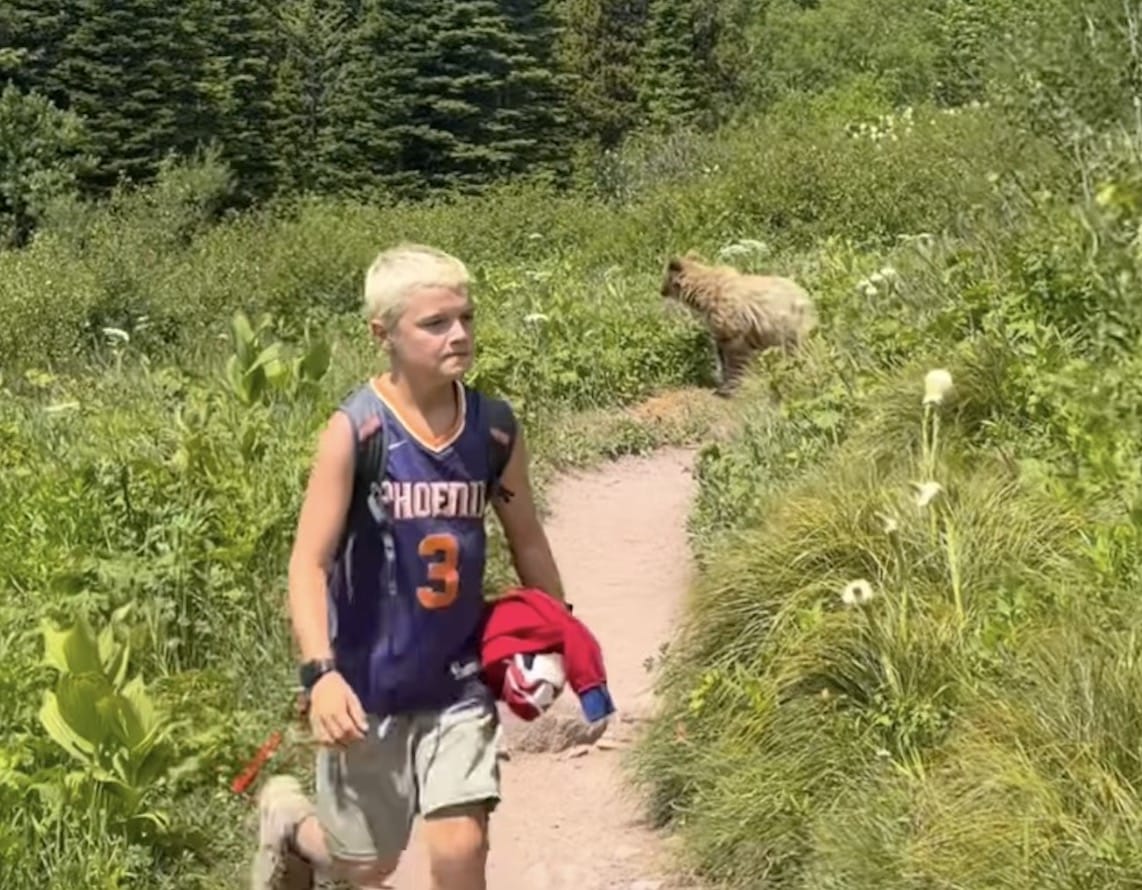
Tense moments caught on video as a father and his young son hiking along Iceberg Lake Trail in Glacier National Park were followed by a juvenile grizzly bear.
Sean Feucht was hiking with his son Zion when they came around a bend in the trail and encountered the grizzly standing just 15 feet away. The bear immediately stood up on its hind legs, which is usually a sign of curiosity rather than aggression as it allows them to get a a better view or smell of its surroundings.
The father and son kept their cool and calmly backed away as the grizzly followed them down the trail. Their composure was a textbook demonstration of why its critically important not to run when confronted with a grizzly bear encounter as running can trigger their their natural instinct to chase and catch prey.
“For a few tense moments, it followed us down the trail as we slowly backed away. On one side was a steep drop, on the other was thick brush. I was definitely packing heat but praying even harder. One of the most important things in a situation like that is not to panic. Don’t run. Don’t scream. Stay calm, give the bear space, and slowly back away. Eventually, he wandered off down the hillside.” –Sean Feucht
Its an old joke that you don’t have to be the fastest runner if a bear is chasing you, you just have to be faster than your friends, but it is super important to remember that running is not a viable option in a grizzly encounter as they can reach top speeds of 35 mph (Olympic sprinter only peaks at about 28 mph) and can cover challenging terrain steep hills, thick brush, and rough ground much better than humans can. Learn more about bear safety at Glacier National Park below.
Glacier National Park Bear Encounter Safety Guidelines:
If you encounter a bear inside the minimum recommended safe distance (100 yards; 91 m), you can decrease your risk by following these guidelines:
- If a bear or other animal is moving in your direction on a trail, get out of its way and let it pass.
- If you can move away, do so. If moving away appears to agitate the bear, stop. In general, bears show agitation by swaying their heads, huffing, and clacking their teeth. Lowered head and laid-back ears also indicate aggression. Bears may stand on their hind legs or approach to get a better view, but these actions are not necessarily signs of aggression. The bear may not have identified you as a person and may be unable to smell or hear you from a distance. Help the bear recognize you as a friendly human.
- Talk quietly.
- Do not run! Back away slowly. Stop if it seems to agitate the bear.
- Use your peripheral vision. Bears may interpret direct eye contact as threatening.
- Continue to move away as the situation allows.
- If a bear appears intent on approaching you, your group, or your campsite in a non-defensive manner (not showing signs of agitation), gather your group together, make noise, and try to discourage the bear from further approaching. Prepare to deploy your bear spray. If you are preparing or consuming food, secure it. DO NOT LET THE BEAR GET YOUR FOOD!
- If a bear approaches in a defensive manner (appears agitated and/or charges), stop. Do not run. Talk quietly to the bear. Prepare to deploy your bear spray. If contact appears imminent and you do not have bear spray, protect your chest and abdomen by falling to the ground on your stomach, clasp your hands around the back of your neck, and leave your pack on for protection. If the bear attempts to roll you over, try to stay on your stomach. If the attack is defensive, the bear will leave once it recognizes you are not a threat. If the attack is prolonged, FIGHT BACK!