

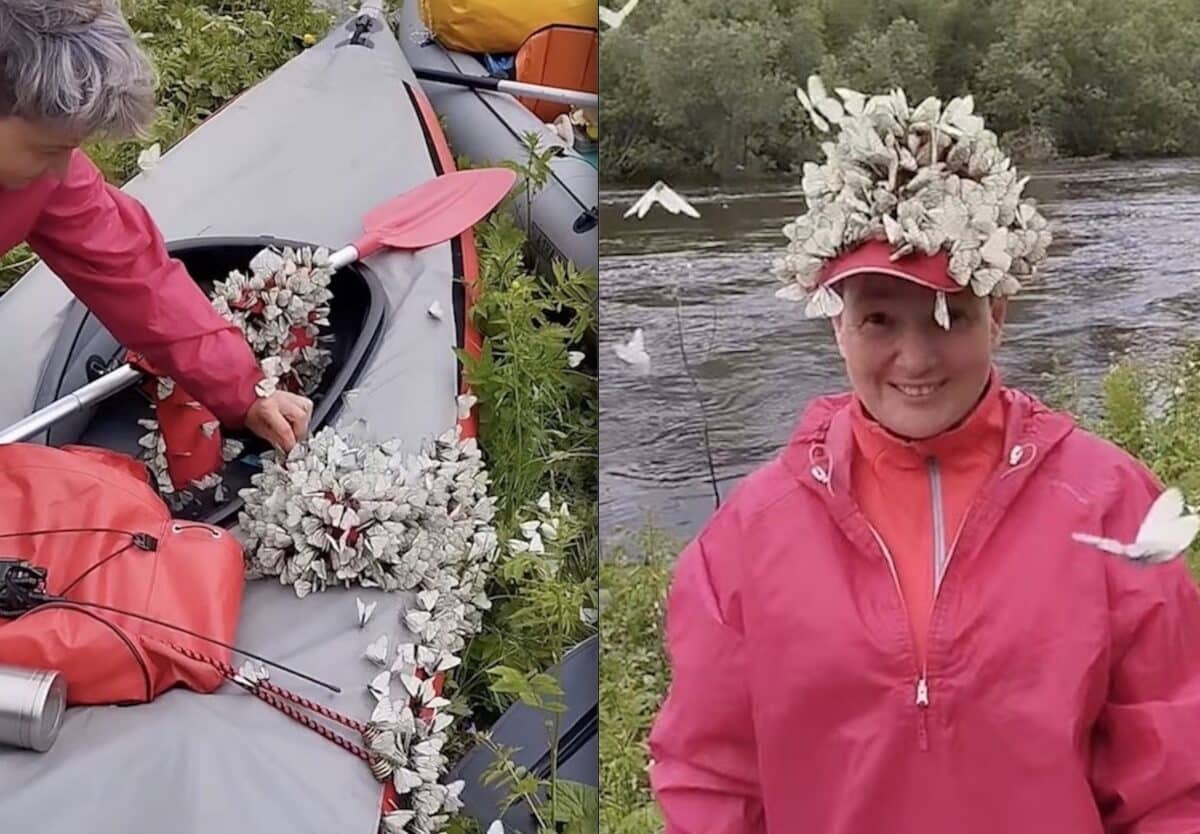
A kayaker paddling on the Vagran River in the remote Ural Mountains of west-central Russia couldn’t hide her joy as a flutter of butterflies (alternately a kaleidoscope of butterflies) swarmed her vessel while taking a break on the riverbank.
We have identified the beautiful bugs as Black-Veined Whites Butterflies (Aporia crataegi) due their striking white, slightly translucent wings with their namesake boldly outlined black veins. Black-Veined Whites typically emerge from their chrysalises around mid-June are known to congregate in massive numbers on muddy riverbanks where they roost by night and drink moisture by day.
Black-Veined White butterflies are strongly attracted to color, particularly when foraging for nectar and pollen, which could explain why they found this red hat so irresistible:
Black-Veined Whites Butterflies play a vital role in the local ecology of the Ural Mountains as a vital ecological catalyst, particularly during their cyclical population explosions.
As caterpillars, they feed heavily on wild rosaceous shrubs like bird cherry and hawthorn, acting as a natural check on vegetation density in the taiga’s understory. When millions of adults emerge simultaneously along river basins like the Vagran, they become a massive, high-protein food source for local birds, dragonflies, and small mammals.
Interestingly due to their intense “mud-puddling” behavior (gathering on damp soil, dung, or sweat to suck up essential minerals like sodium and amino acids needed for reproductive success) the Black-Veined Whites also help to cycle essential nutrients like sodium and nitrogen from damp riverbanks and soils back into the surrounding terrestrial ecosystem.
