

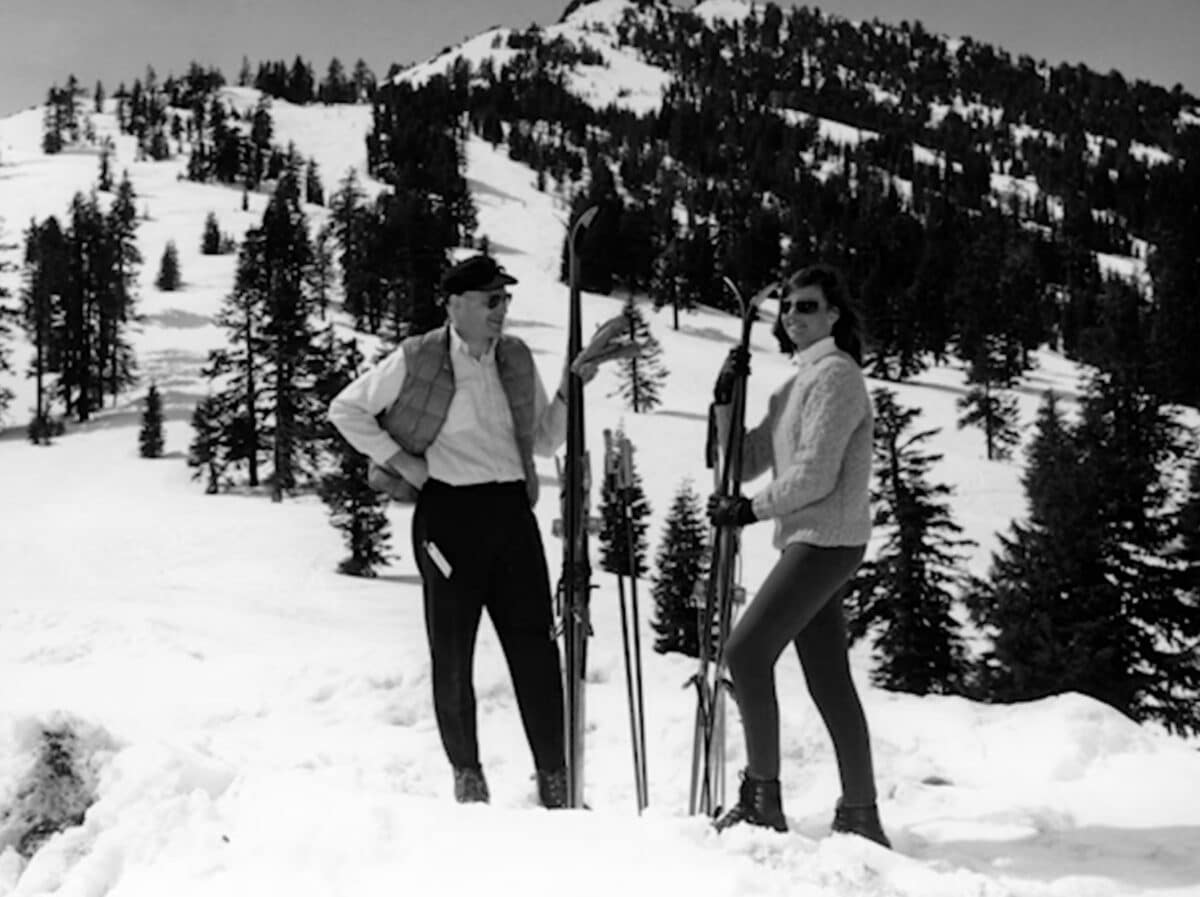
For over six decades, the Mount Ashland Ski Area has stood as a crown jewel of Southern Oregon and Northern California. Rising high above the Rogue Valley, its night lights signal a snowy sanctuary for generations of winter enthusiasts. But behind the incredible trails of the modern resort lies a rich and dramatic history built on community grit, environmental battles, and a unique nonprofit spirit.
The following video is an exploration into the history of the resort delivered by Mt. Ashland’s marketing manager Gabby Conner during the Windows in Time lunchtime lecture. These lectures are jointly sponsored by the Southern Oregon Historical Society (SOHS) and Jackson County Library Services:
The Early Pioneers (1910–1959)
Long before chairlifts carved up the mountain, local families were exploring the slopes. As early as 1910, skiers began trekking to a wilderness spot known as “Trail Camp.” By 1936, the burgeoning winter sports movement led to the creation of the Rogue Snowman Ski Club. Armed with a portable rope toe and an early model of the Medford-built Tucker Snowcat, these pioneers brought organized weekend skiing to the region.
The momentum grew when the Civilian Conservation Corps (CCC) stepped in between 1936 and 1937, constructing the Ashland Loop Road and establishing a formal warming hut and gas-powered rope toe at Trail Camp, roughly 2,500 feet below Mount Ashland’s summit.
By 1950, formal ski education took root when Dan Bulkley established ski classes through Southern Oregon University (then Southern Oregon College). Skiing was gaining traction, and town boosters officially renamed the peak from “Ashland Butte” to “Mount Ashland,” paving the way for a grander vision.
Building a Mountain: The 1960s Boom
The dream of a dedicated local ski resort formalized in 1960. A coalition of local governments known as the O&C Counties launched a program to fund access roads to recreation areas in the Cascade and Siskiyou ranges. Seizing the opportunity, a group of local investors formed the Mount Ashland Corporation in February 1961.
Financing was a true community endeavor: stock was offered to any Rogue Valley resident for $100 per share, which, alongside small local donations and a substantial investment from civic leader Glenn Jackson, raised $250,000.
Construction on the main ski lodge and the mountain’s first chairlifts began in earnest in 1963. On January 11, 1964, Mount Ashland officially opened its doors to an overwhelming crowd of 2,000 visitors. The resort debuted with two lifts: the Poma lift and the Ariel chairlift, which was a classic Riblet design that remains the oldest operating lift on the mountain today. By 1967, the mountain was a certified success, logging over 90,000 skier visits a year with lift tickets costing a modest $4.
Environmental Hurdles and the “Windsor” Era (1970s)
The 1970s brought significant growing pains. In 1972, a massive release of sediment from the nearby Reeder Reservoir muddied Ashland and Bear Creeks, leading the Department of Environmental Quality (DEQ) to recommend halting any further development on the mountain, including plans for a crucial second chairlift. It wasn’t until 1976 that exhaustive studies concluded the ski area did not significantly contribute to watershed erosion, giving the resort the green light to expand.
Financial instability paired with these delays led to the dissolution of the original Mount Ashland Corporation in 1974. Desperate to keep the mountain alive, Dick Hicks, a Grants Pass supermarket owner and an 11-year veteran of the Mount Ashland Ski Patrol, purchased the resort’s facilities in 1977, forming Ski Ashland Inc.
To replace a broken surface T-bar with a proper double chairlift without taking on crippling debt, Hicks pioneered an innovative community funding drive. He sold 133 “23-year season passes” for $2,500 each, offering the first 80 buyers the unique honor of having their names imprinted on the backs of the lift chairs. Thanks to this effort, the Windsor Chairlift was installed in 1978, with a heavy-lift Ericsson Air-Crane helicopter flying the towers directly onto the snow-covered slopes.
The Fight for Survival and the Shift to Nonprofit (1980s–1990s)
In 1983, ownership shifted to Harbor Properties, a Washington-based firm that operated Stevens Pass. They injected much-needed capital into the mountain, adding night lighting, expanding the rental fleet, and replacing old rope toes with the Comr and Sonnet triple chairlifts in 1987.
However, corporate ownership proved short-lived. In January 1992, Harbor Properties shocked the region by announcing they intended to either sell the ski area for $1.7 million or dismantle the chairlifts and move them to Washington.
Refusing to lose their mountain, the Southern Oregon community united. Local Rotary clubs raised $600,000, and Oregon Lottery funds provided an additional $500,000 to buy out the resort. Because the newly formed community coalition didn’t yet have legal standing to hold a U.S. Forest Service special use permit, the City of Ashland stepped forward to hold the permit, assigning all operational responsibilities to the newly minted, 501(c)(3) nonprofit: the Mount Ashland Association. Mount Ashland was officially saved, transformed into the community-owned treasure it is today.
The Master Plan Battles (2000–2011)
The turn of the millennium brought a decade of fierce legal and environmental disputes. Seeking to make the notoriously steep mountain more accessible to beginner and intermediate skiers, the Mount Ashland Association proposed an expansion into the “C6” area on the back of the mountain. Legendary ski map artist James Niehues even painted a new trail map in 2002 reflecting these planned runs.
However, the expansion drew intense scrutiny. A draft Environmental Impact Statement (EIS) triggered over 6,000 public comments, splitting the community down the middle. For six years, the project was riddled with lawsuits, injunctions, and appeals from environmental groups concerned about the local watershed.
The gridlock finally broke in May 2011 when federal courts lifted the remaining injunctions, ruling that the Forest Service had met all regulatory requirements. Though the association ultimately chose not to execute the expansion, the territory remains designated in the resort’s official master plan. To streamline operations and eliminate political friction, the City of Ashland officially stepped away in late 2011, transferring the Forest Service special use permit entirely to the Mount Ashland Association.
The Modern Era and a Sustainable Future
Today, Mount Ashland is thriving, bridging its historic roots with modern innovation. In 2017, the historic lodge underwent a massive revitalization, transforming into the Karen & Sid DeBoer Lodge. That same year, Mount Ashland made history by becoming the first ski resort in the world to earn STOKE certification, which is an international gold standard for sustainably operated tourism.
The resort achieved another massive milestone in 2024 with the installation of the Lithia Chairlift, made possible by a historic $2.5 million donation from the Karen & Sid DeBoer Foundation, marking the largest single gift in the association’s history. The new lift helped catalyze the resort’s second-busiest winter on record, welcoming over 128,000 skiers and snowboarders.
To combat the long-term threat of climate change and changing winter snowpacks, Mount Ashland has successfully introduced summer operations. The mountain now serves as a year-round recreation hub, hosting youth Alpine Adventure Camps, trail races, open-air drive-in movies, and autumn festivals.
Whats To Come For Mount Ashland
With an annual economic impact of $9 million, over 250 seasonal employees, and subsidized ski programs that introduce 1,400 local school kids to the snow every year, Mount Ashland’s community footprint is undeniable.
Yet, the mountain faces a familiar challenge: aging infrastructure. The iconic Ariel lift is now 62 years old, and the Windsor lift is 48. Maintaining these historic lifts requires scarce parts and aging institutional knowledge. As the Mount Ashland Association looks to the future, its next great hill to climb will be rallying the community once more to fund and replace these legendary lifts, ensuring that the Gemütlichkeit, the warm, welcoming alpine spirit of Mount Ashland, endures for generations to come.
