

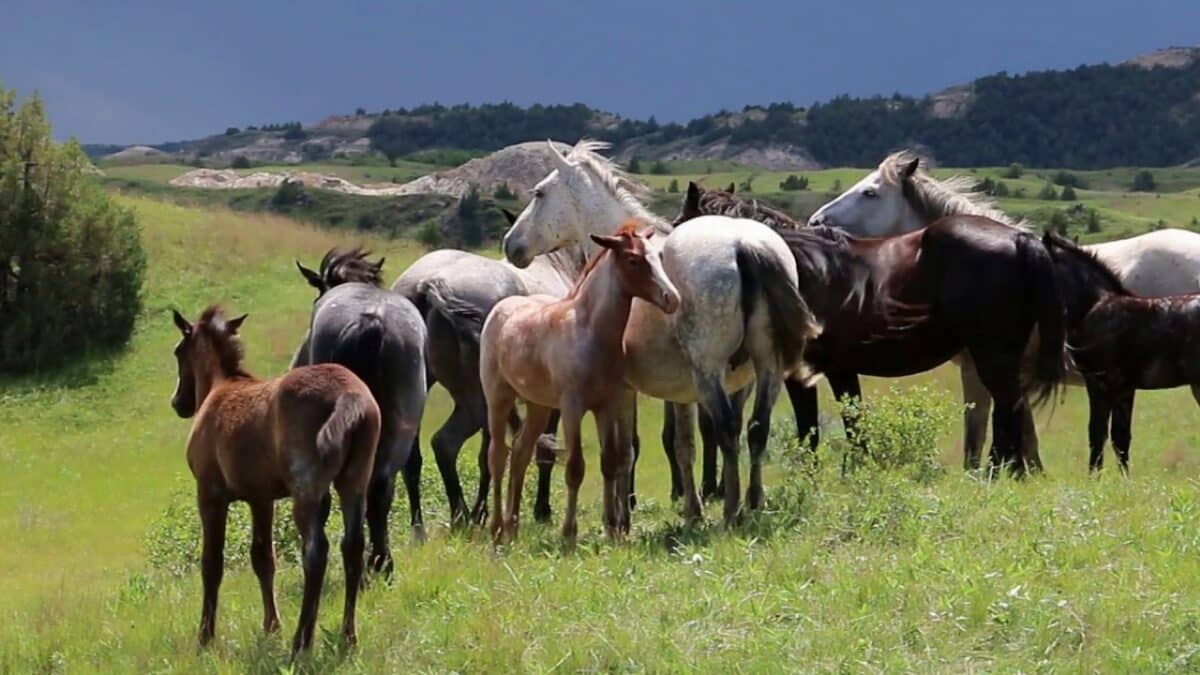
WASHINGTON — In a major step toward preserving a historic fixture of the American West, the U.S. Senate has passed bipartisan legislation to permanently protect the wild horse herd at Theodore Roosevelt National Park in North Dakota. Co-introduced by Republican Senator John Hoeven of North Dakota and Democratic Senator Tim Kaine of Virginia, the bill is now headed to the House of Representatives for consideration.
The legislation mandates the Department of the Interior to maintain a genetically diverse herd of at least 150 horses in the park’s south unit. Under the strict guidelines, the federal government is prohibited from removing any horses unless doing so directly improves genetic diversity, responds to an emergency, or protects public health and safety.
Furthermore, the bill requires the federal government to develop a comprehensive management plan within 120 days and publicly disclose data regarding the herd’s population and health.
“Wild horses add so much to Theodore Roosevelt National Park. Our legislation is about preserving a critical part of this region’s character and history. The wild horses are a primary draw for those coming to the park, and they truly help set the historic scene as it would’ve existed in Teddy Roosevelt’s time. Passing our bill through the Senate is a big step forward and brings us closer to ensuring the future of wild horses at the park for future generations.” -Senator John Hoeven
About The Wild Horses of Theodore Roosevelt National Park:
Theodore Roosevelt National Park is one of the few national parks in America where visitors can see free-roaming horses. Their presence represents Theodore Roosevelt’s experiences here during the open range ranching era.
By the late 1800s European settlement of the plains had reached the Dakotas. Ranchers turned horses out on the open range to live and breed. When needed, they would round up horses and their offspring for use as ranch horses. For generations, ranchers used land that would later become Theodore Roosevelt National Park for open range grazing.
After the park was fenced, a horse round-up held in 1954 removed 200 branded animals. A few small bands of horses eluded capture and went unclaimed. These horses continued to live free-range in the park.
For several years the National Park Service tried to remove all horses from the park. In 1970, a change of park policy recognized the horse as part of the historical setting. New policies were written and enacted to manage the horses as a historic demonstration herd. (The horses do not fall under the protection of the Wild Free-Roaming Horses and Burros Act which only applies to animals on US Forest Service and Bureau of Land Management lands.)
Historically, the park conducted roundups every three to four years using helicopters to herd horses to a handling facility and then sold them at public auction. More recently, the park has tried new methods for herd management including contraceptives, low-stress capture techniques, genetics research, and partnerships with nonprofit horse advocacy groups. Horses are currently captured using tranquilizer darts and sold in online auctions held by the General Services Administration .
