

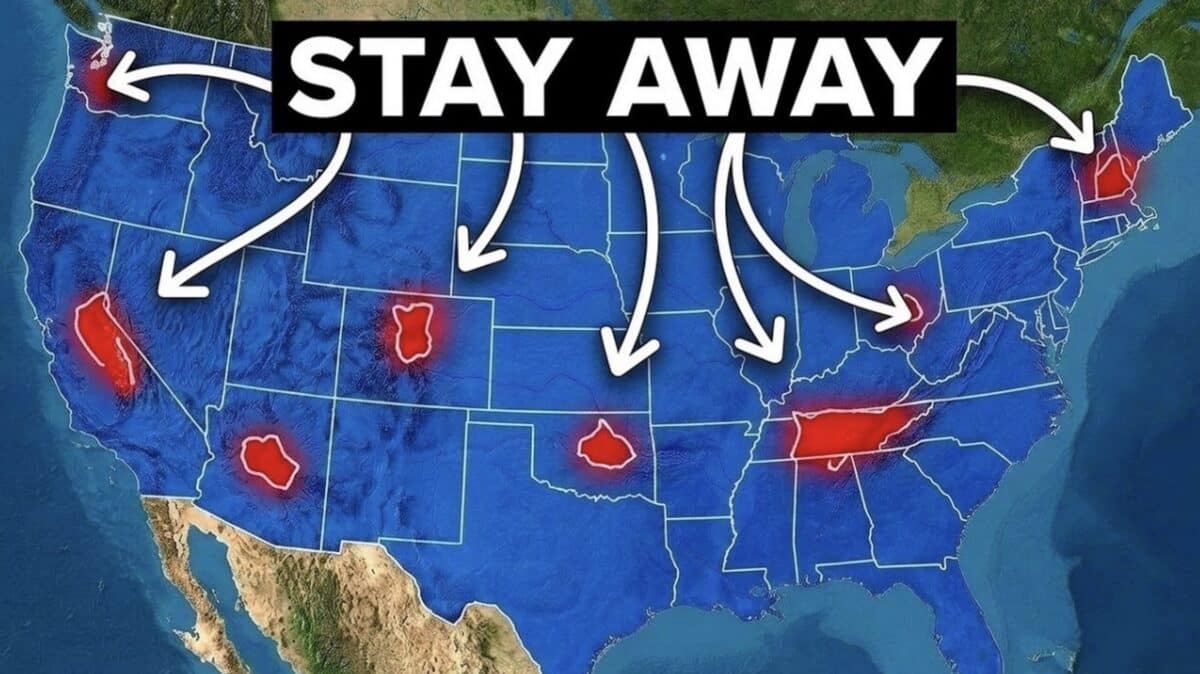
America’s landscapes are among the most spectacular on the planet, but every single state harbors a geographic feature with a documented history of claiming lives. The YouTube channel Across the Globe recently explored the most dangerous natural and geographic hazard in all 50 states.
The list runs the full spectrum of American geography. Denali in Alaska has killed over 130 climbers since 1932 (one in every 200 people who attempt the summit doesn’t come back). Yellowstone’s thermal features dissolved a man completely within 24 hours back in 2016, and the ground at Centralia, Pennsylvania has been on fire since 1962 and may keep burning for another 250 years.
Unsurprisingly, water features are the most consistent killers across the country. Low-head dams (often called “drowning machines” by rescuers) can be found in rivers in Connecticut, Illinois, Iowa, and Virginia, creating recirculating hydraulic traps. Lake Michigan alone accounts for nearly half of all Great Lakes drownings over the past 15 years, while Lake Superior, averaging 40°F, is famous for never giving up its dead.
Other dangers wear a beautiful disguise. Havasupai Falls in Arizona is one of the most photographed waterfalls in America, but it sits at the bottom of a slot canyon that can flood with a 20-foot wall of water in under 30 minutes. Angel’s Landing in Utah has claimed at least 18 lives, while Ohio’s most visited natural area, Hocking Hills, is also its deadliest.
The geography in some states makes for dangerous weather events. Moore, Oklahoma has been struck by five major tornadoes since 1999, including the 1999 event that produced the highest wind speed ever recorded on Earth: 321 mph. The Mississippi Sound’s shallow geometry stacked Hurricane Katrina’s surge into a 27.8-foot wall of water, the highest storm surge ever recorded in America. Mount Rainier holds enough glacial ice that a single eruption could bury 80,000 people living on ancient debris flows downstream.