

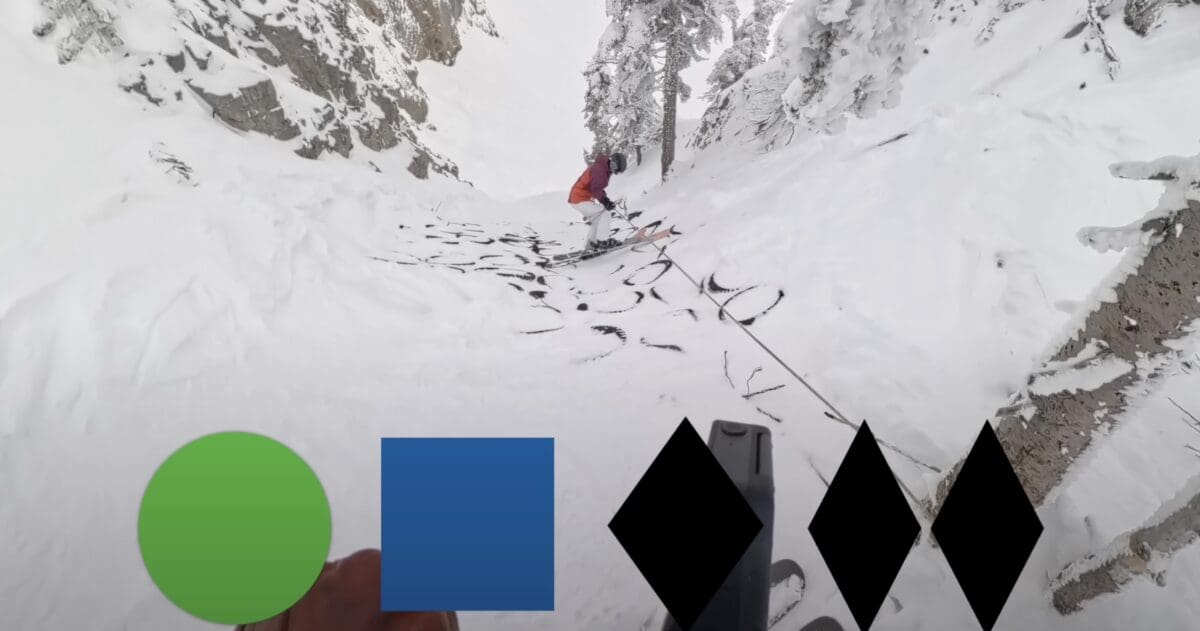
If you’ve ever experienced inconsistency from one ski resort to another when it comes to their trail rating system you are not alone. Some places blacks seem like blues and others are the exact opposite.
“You’ll find them on trail maps and posted on signs on the mountain. The same trail symbols are used at every resort in the country, but as Albert Einstein must have said, “It’s all relative.” A Green Circle trail at Jackson Hole, Wyoming might be as tough as a Blue Square at Sunlight, Colorado. Not a big deal. The trail ratings are consistent within each resort. So all the Greens at a ski area will be about the same difficulty, as will the Blues and the Blacks.” -National Ski Area Association
Trail rating is a subjective art and the following video ventures to explain the North American trail rating system, its origins, and why ratings tend to differ between resorts.
The Disney-Origin Trail Rating System
In the 1960s, Walt Disney planned a ski resort in California’s Mineral King Valley. To make it family friendly, Disney developed a color coded system to guide skiers to appropriate runs. Though the resort was scrapped due to environmental issues, the National Ski Areas Association adopted this system in 1968. It uses shapes and colors to indicate difficulty:
- Green Circle: Beginner, gentle slopes.
- Blue Square: Intermediate, moderate pitch.
- Black Diamond: Advanced, steep and challenging.
- Double Black Diamond: Expert, very steep with hazards.
- Triple Black/Extreme: Unmarked, extreme terrain with high risk.
Why Ratings Vary
Trail ratings are relative to each resort. Factors like slope steepness measured in degrees, grooming, and hazards determine ratings, but resorts apply them subjectively:
- Green Circle: Flat to 15°, wide, groomed, no hazards.
- Blue Square: 15-23°, often groomed, minimal hazards.
- Black Diamond: Over 23°, with moguls, trees, or variable terrain.
- Double Black Diamond: 25°+ with cliffs, chutes, or ungroomed areas.
- Triple Black/Extreme: Unmarked, high-risk runs with potential for serious injury.
Smaller resorts may inflate ratings to attract expert skiers, while larger rate conservatively due to intense terrain. Eastern resorts often have milder runs for the same rating.
International Differences
In Europe, colors replace shapes: green (beginner), blue (easy), red (intermediate), black (expert), and orange (extreme). Yellow may indicate controlled off-piste routes.
Ski Smart
Ratings aren’t universal, so always ask around and do your best to gather recon on a run before diving in. Remember conditions can play a major role in how hard a trail skis on any given day. Be conservative, be safe, have fun.
Related: Disney’s Ski Resort That Never Happened
