

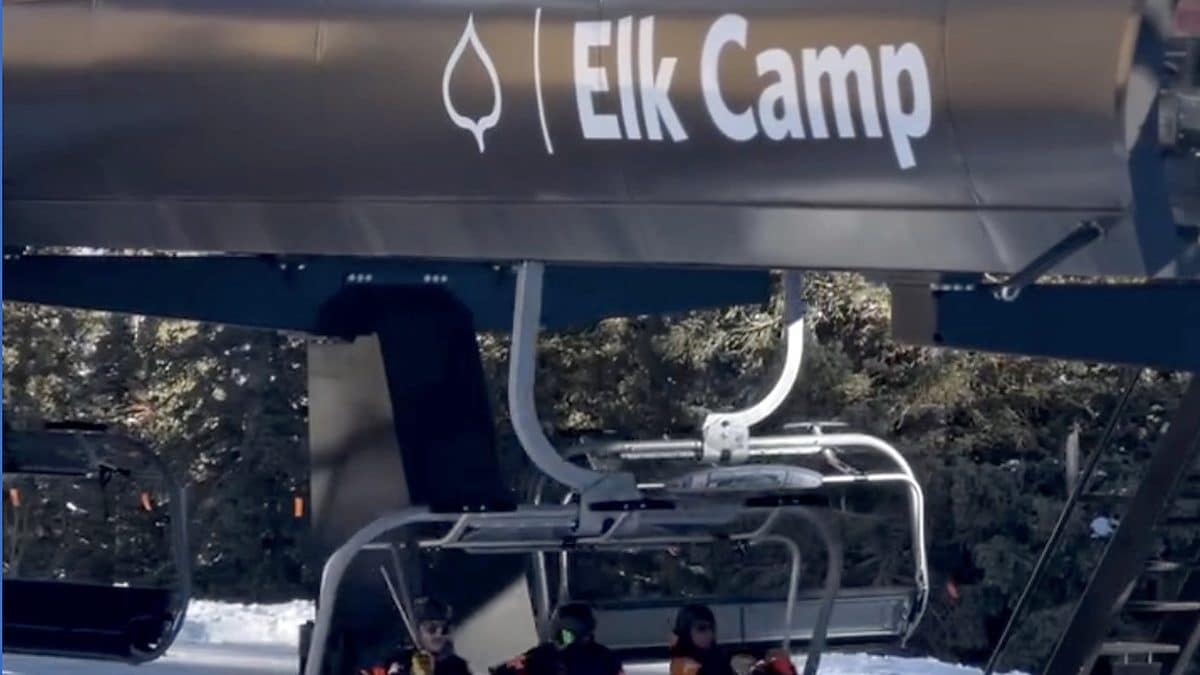
Aspen Snowmass has replaced the diesel backup generator on its Elk Camp chairlift with a battery big enough to keep the lift running for up to two hours during a power outage — and, when the lift is idle, to push electricity back onto the local grid.
The resort describes it as the world’s first fully battery-backed chairlift. For skiers, the change is close to invisible. For the rest of the ski industry, it is a test of whether emergency equipment can earn its keep the rest of the time.
Snowmass’s battery-backed chairlift: the key numbers
- Lift: Elk Camp, a high-speed six-passenger chairlift at Snowmass Ski Area, Colorado
- Battery: a 900-kilowatt system with 1,881 kilowatt-hours of storage
- Backup runtime: up to two hours of lift operation during an outage
- Grid partner: Holy Cross Energy, the local electric cooperative
- Emissions avoided: roughly 144 tons of carbon a year from the retired diesel generator
How a battery-backed chairlift actually works
Elk Camp does not run on batteries all day. Under normal conditions the high-speed six-pack draws power from the grid, like most modern chairlifts. The difference shows up when that supply is interrupted.
Resorts have traditionally leaned on diesel-powered backup equipment to restart or move a lift during an outage — equipment that matters most when skiers are already suspended above the snow.
At Snowmass, a large battery now fills that role. According to Aspen Skiing Company, the installation pairs a 900-kilowatt battery system with 1,881 kilowatt-hours of energy storage. That is enough to keep Elk Camp turning for up to two hours, depending on operating conditions.
The goal is not an off-grid ski lift. It is to keep the lift moving long enough to clear it safely when the power drops.
Aspen Snowmass introduced the new Elk Camp six-pack during the 2025–26 season, replacing an older quad chairlift. The battery adds another layer of modernization on top of that.
Why backup power matters when a chairlift stops
Anyone who has sat on a stopped chairlift knows backup power is more than a technical footnote. An outage can leave passengers hanging above the snow in cold, wind or deteriorating weather.
Most resorts have procedures for exactly this. If grid power fails, operators may use an auxiliary or emergency drive to bring passengers to an unloading station. If the lift cannot be restarted safely, specially trained crews may have to run a rope evacuation.
A battery gives operators one more way to supply that power. It does not eliminate every scenario: mechanical failures, damaged components and extreme weather can still stop a lift even when electricity is available.
The battery can also send power back to the grid
This is where the project gets interesting. When Elk Camp is not running, its battery does not have to sit idle.
Aspen Snowmass has partnered with Holy Cross Energy, the member-owned cooperative that serves the Roaring Fork Valley, to discharge stored electricity during periods of high demand. The practice is known as peak shaving.
Electricity demand swings through the day. When consumption spikes, utilities have to find extra power to keep the system balanced. A large battery can store electricity when it is plentiful and release it when demand climbs, easing pressure on the grid and reducing the need for more expensive peak-period power.
So the same battery does two jobs: emergency power for a chairlift, and energy storage for the surrounding community. Instead of buying backup equipment that spends most of its life waiting for a failure, a resort could own an asset that returns something year-round.
The diesel generator it replaced produced about 144 tons of carbon a year
According to Aspen Snowmass, the diesel generator previously assigned to Elk Camp backup duty was responsible for approximately 144 tons of carbon emissions annually. Swapping in a battery removes the need to run it as the lift’s backup power source.
There are practical gains too. Diesel equipment needs fuel deliveries, routine maintenance and periodic replacement of stored fuel — all of which means moving equipment and fuel around steep terrain. A battery drops most of that. It also runs far more quietly.
Batteries are not impact-free, of course. Manufacturing, installation, the generation mix that charges them and eventual recycling all count toward their footprint. But the project is a different route to cutting diesel dependence on mountain infrastructure.
Could battery storage actually save ski resorts money?
That is arguably the biggest unanswered question. A large battery is a substantial upfront investment: the battery itself, electrical equipment, installation, engineering, maintenance and the connection to the grid.
Aspen Snowmass has not publicly disclosed the total installation cost or a projected payback period. Without those numbers, it is hard to say whether the math works at a smaller ski area.
Several factors would decide it. A resort paying steep peak-demand rates stands to gain more than one with lower or flatter electricity prices. A ski area that can partner with its utility, as Snowmass has, gets another way to offset the investment. Fuel and maintenance savings accumulate over the life of the system, but they have to be weighed against eventual battery replacement and other long-term costs.
Other ski areas are already looking at battery storage
Snowmass is not the only ski area working on this. In Massachusetts, Berkshire East has been pursuing a much larger energy-storage project built around the electricity demands of snowmaking, helped along by a $4.51 million state grant. Per DCSki, the proposed system would hold roughly 80 megawatt-hours, with the emphasis on reducing peak electrical demand.
The two projects are not the same thing. Snowmass is using a battery to replace backup power for a single chairlift, while Berkshire East is looking at storage mainly to manage snowmaking load. But both point at the same underlying problem.
Modern resorts consume enormous amounts of energy running lifts, pumping water, making snow and heating lodges. Finding ways to store and shift that energy gets more valuable as the infrastructure gets more power-hungry.
The contrast with smaller independents is striking. Montana’s Lost Trail Ski Area runs its five double chairlifts and three rope tows on an independent generator system rather than utility power. There clearly is not one universal solution for powering a ski mountain.
Is this the future of chairlifts?
It is too early to write off diesel backup generators. For many ski areas they remain proven and familiar, and they can supply backup power for extended periods as long as fuel keeps arriving. Batteries bring their own considerations: installation cost, charging requirements, finite storage capacity and performance during a prolonged outage.
But Aspen’s project raises a real possibility — that the equipment keeping skiers safe during a power outage could also help a resort manage electricity costs and support the local grid. That would make backup infrastructure something other than a line item waiting for an emergency.
For now, Snowmass has shown that a large, modern chairlift can keep running on stored battery power when the grid fails. Whether other resorts follow will depend less on whether the technology works and more on whether the financial numbers add up.
For skiers, the change may be almost invisible. Until, of course, the power goes out.