

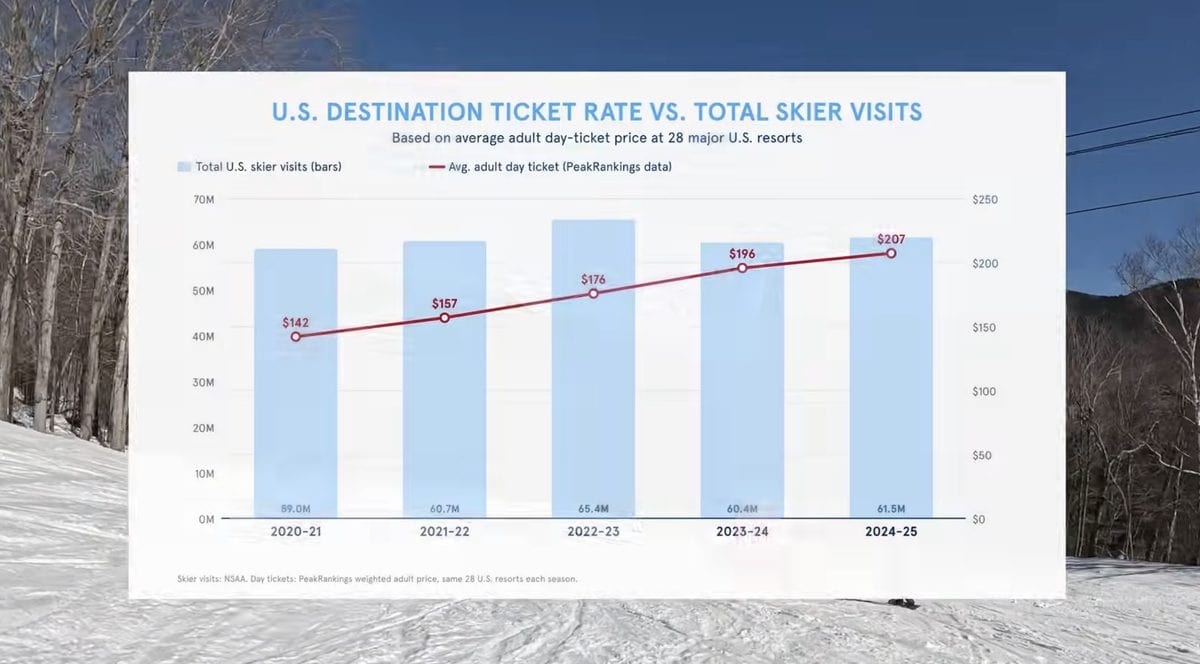
For years, North American ski resorts have raised lift ticket prices, sold increasing numbers of expensive multi-resort passes and invested hundreds of millions of dollars in new infrastructure. Despite the rising costs, skier visits have remained near record levels, but recent financial reports suggest that the industry’s remarkable run may be losing momentum.
A new analysis from PeakRankings examines whether the North American ski industry is experiencing a market correction, looking at declining Epic Pass sales, record-low Western snowpack, changing consumer habits and a slowdown in new chairlift construction.
The numbers are particularly interesting heading into the 2026-27 season, with Vail Resorts reporting a 12% decline in advance pass sales by unit and other major operators introducing new discounts and incentives to attract customers.
Epic Pass Sales Are Falling
Vail Resorts provides one of the clearest indications that something may be changing. According to the company’s September financial report, skier visits fell 13.4% during the 2025-26 season, while annual net income dropped from $280 million to approximately $148 million.
The company’s outlook for the upcoming winter is also concerning. Through September 18, Epic Pass unit sales were down 12% compared with the same period last year, while estimated ski days sold fell 10% and pass sales revenue declined 6%.
PeakRankings points out that the largest declines are concentrated among occasional destination skiers purchasing products for just a handful of days, rather than customers purchasing unlimited passes.
Vail CEO Rob Katz has suggested that some of these customers may be delaying their purchases following last winter’s poor conditions rather than abandoning skiing altogether. However, declining Epic Pass sales were already becoming apparent before the historically difficult 2025-26 season.
For Real Though, Has Skiing Become Too Expensive?
PeakRankings also examines whether the industry’s advance-purchase business model has begun working against itself.
For years, Epic and Ikon have encouraged customers to purchase lift access months before the winter begins, offering substantial savings compared with the prices charged at resort ticket windows. While that approach can provide excellent value for frequent skiers and snowboarders, occasional visitors face a different calculation.
Buying a pass months in advance means committing hundreds or thousands of dollars without knowing whether the upcoming winter will deliver good skiing. Waiting until snow conditions improve can mean paying dramatically higher lift ticket prices, especially at major destination resorts.
The 2025-26 season demonstrated just how consequential that decision can be. According to the National Ski Areas Association’s revised figures, U.S. ski areas recorded approximately 53.1 million skier visits, down from 61.6 million the previous winter. Much of the decline was concentrated in the West, where historically poor snow conditions affected numerous major ski destinations.
PeakRankings argues that the widespread Western snow drought may have undermined one of the biggest selling points of multi-resort passes: the ability to visit a different region when conditions are poor closer to home.
Are Ski Resorts Changing Their Strategies?
Interestingly, advance pass purchases helped protect major resort operators financially during the disappointing winter. Vail Resorts reported that despite a 13.4% decline in skier visits, lift revenue fell just 3.5%, while revenue from season passes actually increased 3.9%.
PeakRankings identifies a potential weakness in that strategy. Skiers who already paid for a disappointing winter may be less willing to commit their money months in advance for another season.
Both Vail and Alterra have begun experimenting with new pricing incentives. Vail has introduced a 20% Epic Pass discount for customers ages 13 to 30 and expanded advance-purchase lift ticket discounts, while Ikon has offered enhanced Friends & Family ticket promotions and revised its renewal benefits.
Another potential indicator is the slowing pace of resort infrastructure investment. According to Ski Area Management, North American ski areas installed 37 new aerial lifts in 2025, down from 57 in 2023. Rising construction costs and the completion of major investment programs are also contributing factors, and resort operators continue to spend heavily on improvements.
What Could This Mean for Skiers and Snowboarders?
PeakRankings stops short of declaring that skiing is entering a definitive market correction. Strong visitation at some independent resorts and in regions with favorable snow conditions suggests that Americans haven’t suddenly lost interest in winter sports.
Instead, the analysis raises the possibility that the market for expensive lift tickets and advance-commitment passes is beginning to change.
For skiers and snowboarders, that could eventually mean more competitive in-season pricing, greater flexibility when planning trips and fewer financial penalties for waiting to see where the snow falls. However, reduced revenue could also force resort operators to become more selective about future infrastructure projects and other investments.
Whether those changes materialize will depend on how consumers respond during the 2026-27 winter. PeakRankings’ examination suggests that while the appetite for skiing remains strong, the industry’s ability to keep raising prices while requiring customers to commit months in advance may be facing its biggest test in years.
