

While skiable acreage, annual snowfall and the number of chairlifts are popular ways to compare ski resorts, there’s something particularly appealing about a mountain with an enormous vertical drop. The opportunity to start above the tree line, ski through alpine bowls and finish thousands of feet below is one of the great experiences in American skiing.
Relatively few American ski resorts boast more than 4,000 feet of vertical drop. However, not every resort measures vertical the same way. Some include hike-to terrain, while others count terrain that requires a shuttle or additional lift rides.
Here are five American ski resorts boasting more than 4,000 feet of vertical, along with what skiers and snowboarders should know about accessing it.
1. Timberline Lodge, Oregon: 4,540 Vertical Feet
Oregon might not be the first state that comes to mind when discussing America’s biggest ski mountains, but Timberline Lodge on Mount Hood boasts an extraordinary 4,540 feet of continuous skiable vertical.
The full descent at Timberline begins at the top of the Palmer snowfield and finishes at Summit Pass in Government Camp. Along the way, skiers and snowboarders transition from exposed alpine terrain high on Mount Hood to the heavily forested slopes below the historic lodge.
Depending on conditions, the uppermost terrain is accessed by the Palmer chairlift or a snowcat. After descending the Alpine Trail to Government Camp, guests can catch a resort-operated shuttle back to Timberline Lodge.
The full vertical is dependent on snow coverage, upper-mountain operations and shuttle availability, but when everything comes together, Timberline offers a remarkable top-to-bottom skiing experience.
2. Telluride Ski Resort, Colorado: 4,425 Vertical Feet
Nestled in Colorado’s spectacular San Juan Mountains, Telluride combines some of America’s most impressive mountain scenery with exceptionally challenging high-alpine skiing.
According to Telluride’s official mountain statistics, the resort boasts a total vertical drop of 4,425 feet. However, its lift-served vertical is 3,790 feet, with the remaining elevation accessed on foot.
Experienced skiers looking for an adventure can explore the resort’s extensive hike-to terrain, including Black Iron Bowl and Palmyra Peak. Some of these areas require substantial hikes at high elevations and contain extremely challenging terrain.
For most visitors to this Epic Pass destination, the nearly 3,800 feet of lift-served vertical will provide more than enough skiing to keep their legs burning.
3. Snowmass, Colorado: Approximately 4,400 Vertical Feet
The largest of Aspen Snowmass’ four ski mountains boasts approximately 4,400 feet of vertical rise and more than 3,300 acres of skiable terrain.
The Cirque surface lift provides access to some of the mountain’s highest terrain, reaching an elevation of approximately 12,510 feet. From there, skiers can link upper-mountain terrain with trails descending toward Snowmass Base Village, covering more than 4,000 vertical feet.
What makes Snowmass particularly appealing is the variety of skiing available across its enormous elevation range. The mountain offers everything from steep alpine terrain and powder-filled glades to expansive groomers and family-friendly slopes.
Unlike some mountains on this list, Snowmass offers a substantial amount of long, intermediate-friendly skiing, making its impressive vertical accessible to a broad range of abilities, even if its highest terrain is more demanding.
4. Big Sky Resort, Montana: 4,350 Vertical Feet
Few American ski resorts can match the sheer scale of Big Sky. The Montana destination boasts 5,850 acres of skiable terrain and 4,350 feet of total vertical drop.
The centerpiece of the resort is Lone Peak, which reaches an elevation of 11,166 feet. The modern Lone Peak Tram, which debuted in December 2023, transports skiers and snowboarders to the summit in approximately four minutes.
Big Sky’s advertised vertical represents the overall elevation range of its ski terrain, rather than the distance from Lone Peak to its main base village. A descent from the summit to Mountain Village, for example, covers 3,666 feet of elevation.
With multiple mountain faces, extensive alpine terrain and a sophisticated lift network, Big Sky offers plenty of opportunities for skiers looking to accumulate serious vertical throughout the day.
5. Jackson Hole Mountain Resort, Wyoming: 4,139 Vertical Feet
Jackson Hole offers perhaps the most straightforward way to access more than 4,000 feet of continuous vertical skiing in the United States.
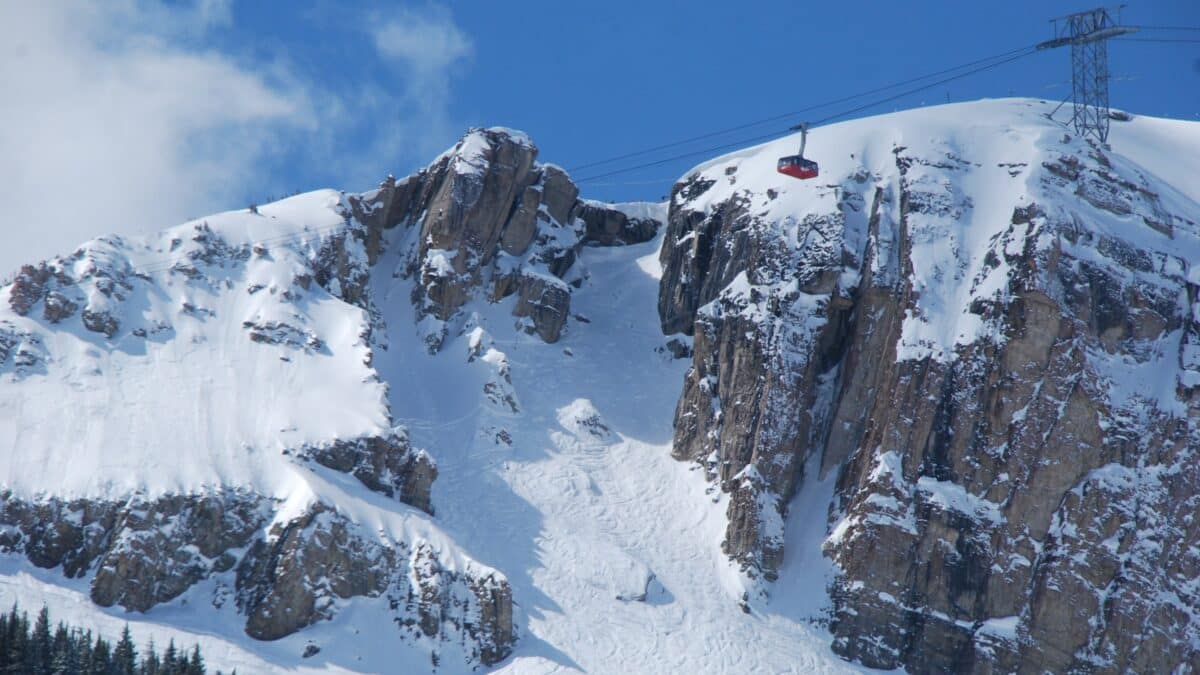
The resort’s iconic red Aerial Tram transports skiers and snowboarders from Teton Village at 6,311 feet to the summit of Rendezvous Mountain at 10,450 feet. According to Jackson Hole’s official mountain statistics, the tram climbs 4,139 vertical feet in approximately nine minutes.
From the summit, experienced skiers can connect expansive alpine bowls, steep pitches and lower-mountain trails all the way back to the base of the tram without needing to ride another lift.
It’s an enormous amount of skiing accessed in a single lift ride, and one of the reasons Jackson Hole has earned its reputation as one of America’s premier destinations for advanced and expert skiers.
For those who appreciate a long descent followed by another ride straight back to the summit, few American ski resorts can rival Jackson Hole.
