
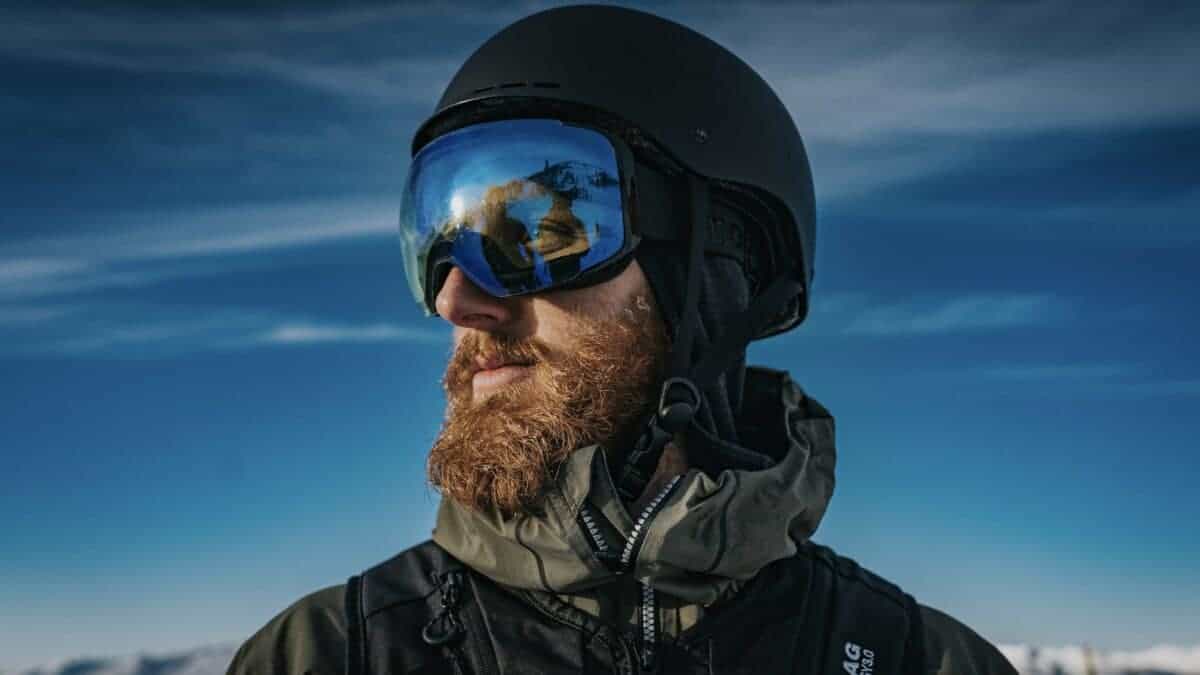
It’s November, and that means there will likely be a lot of guys sporting some sort of facial hair that they usually try to keep close shaven. Beyond the clear fundraising benefits of No Shave November and Movember, we wanted to ask if having facial hair has any benefits toward your experience on the slopes. There’s no doubt it looks sweet, but is it helpful?
Anyone who’s spent a full day on the mountain in freezing temperatures knows that exposed skin on your face can take a serious beating. Your face is often one of the least protected parts of your body, and wind, blowing snow, and bitterly cold temperatures can do some serious damage. A balaclava or neck gaiter can be incredibly helpful, but what about growing your own natural layer of protection?
There aren’t any clear studies on what facial hair does to skiers and snowboarders (unsurprisingly), but a 2025 study published in Military Medicine could offer some scientific backing for it being quite useful.
The Science Behind Beards in the Cold
The study, title Does Facial Hair Provide Significant Thermoregulatory Advantage and Protection in the Arctic? A Case for Bearded Arctic Warriors, was conducted by researchers affiliated with the United States Army Research Institute of Environmental Medicine.
Researches used mathematical models to look at how different amount of facial hair affected the body’s response to varying temperatures. The simulations compared clean-shaven faces with three progressively fuller levels of facial hair under mild heat, cold stress, and extreme cold conditions. The cold-weather scenarios included temperatures of -24°C (-11°F) and -45°C (-49°F), conditions that are much more extreme than what skiers and snowboarders will experience on a typical day.
The findings were rather quite interesting. Researchers found that full beards did not provide a significant advantage in main core body temperature, but facial hair did provide meaningful protection against frostbite injuries to the face. In other words, a beard won’t keep your whole body warm, but it can certainly protect the skin underneath it.
Does This Mean Beards Are Better for Skiing?
I can’t give much of an anecdote, as facial hair has never extended much beyond a mustache, but I can say that my upper lip tends to stay plenty warm throughout the day, even when it’s got a nice covering of snow.
While the study focused on military personnel operating in Arctic environments rather than recreational skiers, the underlying science could still have some practical applications on the mountain. Facial frostbite becomes a real concern when temperatures drop and when wind chill makes exposed skin even more vulnerable. An additional layer of facial hair could provide some protection, potentially giving bearded skiers and snowboarders an advantage over their clean shaven counterparts.
Of course that doesn’t mean growing a beard is a replacement for proper cold weather equipment. You should still wear balaclavas, face coverings, goggles, and appropriate layering to keep yourself safe in freezing conditions.
Should You Grow a Beard This Ski Season?
Obviously growing a beard is a personal decision that impacts a lot more than just skiing. If you like the way you look with one, it gives you confidence, or you’ve been curious about trying it out, what’s stopping you? The bearded skiers and snowboarders are always the coolest on a powder day, so you might as well, right?
The research certainly gives us mountain enthusiasts another reason to put down the razor throughout the ski season. It doesn’t prove that bearded skiers will have a warmer day on the mountain, but it does show that there’s some meaningful protection against frostbite.
So if you’ve been considering growing a beard this winter and haven’t found your inspiration, the science might be giving you another excuse.