

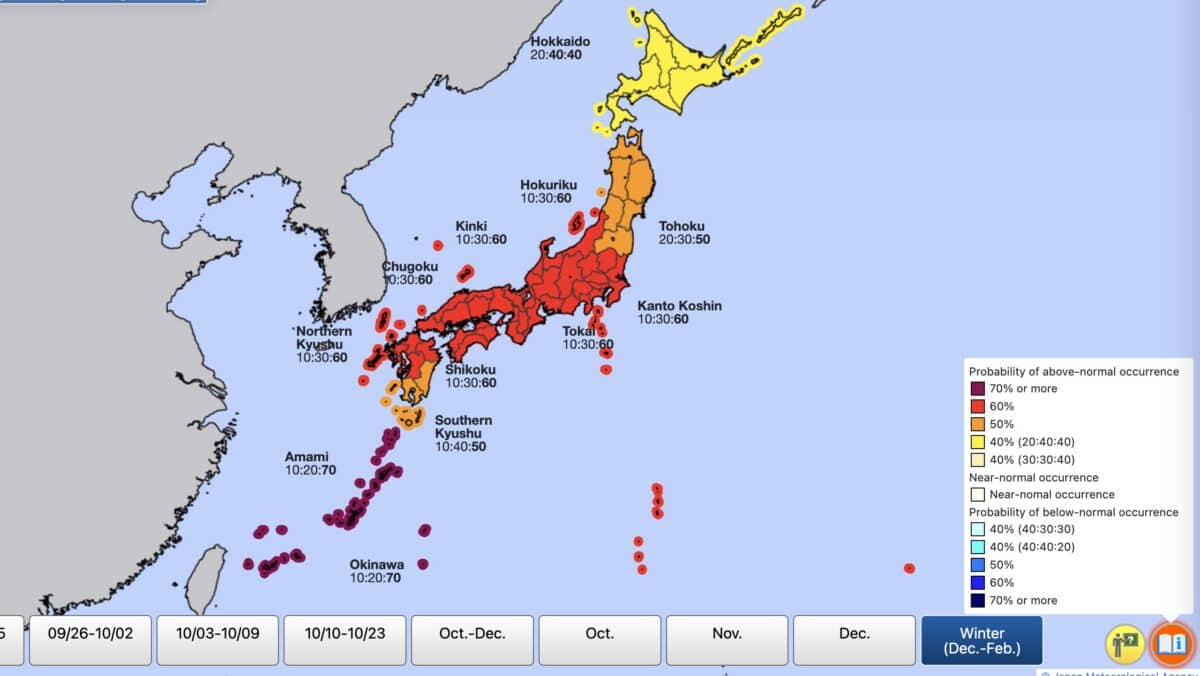
Japan’s official winter forecast is out and the early outlook favors warmer temperatures and lower snowfall odds across several of the country’s snowiest regions.
The Japan Meteorological Agency released its 2026-27 cold-season forecast Sept. 18, covering December through February. The outlook favors above-normal temperatures across much of Japan, while the Japan Sea sides of Tohoku, Hokuriku and western Japan have a 50% chance of below-normal snowfall.
Hokkaido’s outlook is less decisive but still leans away from an especially snowy winter. JMA gives the Japan Sea side of Hokkaido a 40% chance of below-normal snowfall, a 40% chance of near-normal snowfall and a 20% chance of above-normal snowfall.
For skiers planning a trip to Japan, those numbers are worth watching, but they are not a prediction that Japan will have a bad ski season.
Seasonal forecasts describe probabilities across an entire three-month period and large geographic regions. Japan can still produce major storms and extended powder cycles during a warmer or below-normal snowfall winter.
Lower Snowfall Odds Across Several Major Snow Regions
The strongest below-normal signal appears farther south.
JMA gives the Japan Sea side of Tohoku a 50% chance of below-normal snowfall, compared with a 30% chance of near-normal snowfall and a 20% chance of above-normal snowfall.
The same 50%-30%-20% split appears in Hokuriku, which includes Niigata and some of the deepest-snow areas on Honshu.
Winter temperatures in Hokuriku have a 60% chance of finishing above normal, according to the Japan Meteorological Agency’s seasonal outlook.
The Japan Sea side of the Kinki region also has a 50% chance of below-normal snowfall.
Hokkaido is slightly different. Average winter temperatures there have a 40% chance of being above normal, a 40% chance of remaining near normal and a 20% chance of finishing below normal. Snowfall on Hokkaido’s Japan Sea side carries the same 40%-40%-20% distribution for below-normal, near-normal and above-normal conditions.
That is relevant for destinations in western Hokkaido, home to some of the powder skiing that has helped make the island an international ski destination.
Nagano Is a Little More Complicated
The outlook should not be interpreted as a blanket snowfall prediction for every major Japanese ski destination.
Nagano, home to Hakuba, Nozawa Onsen and numerous other major ski areas, falls within JMA’s Kanto-Koshin region.
JMA gives Kanto-Koshin a 60% chance of above-normal winter temperatures and a 50% chance of above-normal precipitation.
However, JMA does not provide the same regional December-through-February snowfall category for Kanto-Koshin that it provides for Hokkaido’s Japan Sea side, Tohoku’s Japan Sea side and Hokuriku.
In other words, the national outlook does not support simply applying Hokuriku’s 50% chance of below-normal snowfall to Hakuba or every ski area in Nagano.
Temperature will still be important. A wetter winter does not necessarily mean a snowier winter if more storms arrive with warmer air.
A Powerful El Nino Is Driving the Forecast
One of the biggest influences on JMA’s outlook is an unusually strong El Nino.
JMA’s latest El Nino update says El Nino conditions have persisted since spring and gives the pattern a 100% probability of continuing into the Northern Hemisphere winter.
The event strengthened rapidly during the summer.
In August, sea-surface temperatures in JMA’s NINO.3 monitoring region were approximately 6.1 degrees Fahrenheit above normal. JMA says that was the largest August anomaly in its record dating to 1949, surpassing the previous August record set during the powerful 1997 El Nino.
El Nino tends to weaken the winter monsoon around Japan. That matters because some of Japan’s legendary snowfall is produced when cold continental air travels across the comparatively warmer Sea of Japan, picks up moisture and unloads snow when it reaches the mountains.
JMA’s forecast reasoning calls for weaker seasonal winds around Japan and reduced influence from cold air during the coming winter.
An earlier preseason outlook for Japan also leaned toward below-average snowfall as the developing El Nino strengthened.
What 50% Below Normal Actually Means
A 50% chance of below-normal snowfall is meaningful, but it is not the same thing as saying snowfall will definitely finish below average.
In Hokuriku, for example, JMA’s probabilities are:
Below normal: 50%
Near normal: 30%
Above normal: 20%
There is therefore still a combined 50% probability of snowfall finishing either near or above normal.
The forecast also covers the entire December-through-February period. One exceptionally snowy month can occur during an otherwise warmer or less snowy winter, and localized mountain snowfall can differ substantially from regional averages.
That distinction is particularly important in Japan, where terrain and the Sea of Japan can generate enormous snowfall differences over relatively short distances.
Japan Can Still Have Huge Powder Days
For anyone already planning a Japan ski trip, the forecast is a reason to watch the weather rather than cancel the trip.
Niseko, for example, has built its international reputation around frequent cold powder storms. The experience of skiing Niseko and its surrounding terrain remains heavily dependent on individual storm cycles rather than a seasonal national average.
The same applies across Honshu.
A warmer seasonal average does not prevent temporary outbreaks of cold air, major storms or deep mountain snowfall.
JMA is also expected to continue refining its outlook as winter approaches. The agency reviews the cold-season forecast alongside subsequent three-month forecasts, meaning the picture for December through February can change as atmospheric and ocean conditions evolve.
For now, however, Japan’s first official winter outlook clearly leans warmer, with lower-than-normal snowfall favored across several important Japan Sea snow regions.
For powder skiers accustomed to seeing endless images of “Japow,” it is an early forecast worth paying attention to.
