

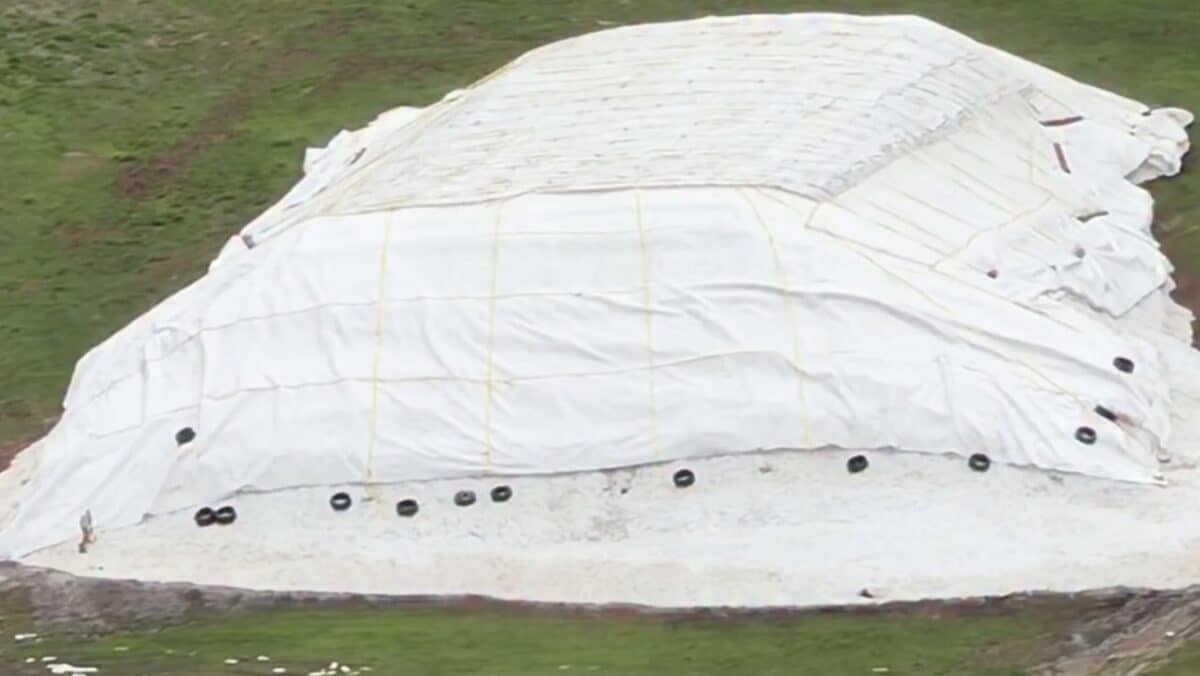
Aspen Snowmass preserved 85% of the snow stored beneath insulated blankets through the Colorado summer, according to the company behind the technology.
Snow Secure USA said Sept. 24 that drone measurements taken by Aspen management on Aug. 31 found 85% of the stored snow volume remained. The figure accounts for losses from both melting and the natural compression of the snow over the summer.
The result comes from Aspen Snowmass’s first large-scale test of Snow Secure’s insulated snow-storage system, which was deployed at Buttermilk and Snowmass last spring.
Large piles of snow were consolidated at the two mountains and covered with insulated blankets designed to protect them from summer heat and rain. The goal is to uncover and reuse the surviving snow as Aspen Snowmass prepares for the 2026-27 ski season.
Earlier this summer, resort officials said Aspen Snowmass had stored roughly 10 acre-feet of snow-water equivalent, equal to about 3.5 million gallons. Aspen was hoping to retain roughly 80% of the stored snow through the summer, making the company-reported 85% result slightly better than the original target.
Saving Snow From One Winter for the Next
The process is commonly known as snow farming.
Instead of allowing leftover snow to melt at the end of winter, resorts consolidate it into large piles and cover it with insulating material. The remaining snow can then be uncovered and redistributed before the following season.
Aspen Snowmass became the first Colorado ski resort to test Snow Secure’s system, according to the company.
The insulation faced some significant summer heat during the test.
Snow Secure said sensors on top of the covers at Snowmass recorded an average temperature of 61.8 degrees between April 30 and Aug. 31, while surface temperatures reached as high as 118 degrees.
Directly beneath the insulation, however, the snow surface averaged 33.6 degrees, according to Snow Secure’s report on the Aspen experiment.
Snow Secure CEO Antti Lauslahti said storing snow gives resorts another option when fall temperatures are not favorable for conventional snowmaking.
“Resorts cannot control the autumn weather, but snow storage gives them another way to control when they have snow available.”
Why Aspen Is Testing Snow Storage
Aspen Snowmass is evaluating the technology partly as a way to reduce the water and energy required for early-season snowmaking.
Stored snow could also provide mountain crews with a more predictable supply for terrain park construction, where significant amounts of snow are needed to build jumps, landings and other features.
That could be particularly useful at Buttermilk and Snowmass, where terrain park construction requires large volumes of snow before and during the ski season.
The experiment also follows an unusually difficult 2025-26 winter in Colorado.
Poor snow conditions contributed to Buttermilk closing earlier than planned in March, while Snowmass ended its season early on April 5.
Snow storage is only one part of Aspen Snowmass’s efforts to make early-season operations more reliable. The resort has also been making snowmaking and other mountain infrastructure improvements across its four mountains.
The stored snow is not expected to replace conventional snowmaking. Resorts still need sustained cold temperatures, natural snowfall and machine-made snow to establish and maintain coverage across the mountain. Instead, snow farming could give crews a supply of already-produced snow before temperatures become consistently cold enough for widespread snowmaking.
Aspen Snowmass has said the pilot will help determine whether snow storage makes sense on a larger scale.
The next major test will come this fall when the stored snow is uncovered and put back to use. Aspen Mountain and Snowmass are scheduled to open Nov. 26, with Buttermilk and Aspen Highlands scheduled to follow on Dec. 12, conditions permitting.
