

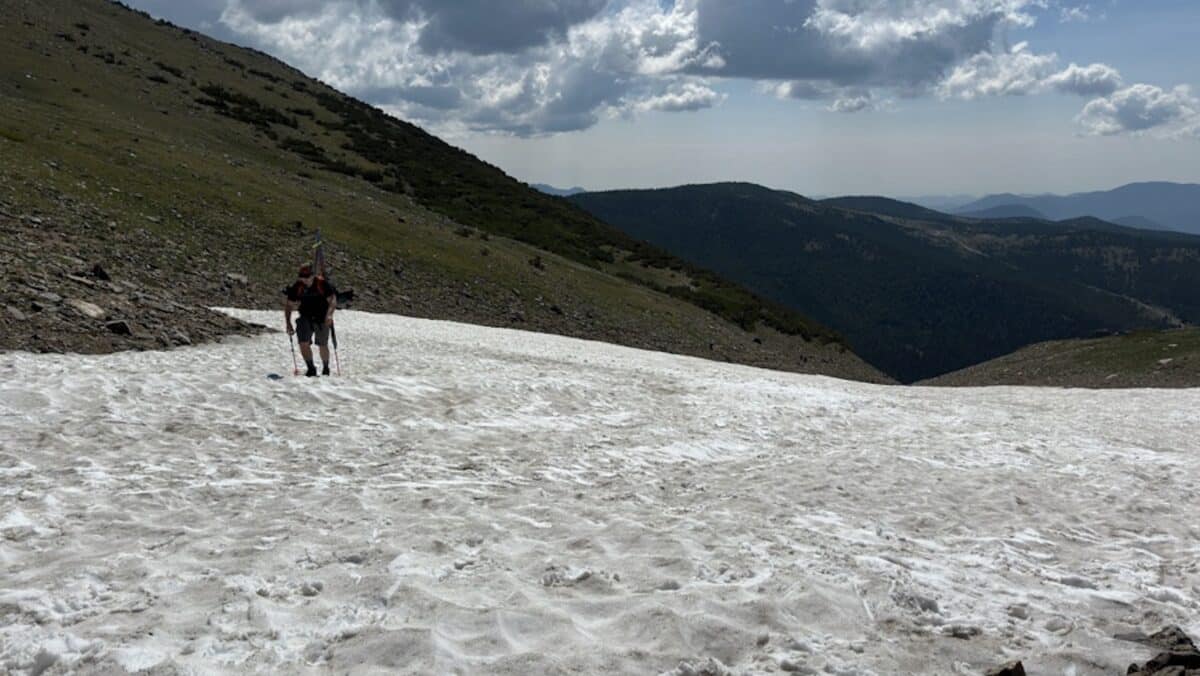
St. Mary’s Glacier, one of Colorado’s best known year-round snowfields, has completely melted away for what is believed to be the first time in at least 100 years.
The snowfield above St. Mary’s Lake near Idaho Springs entered summer following a historically poor Colorado snow season, then endured the hottest summer on record in the state. By mid-September, the remaining snow had disappeared, leaving bare rock and meltwater where snow normally survives from one winter to the next.
One thing to keep in mind is that despite its name, St. Mary’s Glacier is not technically a glacier.
The U.S. Geological Survey defines a glacier as a perennial accumulation of ice and snow that moves downslope under its own weight and gravity. St. Mary’s does not exhibit that glacial movement and is more accurately classified as a perennial snowfield.
“Perennial snowfields, like glaciers, are masses of snow and ice that persist for many years and form through the accumulation and compaction of snow. However, unlike glaciers, snowfields never grow thick enough to flow with gravity.” -National Park Service
That distinction does not change what happened this summer. A perennial snowfield, by definition, survives through the warm season and carries snow from one winter into the next. St. Mary’s did not make it this year.
Colorado entered spring with extraordinarily little snow available to survive the summer.
The Natural Resources Conservation Service reported that Colorado’s April 1 snow-water equivalent was just 22% of median. Field observations put the statewide April 1 snow-water equivalent at only 1.66 inches, less than one-third of the previous record low of 5.21 inches set during the exceptionally dry 1976-77 winter.
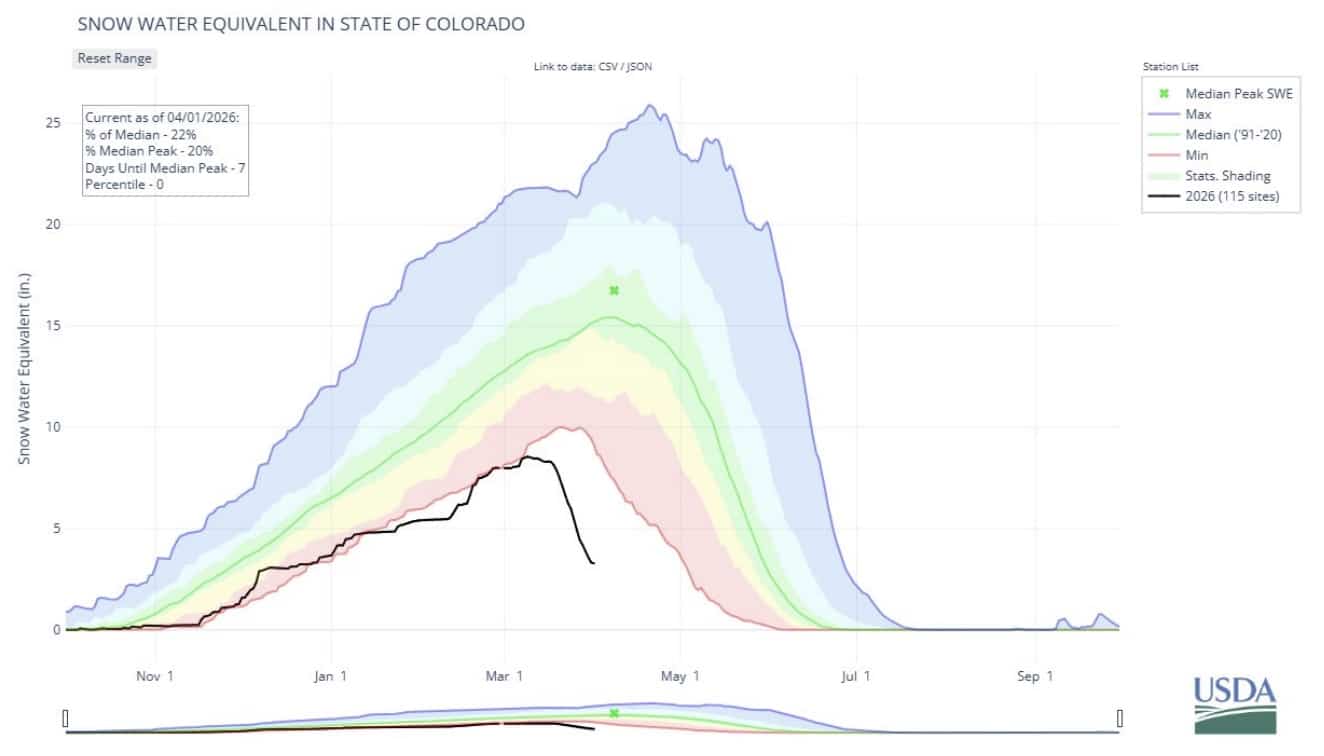
NRCS said Colorado’s snowpack peaked unusually early and then rapidly deteriorated during a record-warm March. Statewide snow-water equivalent fell from 60% of median on March 1 to about 20% by April 1 as sustained warmth accelerated melting, including at high elevations that would normally still be accumulating snow.
The problem extended far beyond Colorado. NRCS found that 65% of more than 1,500 April 1 snow measurements across the western United States either set or tied record lows in 2026. Among long-running snow courses with at least 70 years of observations, 67% recorded either their lowest or second-lowest April 1 measurement.
Whatever remained at St. Mary’s then faced exceptional summer heat.
NOAA’s National Centers for Environmental Information reported that Colorado recorded its hottest meteorological summer, June through August, in a statewide temperature record extending back to 1895. Colorado also experienced its hottest August on record.
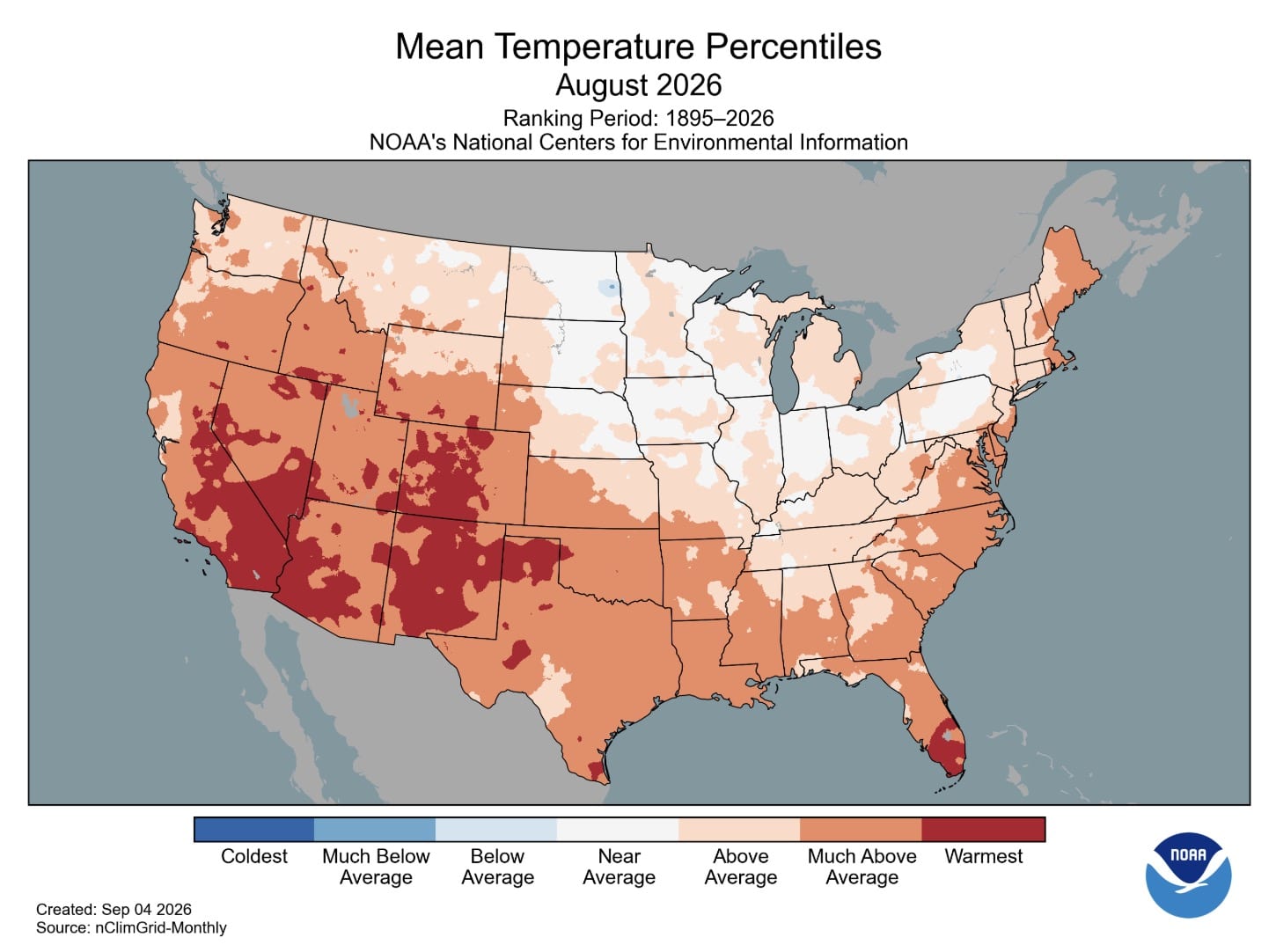
July 2026 was also the hottest month ever recorded across the contiguous United States, according to NOAA.
The combination left St. Mary’s with little margin for survival: historically low snow accumulation going into spring followed by record summer heat.
St. Mary’s has long been a recognizable piece of Colorado’s high country because snow typically remains on the slope when the surrounding terrain is bare. It has also provided an accessible destination for skiers and snowboarders looking for summer turns after Colorado’s lift-served ski season ends.
Colorado State University associate professor Dan McGrath specializes in glaciers and seasonal snow and uses field measurements and remote sensing to study changes in the cryosphere. His work includes tracking how snow and ice respond to changing environmental conditions. Colorado State University’s Department of Geosciences identifies glaciers and seasonal snow as a primary focus of his research.
The disappearance of the snowfield does not mean the slope will remain bare after winter returns.
New storms should cover St. Mary’s with seasonal snow again. The more important question is whether enough snow accumulates to survive the following summer and once again make the feature a perennial snowfield.
The USGS notes that persistent ice and snow require winter accumulation substantial enough that warm-season temperatures do not completely eliminate the previous winter’s snow. When annual melting exceeds annual accumulation, persistent snow and ice lose mass.
One snowy winter could dramatically change how St. Mary’s looks next summer. Rebuilding the deep, persistent snowfield that historically survived from year to year would require accumulation to once again outpace warm-season melting.
For now, a Colorado landmark famous for having snow on it when almost everywhere else was bare is itself bare. For the first known time in more than a century, St. Mary’s did not make it from one winter to the next.
