

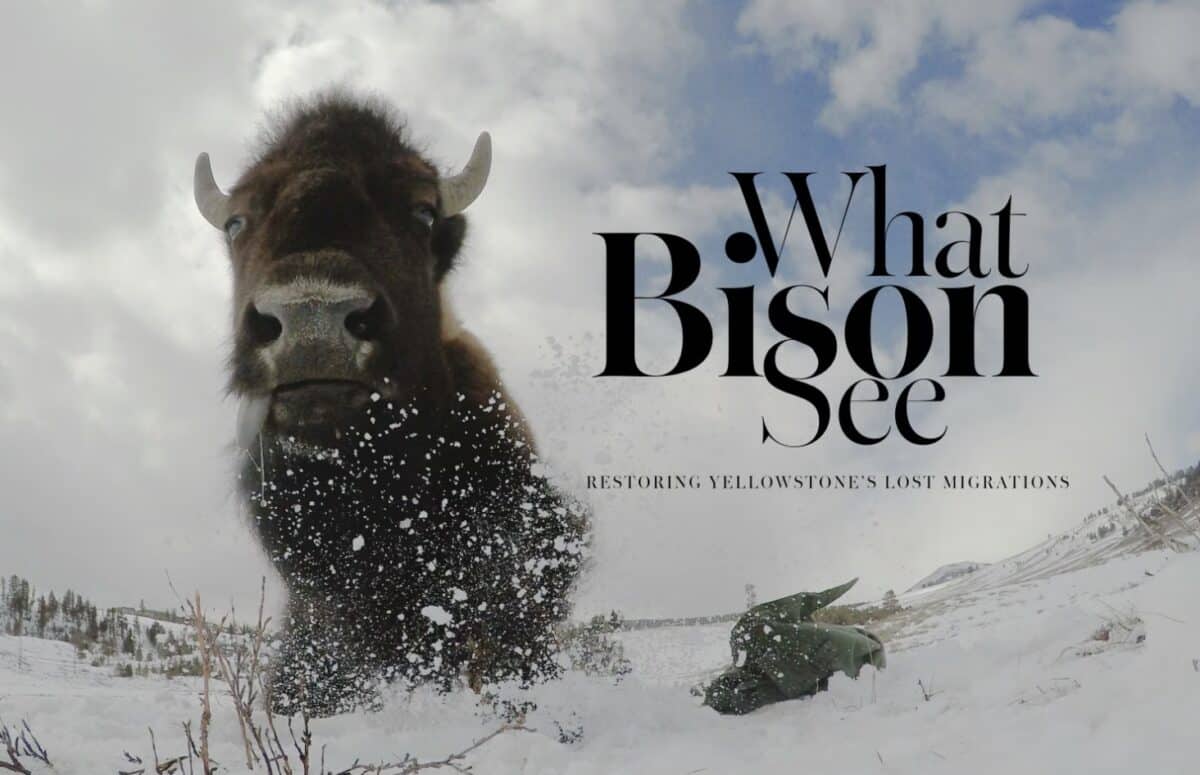
Cheers to the folks behind this new film documenting the recovery of bison migration in Yellowstone from the perspective of the animals themselves. “What Bison See” debuted on August 25, 2026 at Old Faithful Visitor Center and has an upcoming showing at 6:30PM September 11 and Buffalo Bill Center of the West in Cody, Wyoming.
To get the first of its kind footage used in the groundbreaking film, Yellowstone National Park biologists who outfitted bison with HD cameras to record their migrations. Check out the trailer:
The film traces how the National Park Service helped restore migration patterns in America’s last free roaming bison herd, following a century and a half of conservation work in Yellowstone. It also explores how Tribal led efforts are bringing the species back today.
This is likely the first documentary ever filmed using HD camera collars on Yellowstone bison. With special access from Yellowstone Park biologists, the filmmakers captured the process of capturing and GPS-collaring four female bison in northern Yellowstone. “What Bison See” reveals the science behind how these animals developed the migration routes they still follow, tracing back to the first documented winter movement in 1942, when roughly 130 bison traveled from the Lamar Valley to just outside Gardiner, Montana.
The film is especially powerful in showing the ecological value of large mammal migration. New research led by bison biologist Chris Geremia demonstrates how thousands of free-roaming bison act as ecosystem engineers, enriching and diversifying soil microbes while boosting nutrient density in plants throughout the landscape.
Recognizing what bison mean both to the land and to Indigenous peoples, Jason Baldes of the Wind River Tribal Buffalo Initiative is leading efforts to restore bison to tribal lands and their historical range in Wyoming. Yellowstone bison now form part of a herd, numbering over 200, that tribes have reestablished on Shoshone and Arapaho lands within the Wind River Indian Reservation. The film captures Baldes’ vision: not just bringing buffalo back as wildlife, but restoring their migrations as well.
That it took more than a century of hard-won progress to restore Yellowstone’s bison migrations underscores an urgent truth: the world’s remaining large mammal migrations need protection now.
The film will screen at visitor centers in Yellowstone National Park through 2028. The film is presented by Yellowstone Forever, the official nonprofit partner of Yellowstone National Park. The film was produced by Wyoming Migration Initiative at the University of Wyoming in partnership with the National Park Service.
What Bison See: Restoring Yellowstone’s Lost Migrations
Featuring:
- Chris Geremia, bison biologist, Yellowstone National Park
- Janey Fugate, researcher, Wyoming Migration Initiative
- Jason Baldes, executive director, Wind River Tribal Bison Initiative
Presented by: Yellowstone Forever
Produced in partnership with: National Park Service
A film by: Wyoming Migration Initiative at the University of Wyoming
