
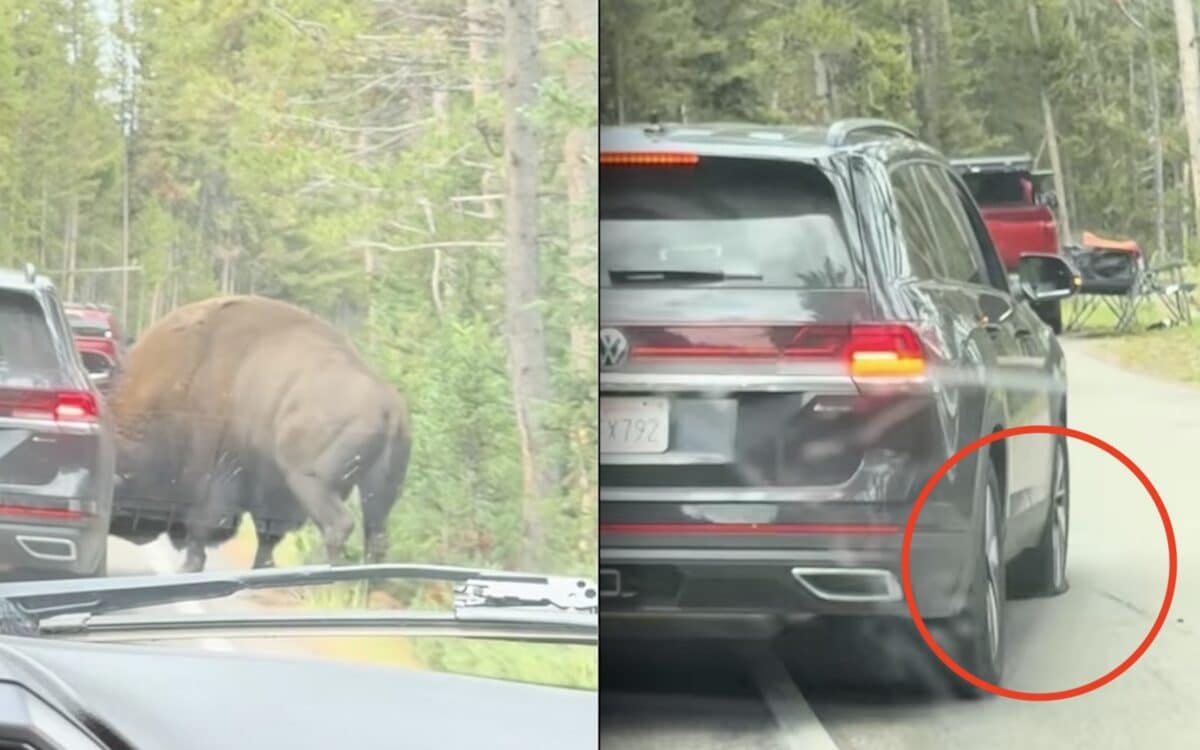
YELLOWSTONE NATIONAL PARK, Wyoming – A recent video from Yellowstone National Park captured the moment a large bison punctured a passing car’s tire. The wild encounter shows off just how powerful these massive animals can be and serves as yet another reminder of why visitors are constantly told to keep their distance.
Yellowstone’s bison population ranges from 3,500 to nearly 6,000 individuals, with an estimate in 2025 putting the number around 5,300 split between two primary breeding herds. While you’re never 100% guaranteed to see any animal during a visit to a National Park, these large numbers certainly mean the odds of spotting bison are very high, and that includes alongside roads.
Bison are massive animals, with bulls weighing up to 2,000 pounds and the cows weighing up to 1,000 pounds. In fact they’re the largest land mammals in North America. Female and male bison generally look pretty similar beyond the size difference, both having horns, though the bull horns tend to be slightly longer than cow horns. Based on the size in this video, this bison seems likely to be a bull.
It is officially the bison rut, or bison mating season. During this time, bulls tend to be quite a bit more on edge and easily agitated. If this was a male, the situation above was almost certainly made more likely by the time of year. Bison rut runs from late July through August and can be a great time to visit the park for bison viewing, though it’s vital that everyone knows how to behave safely around these massive animals.
Always Pay Attention To Bison Safety
Yellowstone generally recommends driving slowly and being patient if you encounter bison on the road, waiting for them to move along rather than honking your horn or driving aggressively toward them. Credit where credit is due, this driver seemed to be passing quite slowly when the animal attacked, but they should have left quite a bit more space and waiting for the animal to pass.
The park requires at least 25 yards of space between people and bison at all times, as the large animals are responsible for more injuries than any other animal in Yellowstone. Yellowstone’s full bison safety guidelines are available below.
Yellowstone National Park Bison Safety Guidelines:
Bison may appear tranquil, but these large animals have injured more people in Yellowstone than any other animal. They can run 3x faster than humans, making it very important to give them plenty of space.
Stay at least 25 yards away from bison
Keep at least 25 yards (23 meters) from bison at all times and never approach a bison to take a photo. If need be, turn around and go the other way if a bison walks within 25 yards.
Run away if a bison charges
If approached too closely, bison may respond by bluff charging, head bobbing while staring at you, pawing, bellowing, or raising its tail. These are warning signs that you are too close and that a charge is imminent—do not stand your ground! Immediately walk or run away from the animal. If the bison follows you, spray bear spray as you are moving away, and seek cover behind nearby trees or cars.
Drive carefully around bison
Plan extra time when driving through Yellowstone—the speed limit is 45 mph, unless posted otherwise, and you’re likely to encounter a “bison jam”. If bison are on the road, be patient, drive slowly, and stay in your vehicle. Wait for bison to move along; do not honk your horn or drive aggressively toward them.
The size and dark coloration of bison means you should be especially careful when driving at night or anytime visibility is poor.