

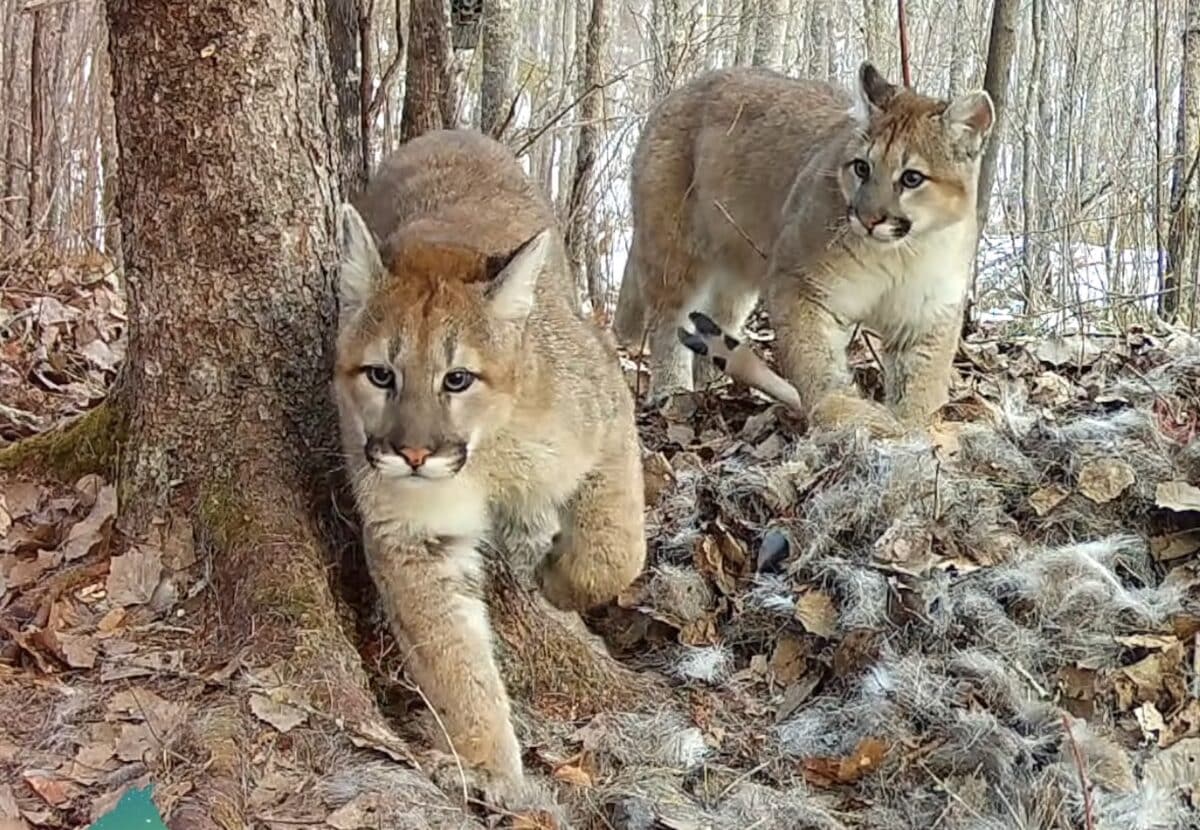
Minnesota — In a landmark discovery for Midwestern wildlife biology, researchers have captured the first documented evidence of a cougar (Puma concolor) mother with kittens in Minnesota in modern history. The footage, recorded south of Voyageurs National Park, shows a female and three large kittens feeding on a deer carcass. The discovery that challenges the long-standing scientific consensus that cougars in the Great Lakes region are exclusively transient males.
For decades, verified cougar sightings in Minnesota, Wisconsin, and Michigan have been attributed to “stepping-stone” dispersal. Research on Puma concolor population dynamics indicates that young males often travel hundreds of miles from source populations in the Black Hills of South Dakota or the North Dakota Badlands in search of new territory. Because female cougars exhibit much higher philopatry (meaning they tend to stay closer to their birth sites) the presence of a family unit suggests the potential establishment of a resident, breeding population rather than a passing wanderer.
Predation Patterns and Social Behavior
The discovery was made during a winter study of white-tailed deer (Odocoileus virginianus) survival. Researchers investigating a mortality signal from a GPS-collared deer found the carcass cached under a pile of leaves, a behavior characteristic of feline predation. While larger felids like cougars are known to “cache” their kills to protect them from scavengers, this is the first time such an event in Minnesota has been linked to a family group.
According to behavioral studies, cougar kittens remain dependent on their mothers for 18 to 24 months, during which they learn essential hunting and prey identification skills. The vocalizations captured in the 7.3 hours of footage provide rare acoustic data. Analysis of cougar bioacoustics suggests that such intraspecific communication is vital for maintaining family bonds and managing social interactions during communal feeding.
Ecological Implications for the Midwest
The presence of a breeding female is a significant indicator of habitat suitability in the northern forest. Previous models have identified the Ozarks and parts of the Upper Midwest as having the dense forest cover and low road density required to host resident populations .
As the Minnesota Department of Natural Resources (DNR) and independent researchers continue to monitor this family group, the data will be instrumental in determining if the state is witnessing a natural recolonization. The presence of apex predators like cougars can have profound effects on local ecosystems, potentially mitigating high-density deer populations and influencing the behavior of other mid-sized carnivores.
