

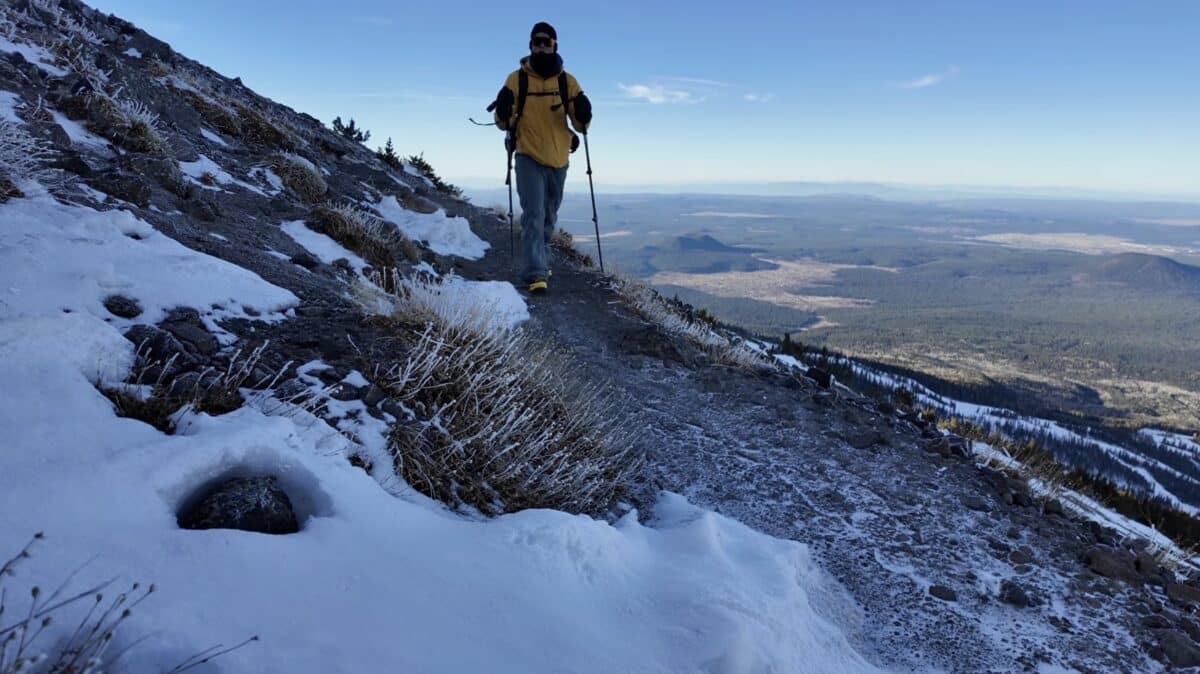
YouTube creator Topo Traveler recently climbed Humphreys Peak, the highest point in Arizona, in the dead of early March. The peak stands at 12,633 feet above the Colorado Plateau and sits within the Kachina Peaks Wilderness outside Flagstaff. He departed the trailhead at 9,313 feet at 4:30am, navigating through a frozen forest in complete darkness before encountering sustained winds of 35 mph and gusts up to 50 mph near the summit ridge.
What makes Humphreys so scientifically notable is the mountain it belongs to. The San Francisco Peaks are the remnant of a collapsed stratovolcano, a formation typically associated with convergent tectonic plate boundaries. There is no such boundary nearby so geologists believe a hot spot beneath the North American plate is responsible, similar in mechanism to the Yellowstone hot spot. The volcanic features in the region appear to grow younger moving eastward, suggesting the plate is drifting west over a stationary magma plume.
At its peak, the original San Francisco Volcano is estimated to have reached over 16,000 feet in elevation. A collapse approximately 400,000 years ago reduced it to its current form. The most recent eruption in the field occurred at Sunset Crater roughly 1,000 years ago.
The ecological significance of the peaks is also pretty major. Because the San Francisco Peaks are the only mountains in Arizona that reach the alpine zone, they harbor species found nowhere else on Earth. The San Francisco Peaks groundsel, for example, is a federally threatened plant endemic to the high talus slopes of these mountains. Bristlecone pines near treeline, some over 1,500 years old, represent the only population of the species in Arizona.
From the summit of the mountain, views stretch to the North Rim of the Grand Canyon more than 50 miles away, along with the Painted Desert, Navajo Mountain, and dozens of nearby cinder cones. It’s a seriously impressive mountain for many reasons.
