

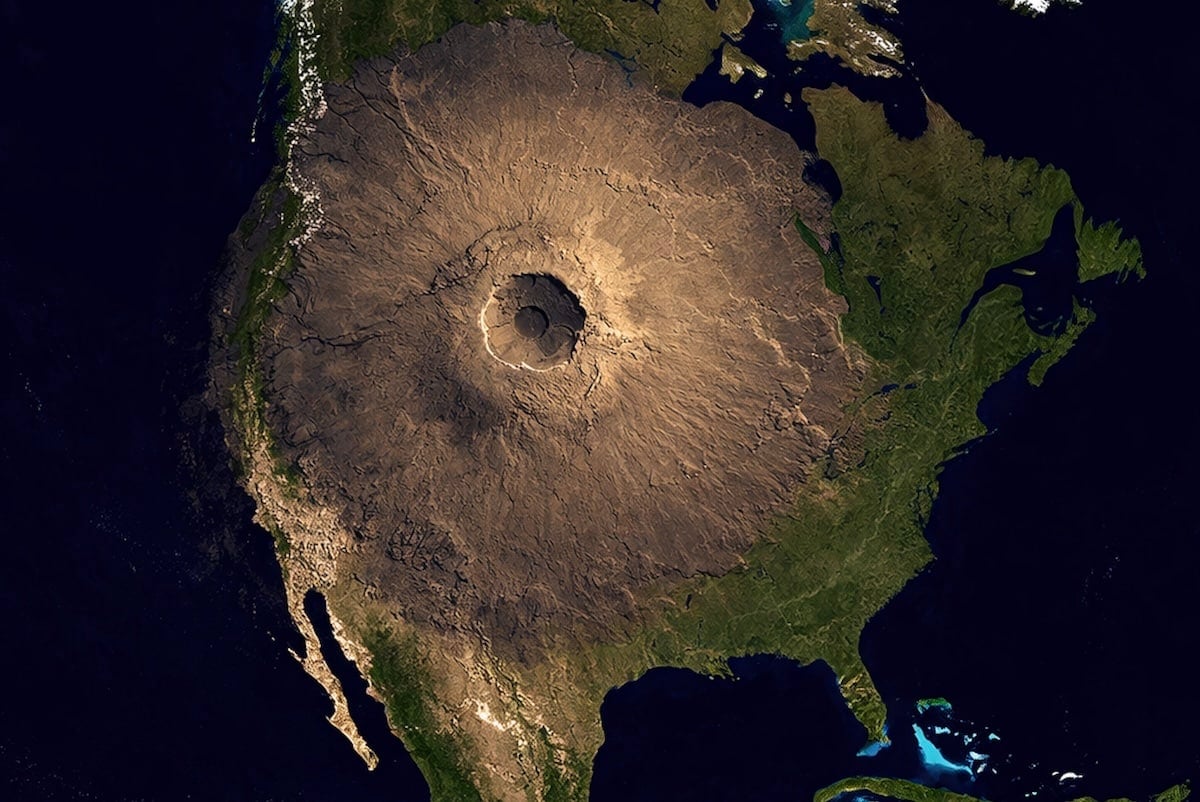
When people think of volcanoes on Mars, one name usually dominates the conversation: Olympus Mons, the tallest volcano in the solar system. But height isn’t everything. Mars is also home to a volcanic giant that dominates the planet in a completely different way.
Meet Alba Mons — a sprawling Martian volcano so wide that its footprint rivals the size of the United States.
The Largest Volcano on Mars (By Area)
Located in the northern Tharsis region of Mars, Alba Mons is a massive shield volcano formed by countless lava flows spreading outward across the Martian surface. In terms of surface area, it’s actually the largest volcano on the planet.
Lava flows from Alba Mons extend at least 1,350 km (840 miles) from the summit, creating a volcanic field that stretches thousands of kilometers across the surrounding plains.
At its widest, the volcano measures roughly:
- ~3,000 km (1,860 miles) across
- ~2,000 km north–south
- Covering about 5.7 million km² of terrain
For perspective, that’s larger than the entire area of India and comparable to the continental United States in overall span.
Surprisingly Flat for Something So Big
Despite its immense footprint, Alba Mons is not particularly tall.
The summit rises about 6.8 km (4.2 miles) above Mars’ reference level.
That’s huge by Earth standards—but only about one-third the height of Olympus Mons, which towers over the Martian landscape at roughly 22 km.
Because it is so wide and relatively low, Alba Mons has extremely gentle slopes. From orbit, its elevation is so subtle that early spacecraft images barely revealed its shape.
Planetary scientists sometimes describe it as looking like a “broad welt” on the planet’s surface rather than a dramatic mountain.
A Volcano With a Unique Shape
Alba Mons is different from other volcanoes on Mars in several ways:
Extremely shallow slopes
Its lava spread over enormous distances rather than building steep layers.
Gigantic lava plains
A central volcanic core about 1,500 × 1,000 km is surrounded by vast aprons of lava that stretch outward for another 1,000 km or more.
Massive fracture systems
Two enormous fault networks flank the volcano:
- Tantalus Fossae (east side)
- Alba Fossae (west side)
These giant cracks stretch up to 2,000 km across the Martian surface.
Scientists believe these fractures formed as the massive volcano grew and the crust flexed under its weight.
An Ancient Martian Giant
Alba Mons likely formed billions of years ago during a period when Mars experienced widespread volcanic activity. Lava erupted repeatedly from a broad magma system beneath the surface, slowly building the huge volcanic province over time.
Unlike many Earth volcanoes, which erupt explosively, Alba Mons appears to have produced long-lasting flows of extremely fluid lava that traveled hundreds of kilometers before cooling.
Those flows created the huge, gently sloping landscape that defines the volcano today.
Why Alba Mons Matters
While Olympus Mons gets the headlines for being the tallest volcano in the solar system, Alba Mons may actually be the most sprawling volcanic structure on Mars.
Its enormous size tells scientists a lot about how volcanoes form on other planets. With lower gravity and no plate tectonics like Earth, Mars allowed lava to spread across the surface for enormous distances, creating volcanoes that dwarf anything found on our planet.
And Alba Mons proves something fascinating:
On Mars, a volcano doesn’t have to be tall to be truly gigantic.