

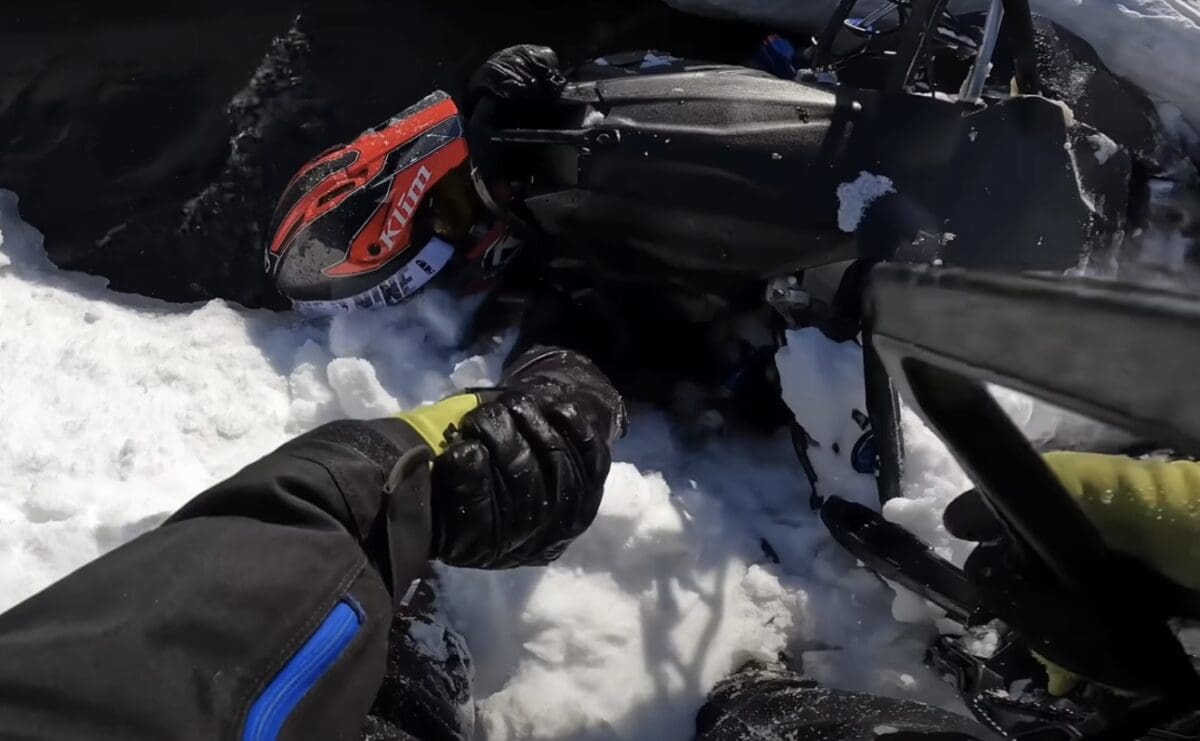
Terrifying moment for this group of snowmobilers in the interior of Alaska when one of them broke through the thin ice a frozen Chulitna River and nearly gets swept underneath the ice by a swift moving current.
You can hear the panic in the victim’s voice as struggles to keep his head above water while his friends frantically come to his rescue. After a nearly two minutes, the man was finally wrestled out of the frigid waters and survived the harrowing experience.
Heads up to all the 10 million snowmobilers across North America, drowning is a leading cause of snowmobile fatalities. If you plan on riding on ice, make absolutely sure the ice is safely frozen. Learn more about snowmobiling ice safety below:
Snow Riders Ice Safety Guidelines:
Ice can always be dangerous because of changing conditions and inconsistencies in its thickness, particularly when there is running water beneath it. The safest snowmobiling rule is to never cross lakes or rivers since ice thickness to support a snowmobile can never be guaranteed. Never venture onto lakes or rivers unless you are absolutely certain of a safe route across the frozen surface.
Never trust the judgment of other snowmobilers by simply following their snowmobile tracks across ice. You are responsible for your own safety so, if you choose to ride across ice, be absolutely certain the ice is safely frozen by testing the ice thickness.

It is critical to evaluate the ice quality and type before traveling out onto it. New ice that is clear and hard is the only kind of ice recommended for travel. Always avoid:
- Slushy ice
- Ice on or near moving water (i.e. rivers, currents, channels)
- Ice that has thawed and refrozen
- Layered or ‘rotten’ ice caused by sudden temperature changes
Other risk factors that weaken or ‘rot’ ice are:
- Snow on ice that acts as an insulating blanket that prevents hardening
- Pressure ridges in the ice due to wind, current, or ice pressure
Know and follow safe ice thickness guidelines, which apply only to new clear hard ice.
Getting Out if You Fall Through
Drowning is a leading cause of snowmobiling fatalities. If you ride on ice often, consider wearing a buoyant floatation snowmobile suit. It is also a good idea to wear a set of commercial ice picks, which have spring-loaded sleeves that cover the points and are attached to a cord so they can be threaded through the sleeves of your jacket.
If you fall through the ice, stay calm. Realize that air trapped inside your snowmobile suit (even a non-buoyant one) and helmet may help keep you afloat for several minutes. Extend your arms out forward in front of you and onto the unbroken ice surface in an attempt to catch yourself. Kick your feet to help propel you onto the ice, like a seal. If the ice keeps breaking, continue kicking and trying to move toward shore or the direction from which you came. Use anything sharp like ice picks, keys, or a knife to dig into the ice to help pull you forward. Don’t remove your gloves or mitts. Once you are on the ice, crawl or roll away from the hole. Do not attempt to stand up until you are well away from the hole.

