

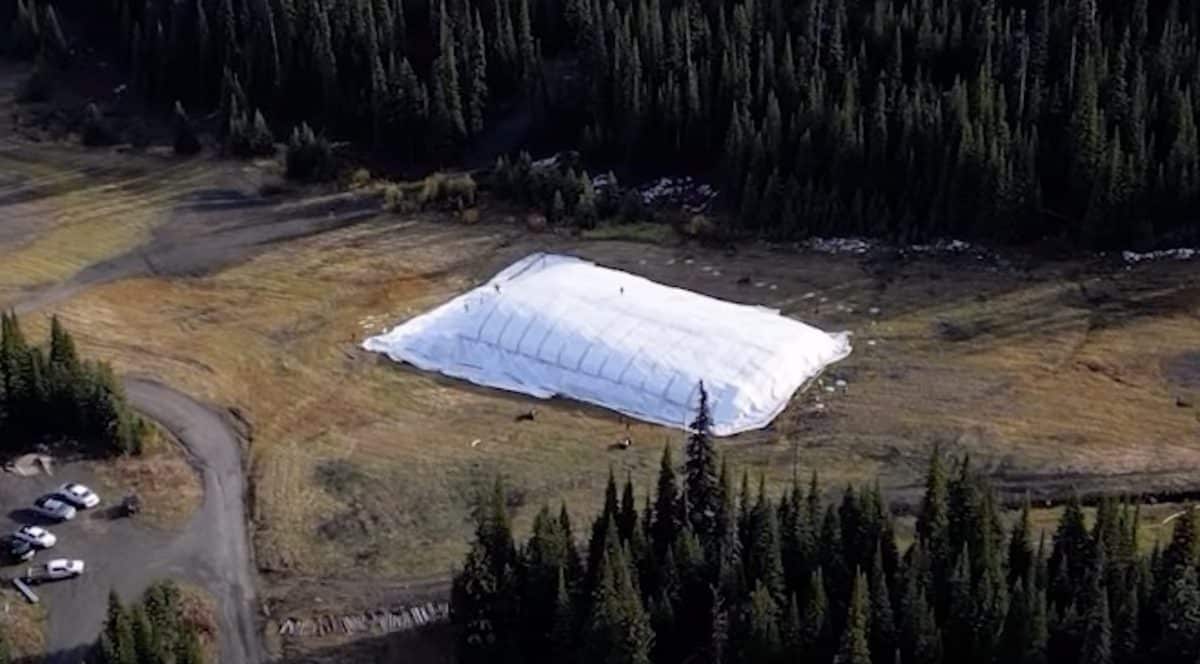
Sun Peaks Resort in British Columbia has tripled its snow storage operation after successfully preserving 85% of its snow through the summer. The Canadian ski resort now has three massive piles of preserved snow ready to help kick off the 2026-27 ski season.
Each of Sun Peak’s three snow piles measures approximately 300 feet long and 30 feet tall, with an original volume of roughly 22,200 cubic yards. Combined, the resort stored approximately 66,700 cubic yards of snow beneath specialized insulating mats on Tod Mountain.
The preserved snow is being spread across the Nancy Greene International Race Centre, where athletes are scheduled to begin training November 6, more than two weeks before the resort opens to the general public.
“More efficient and innovative snow management, more possibilities for the season ahead!” -Sun Peaks Resort
Saving Snow From One Winter for the Next
Sun Peaks first invested in snow storage technology in 2025, purchasing specialized insulated mats from Finnish company Snow Secure. The process, commonly known as snow farming, involves collecting snow at the end of the ski season, consolidating it into enormous piles and covering it with insulation to minimize melting during the warmer months.
The technology has produced some impressive results. According to Sun Peaks’ race center information, the snow beneath the insulated mats registered a surface temperature of just 34 degrees even when the outside air temperature reached 95 degrees.
After successfully storing one pile of snow in 2025, the resort expanded to three storage sites this year. Sun Peaks says it has now invested close to $500,000 in the system.
More Snow for Early-Season Skiing
The benefits extend beyond the race course. By using preserved snow to establish early-season training lanes, Sun Peaks can dedicate more of its snowmaking equipment, water and manpower to preparing other parts of the mountain, including the popular 5 Mile run and beginner learning areas.
The snow storage program complements a separate six year, $5.5 million snowmaking improvement plan, now in its third year. That project includes additional automated snow guns, expanded weather monitoring and infrastructure upgrades designed to make snowmaking more efficient.
Sun Peaks isn’t alone in experimenting with the technology. Colorado’s Aspen Snowmass reported preserving 85% of its stored snow through summer during its first large-scale test of Snow Secure’s system.
While snow farming obviously can’t replace natural snowfall and traditional snowmaking, preserving snow from the previous winter gives ski resorts a super useful head start when fall temperatures aren’t cooperating.
Sun Peaks, Canada’s second-largest ski area with approximately 4,400 acres of terrain, is scheduled to open to the public November 21 for its 65th winter season.
