

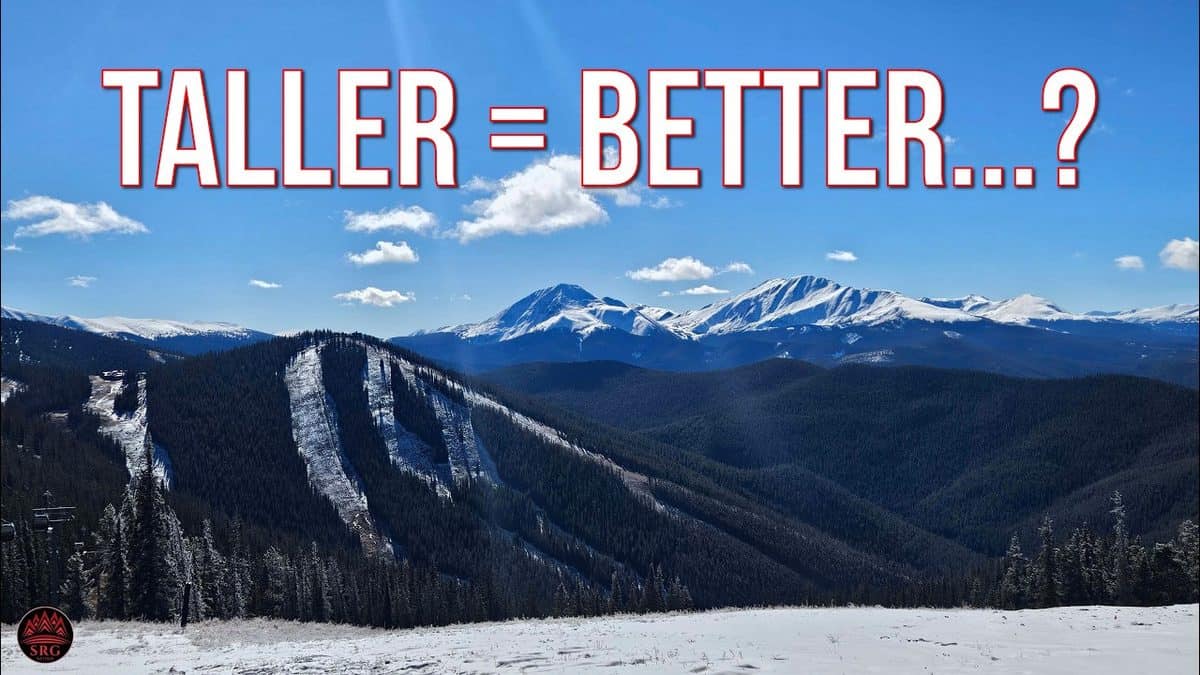
Skiers love comparing statistics. Whether it’s vertical feet, number of runs, distance traveled, or maximum speed, tracking apps have made it easier than ever to measure just about everything from a day on the mountain. But what do those numbers actually mean, and how impressive are they?
SRG Skiing recently broke down some of the most common statistics in skiing, explaining how resorts use them, where the numbers can be misleading, and what they mean for the average skier.
Not All Mountain Statistics Are Created Equal
One of the most commonly advertised resort statistics is vertical drop, which measures the difference between the highest and lowest in-bounds points of a ski area. Revelstoke is frequently cited as having North America’s largest lift-served vertical drop at 5,620 feet.
However, that doesn’t necessarily mean every resort allows skiers to experience its advertised vertical in one continuous run. Some mountains require multiple lifts to connect their terrain.
Skiable acreage can also be misleading. North American resorts typically measure terrain in acres, while European destinations generally use kilometers of marked trails. These measurements aren’t directly comparable, as acreage can include ungroomed woods and open bowls. Other frequently advertised statistics, including annual snowfall, trail counts, and lift capacity, also require additional context.
For example, a resort might advertise hundreds of inches of annual snowfall, but snow quality and storm frequency can make a significant difference. Snow-water equivalent helps explain this, measuring how much water is contained in a given amount of snow. Lighter snow produces more inches from the same amount of water.
What Makes An Impressive Day Of Skiing?
The video also tackles the statistics skiers track themselves. According to tracking app data discussed in the video, an average ski day typically produces between 10,000 and 20,000 feet of vertical. That makes 10,000 meters of vertical, equivalent to just over 32,800 feet, an impressive accomplishment.
However the difficulty of reaching that number depends heavily on the mountain. Skiing groomed runs with high-speed lifts and minimal lines is very different from accumulating the same vertical on challenging off-piste terrain or at a smaller resort with slower lifts. Other useful measurements include distance traveled, number of runs, moving time, and average speed.
The only statistic you should really care about on the mountain is how much fun you’re having on a scale of 1-10.