

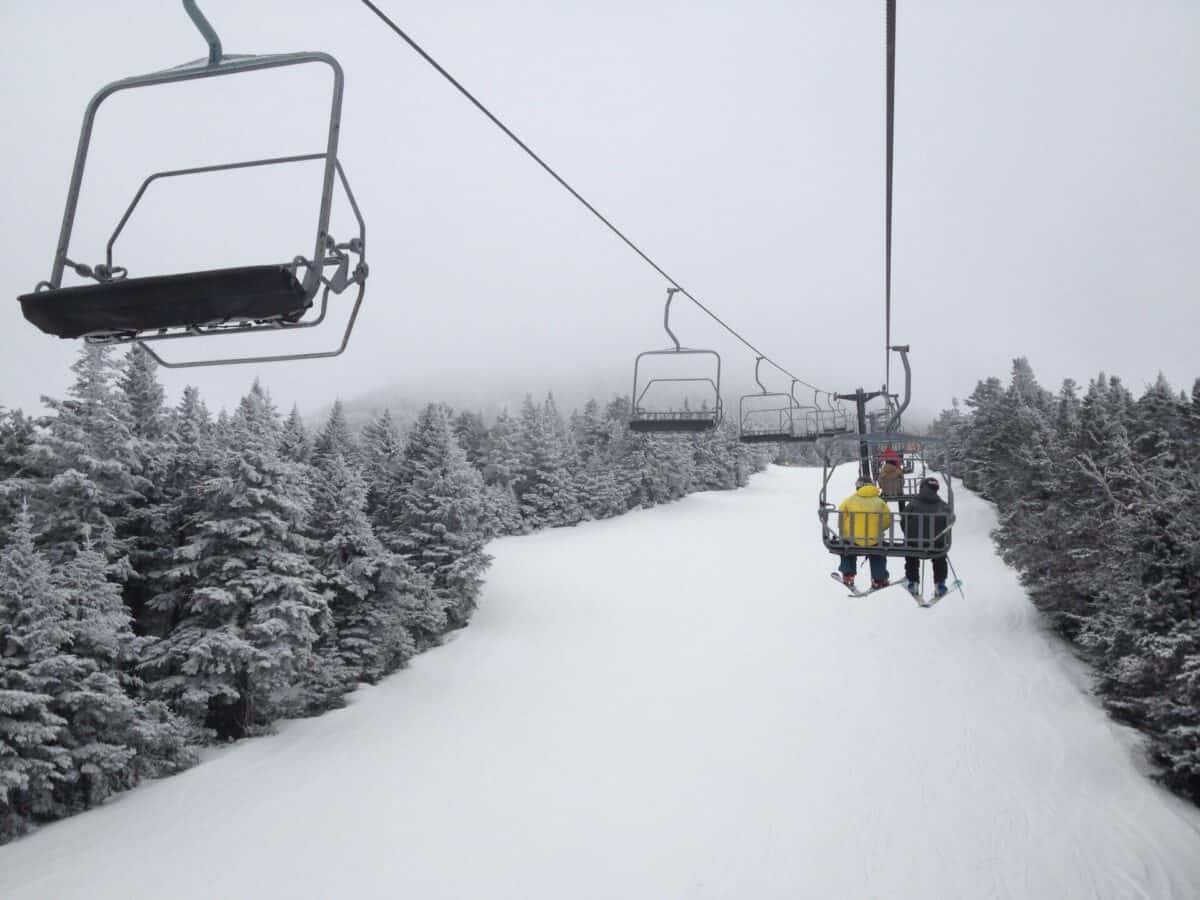

Killington opened November 17, first in New England again, and the new Snowdon Quad is the headline. But the lift is only half of what changed on that side of the mountain this summer — and the other half, buried in a pipe trench, may matter more over a full season.
What the new quad changes for Snowdon laps
The Snowdon Triple ran for 53 seasons, from 1973 until its last spin on March 21, 2026. Its replacement is a Doppelmayr fixed-grip quad — and that choice was deliberate, not a cost compromise.
Here is what actually changes when you lap it:
- 33% more uphill capacity than the triple
- A slightly faster ride than its predecessor, though still slower than the neighboring Snowdon Six Express
- A backup generator that can run the lift at full speed during a power outage
- Roughly a $7.5 million project
Killington’s reasoning is worth repeating because it cuts against the industry default. The resort says keeping Snowdon fixed-grip is part of a long-term strategy to maintain fixed-grip access across the mountain, since fixed-grip lifts generally hold up better when the weather turns. On a Vermont peak that gets wind-held with some regularity, the lift that keeps turning in a 50 mph gust is worth more than the one that would have been 90 seconds quicker on a bluebird Tuesday.
So the realistic read for skiers: Snowdon becomes a more dependable, higher-throughput pod rather than a faster one. On the days when the Six Express is on wind hold and the K-1 line is 20 minutes deep, that is where the upgrade pays off.
We tracked this build all year, from crews blasting tower and terminal foundations in May to the towers going up in September and the final push in November.
The snowmaking half of the project
While the lift went in, Killington ran new pipeline and roughly 23 new low-energy snowguns along Conclusion — a trail that, by the resort’s own account, had not seen active snowmaking in around a decade.
That is the detail that tells you how the terrain-opening plan is meant to work. A new lift with 33% more capacity is a liability if the trails under it cannot be covered on demand; you move more people onto the same two open runs. Pairing the quad with snowmaking on Conclusion means the pod can be opened as a pod — lift and trail network together — rather than a lift sitting over mostly natural-snow terrain waiting on the weather.
Separately, ongoing pipeline replacement work at Bear Mountain is aimed at delivering more reliable snowmaking to trails including Upper Wildfire. Two higher-capacity fan guns also went in on Mouse Trap and Skyeburst, replacing existing guns that will be relocated later.
All of it sits on top of the 1,044 low-energy snowguns Killington finished implementing last season — the investment the resort credits for once again delivering the longest season in the East.
What we would still like to hear from the snowmaking crew: where Conclusion and Upper Wildfire fall in the priority order once the World Cup build is done, and whether the new Conclusion coverage is intended to accelerate Snowdon’s opening date or mainly to protect it late in the season. We will update this post if Killington’s mountain operations team shares that sequencing.
The season around it
This is Killington’s third winter under independent ownership. The owners have committed more than $80 million in capital improvements so far and plan another $200 million over the next decade.
Opening day ran on the K-1 Express Gondola and North Ridge Quad, serving Rime, Reason and Upper East Fall, with roughly eight features in Reason Park. Attention now turns to the Stifel Killington Cup — the resort received positive snow control for the November 28-29 World Cup races after a warm stretch nearly derailed them.
Over at Pico, the retired Outpost Double is being covered this winter by a temporary rope tow, with a new chairlift targeted for 2027-28 — Pico’s 90th anniversary.
Full details are in Killington’s opening day release and its capital improvements rundown. See also our breakdown of the $280 million plan for Killington and Pico.