
The Wallis Annenberg Wildlife Crossing in Southern California is getting closer to opening, and scientists are preparing to monitor how animals use the massive structure. In early November, biologists with Santa Monica Mountains National Recreation Are will install remote wildlife cameras to document animal activity at the crossing ahead of its scheduled opening on December 2, 2026.
The cameras will help researchers identify which species approach and cross the structure, when they use it, and how wildlife responds to the newly restored connection between the Santa Monica Mountains and Simi Hills.
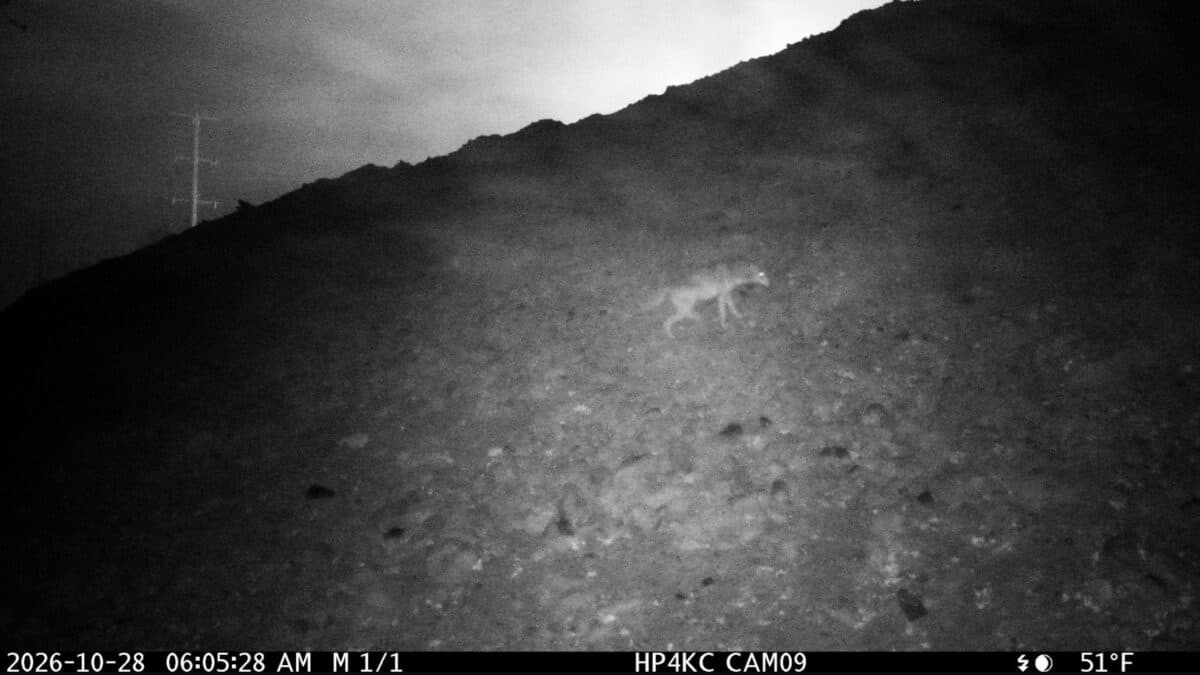
The first animal has already been photographed at the unfinished crossing. On October 28, scientists captured an image of a coyote climbing the structure’s southern slope. Researchers have also regularly observed bobcats, coyotes, gray foxes, mule deer, and mountain lions using a nearby trail during construction.
A Major Wildlife Connection Over the 101 Freeway
Located near Liberty Canyon in Agoura Hills, the Wallis Annenberg Wildlife Crossing is a large, vegetated overpass spanning the 101 Freeway and adjacent Agoura Road. The freeway carries more than 300,000 vehicles daily, creating a significant barrier between wildlife habitats.
The project has been in development for more than a decade and involves several partners, including the National Wildlife Federation, Mountains Recreation and Conservation Authority, Caltrans, and the National Park Service.
The camera installation is part of a broader scientific monitoring program featuring 14 research objectives. Beyond documenting animal activity, scientists will examine genetic diversity, vegetation communities, light and sound, and other indicators of ecological health.
“This is more than just about whether animals use the crossing. We want to understand how effective it is in reconnecting an ecosystem that has been divided by the freeway for decades. That is a much bigger scientific question and answering it will take years.” – Seth Riley, the wildlife branch lead at Santa Monica Mountains National Recreation Area.
That research will take years to complete. Scientists have studied wildlife movement and habitat fragmentation in the region since 1996, establishing baseline data before construction that will help measure the crossing’s long-term effectiveness.
Images captured by the new cameras will eventually be made publicly available, although they will not be shared in real time for security reasons. The Wallis Annenberg Wildlife Crossing is scheduled to officially open to wildlife on December 2, 2026.