
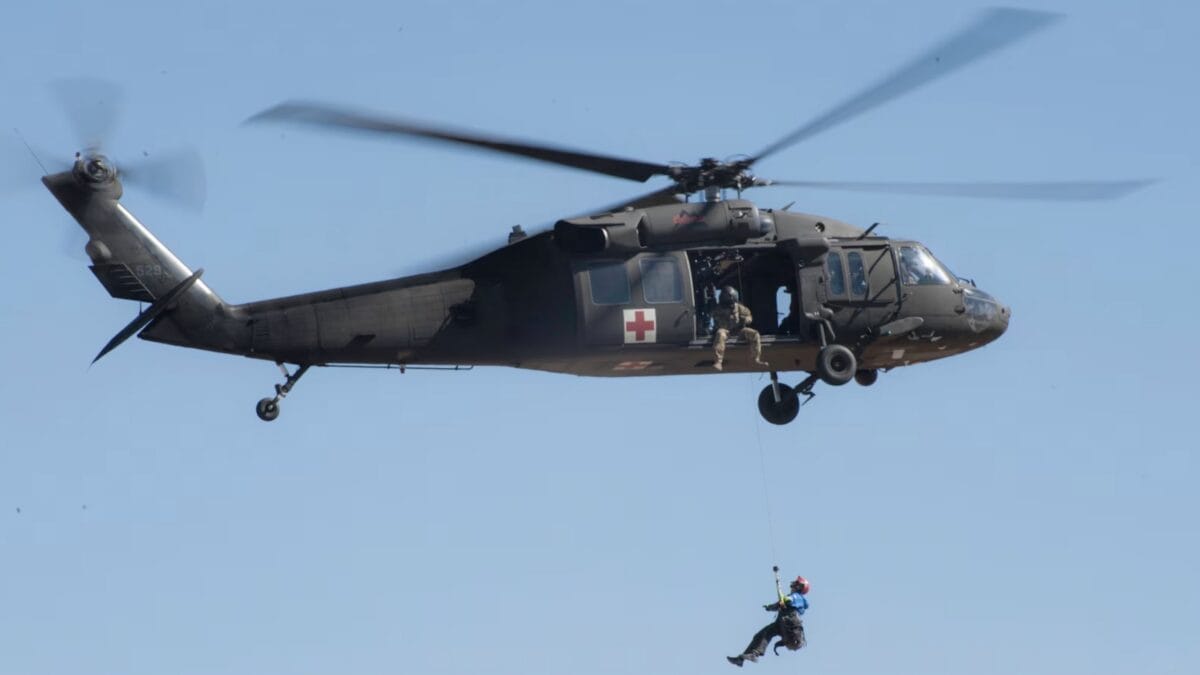
A Colorado Army National Guard UH-60L Black Hawk helicopter suffered a blade strike while attempting to rescue an injured hiker near Nederland, Colorado, on Saturday night, October 31. The incident forced the aircraft to make a precautionary landing, but all five people aboard escaped without injuries.
The rescue operation began around 4:18 p.m. after the Boulder County Sheriff’s Office received a report of an injured hiker in the Diamond Lake area west of Nederland. The 38-year-old man had been hiking alone when he reportedly fell, sustaining multiple injuries, including suspected fractures to his lower extremities.
Helicopter Incident During Rescue Attempt
Due to the remote location and extremely steep, technical terrain, rescue personnel determined that an aerial extraction would provide the safest way to reach the injured hiker. Rocky Mountain Rescue Group and Nederland Fire Protection District deployed ground teams while aviation crews conducted reconnaissance and planned the extraction.
At approximately 10:15 p.m., a Colorado Army National Guard UH-60L Black Hawk experienced a blade strike on nearby obstacles while conducting a hoist rescue attempt. Three Colorado National Guard soldiers and two civilian rescue technicians were aboard the aircraft. Nobody was injured.
The crew successfully landed the helicopter in a field several miles east of the incident site near the Fourth of July Trailhead at Buckingham Park. No injuries were reported on the ground.
According to the National Guard, the Black Hawk will remain at the trailhead until a safety investigation is completed and a maintenance plan is established. National Guard personnel are also remaining on scene to secure the aircraft and protect public safety. The Fourth of July Trailhead and surrounding area have been closed to the public while recovery operations are conducted.
Second Helicopter Completes the Rescue
With the Black Hawk out of service, additional aviation resources were requested to complete the mission. Approximately two hours after the incident, a UH-72B Lakota helicopter launched from the Army Aviation Support Facility at Buckley Space Force Base in Aurora.
At approximately 12:21 a.m. on November 1, the Lakota successfully hoisted the injured hiker from the mountainside and transported him to a landing zone at Nederland High School. He was then transferred to an American Medical Response ambulance and taken to a hospital in Boulder for further evaluation and treatment.
The entire rescue required more than eight hours of coordinated work involving local rescue agencies, aviation personnel, and incident command staff. Darkness, steep terrain, and the complexity of the extraction made the operation particularly challenging.
Colorado Army National Guard Maj. Gen. Robert Davis praised the crew’s response, expressing gratitude that everyone aboard the Black Hawk returned safely.
The National Guard also clarified that the helicopter incident was unrelated to the ongoing flood response search and rescue missions in southwest Colorado.