

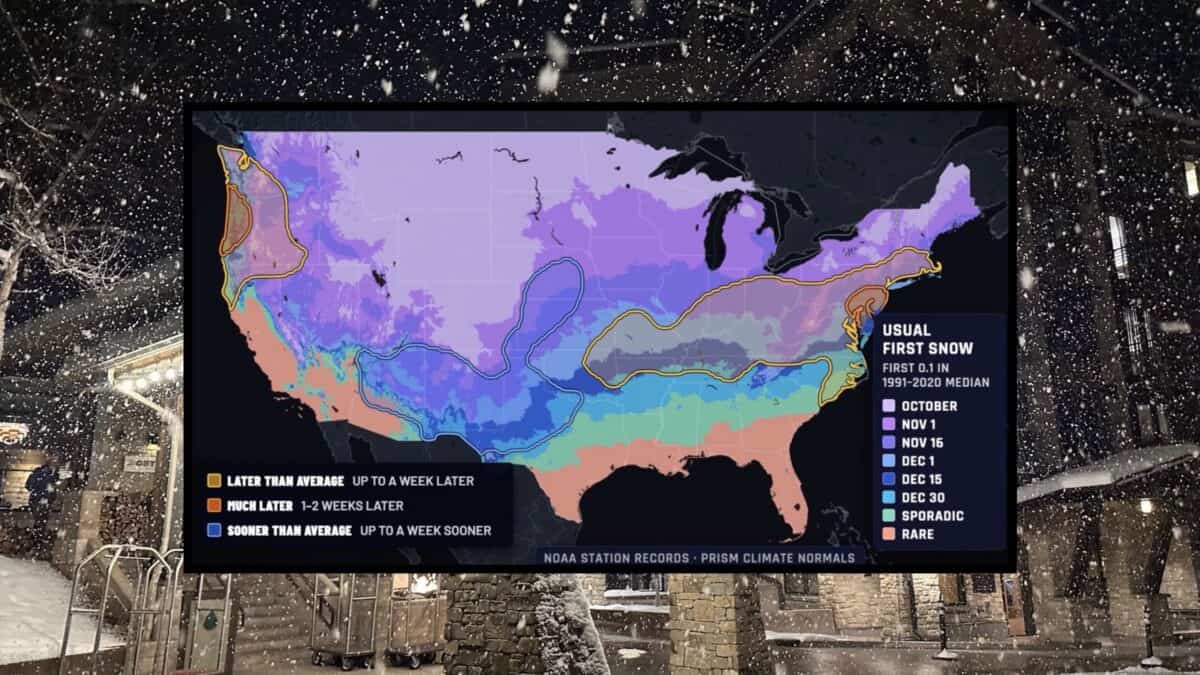
The first measurable snowfall of the season you see will highly depend on where you live. Elevation, latitude, and plenty of other aspects impact when a region will see snow, and meteorologist Ryan Hall took a look at the current weather patterns and historical snowfall record to determine when each region of the country is likely to see its first snowfall. For his analysis, measurable snowfall means at least 0.1 inches on the ground.
The forecast comes as El Niño continues to strengthen in the Pacific. Hall noted that the ocean region used to monitor the phenomenon recently reached a weekly temperature anomaly of 3.1 degrees Celsius, the highest weekly reading ever measured.
Northern Rockies and Northern Plains
The northern Rockies and northern Plains could see their first snow arrive close to normal, according to Hall. He expects the timing to potentially run slightly later than average, despite some locations normally seeing their first measurable snow in October.
Cheyenne typically sees its first snow around October 6th, while Fargo and Billings are also among the locations that can see snow relatively early in the season.
Hall pointed to conflicting signals in the region. Current forecasts suggest a warm start to October, while historical data from major El Niño winters shows some locations receiving their first snow early.
Utah and the Intermountain West
Salt Lake City, Boise and surrounding areas are also facing a potentially warm start to October. Hall said the odds of warmer than normal temperatures between October 5th and October 11th could reach 80 percent in some areas.
Despite that warmth, Hall’s analysis does not point toward a dramatically delayed first snowfall across the broader western region. He expects much of the northern Rockies to remain close to normal, with a slight lean toward later than average.
Southwest and Southern Rockies
A different scenario could unfold across the Southwest and portions of the southern Rockies. New Mexico, Arizona, the Texas Panhandle, southeast Colorado and central Kansas are areas where the first measurable snowfall could arrive earlier than normal.
His analysis suggests these areas could see their first snow up to a week earlier than average, and historical data from strong El Niño winters showed a tendency toward earlier snowfall in these areas.
Some mountain peaks in the southwest have already seen measurable snowfall, including ski resorts like Arizona Snowbowl in Arizona and Brian Head Resort in Utah.
Midwest and Great Lakes
The northern Midwest and Great Lakes are expected to remain relatively close to normal. Hall noted that locations including Minneapolis, Chicago, Indianapolis and Detroit typically see their first snow between October and late November.
He also cautioned that the developing El Niño pattern may have less influence on early season snowfall across the northern tier because its influence on the storm track becomes more significant later in winter.
Ohio Valley and Northeast
The Ohio Valley and Northeast stand out as areas where Hall expects a substantially later start to measurable snowfall.
His forecast places Oklahoma and Missouri through Tennessee, the Ohio Valley and the East Coast as a broad zone where first snow could arrive several days to roughly a week later than normal.
Baltimore, Philadelphia, Delaware and South Jersey are among the locations where the delay could be even greater. Hall estimates these areas could see their first snow one to two weeks later than average. New York City is also included in the later than normal zone.
Pacific Northwest
Western Oregon and Washington are also included in Hall’s delayed snowfall zone. Seattle and Portland could see their first measurable snow arrive several days to roughly a week later than normal. The Willamette Valley stands out as an area where the delay could reach one to two weeks or potentially longer.
Note that this forecast is meant to supplement the official weather forecasts. For the most reliable and up-to-date weather information, check out your local National Weather Service station.
