

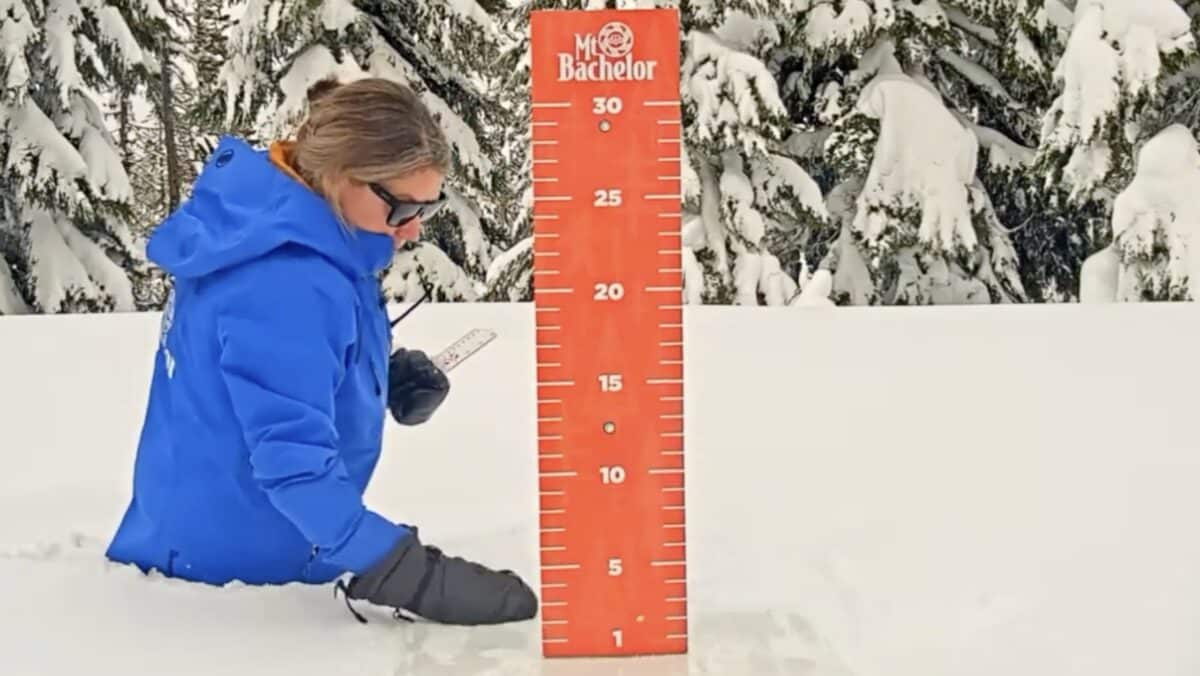
It’s a growing trend these days that ski resorts go through their own independent weather data and issue individual long range forecasts and we love it. Big Sky recently analyzed more than three decades of snowfall records collected by Big Sky Ski Patrol to see how much its snowfall actually varies from season to season and now Mt. Bachelor is following suit.
With an unusually powerful El Niño developing ahead of the 2026-27 ski season, Mt. Bachelor dug through more than three decades of its own snowfall and operating records to see what previous El Niño winters have actually looked like in Central Oregon. The results offer some reason for optimism, but they also reinforce just how little a broad climate classification can tell us about one specific ski season.
Mt. Bachelor identified three previous “Super El Niño” seasons in its records: 1982-83, 1997-98 and 2015-16. Across those winters, the resort averaged 427 inches of snowfall and 204 operating days, or roughly 6.5 months of skiing and snowboarding. When Strong El Niño winters are added to the sample, the average drops to 376 inches of snowfall and 194 operating days, still within 26 inches of the resort’s current annual snowfall average.
Three Super El Niño winters looked pretty good at Bachelor
One of the strongest El Niño events on record occurred during the 1982-83 winter, and it was also a very snowy season at Mt. Bachelor. The resort opened Nov. 12 that year and received more than 500 inches of snow, well above its roughly 398-inch annual average during that era.
Combined with the 1997-98 and 2015-16 seasons, the three Super El Niño winters produced Bachelor’s 427-inch average. That works out to roughly two feet more snow than the resort’s current annual average.
There is one obvious limitation: three winters is a very small sample.
Mt. Bachelor readily acknowledges that point and says its mountain operations team does not put too much weight into seasonal outlooks when making actual operating decisions.
“Nothing is more humbling than trying to forecast the weather at Mt. Bachelor,” said Betsy Norsen, the resort’s senior mountain operations and snow safety manager, who is entering her 27th year at Bachelor.
The resort instead relies on a combination of shorter-range forecasts, weather observations and on-mountain data, while treating long-range outlooks as one piece of a much larger puzzle.
La Niña produced Bachelor’s best and worst recent winters
Mt. Bachelor’s data gets even more interesting when the resort looks at winters since 2010.
During that period, Bachelor recorded nine La Niña seasons that averaged 462 inches of snowfall. Four El Niño seasons averaged 355 inches, while three neutral seasons averaged 373 inches.
At first glance, that would appear to make La Niña the clear winner for Bachelor skiers. The individual seasons tell a very different story. Bachelor’s snowiest winter during that stretch came during the 2010-11 La Niña, when the mountain recorded 665 inches. Last winter was also classified as La Niña, yet the resort received just 206 inches.
That’s a 459-inch difference between two winters carrying the same broad climate classification.
