

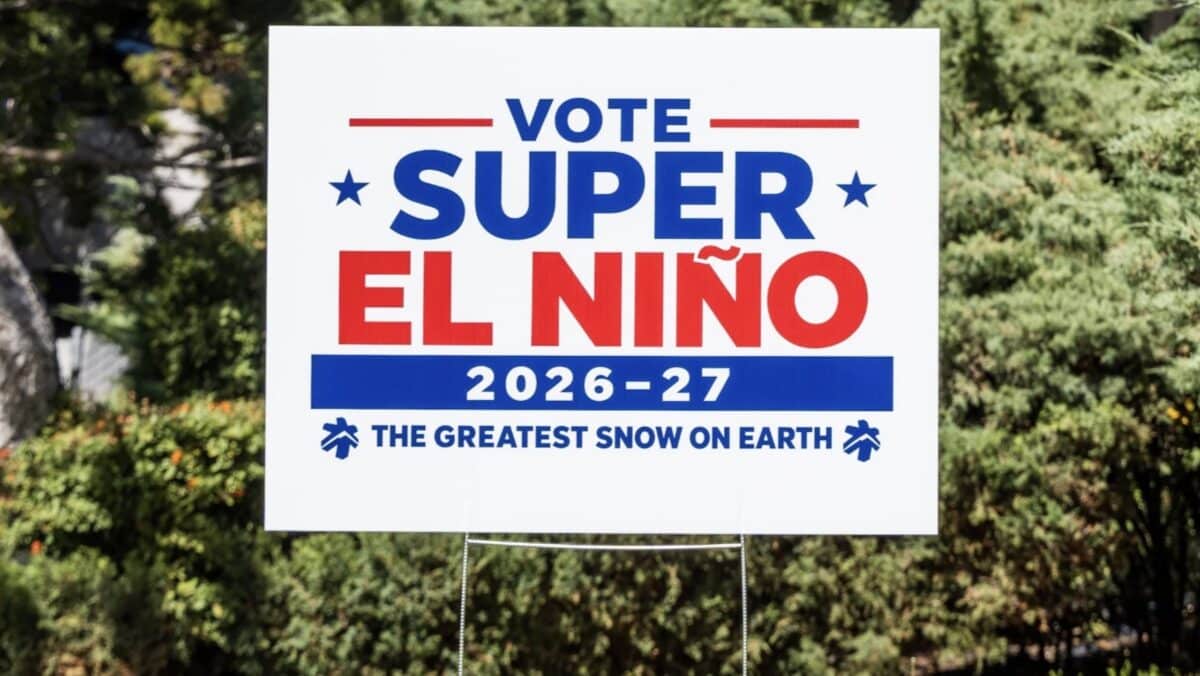
Utah’s ski industry is backing an unusual candidate this election season: “Super El Niño.”
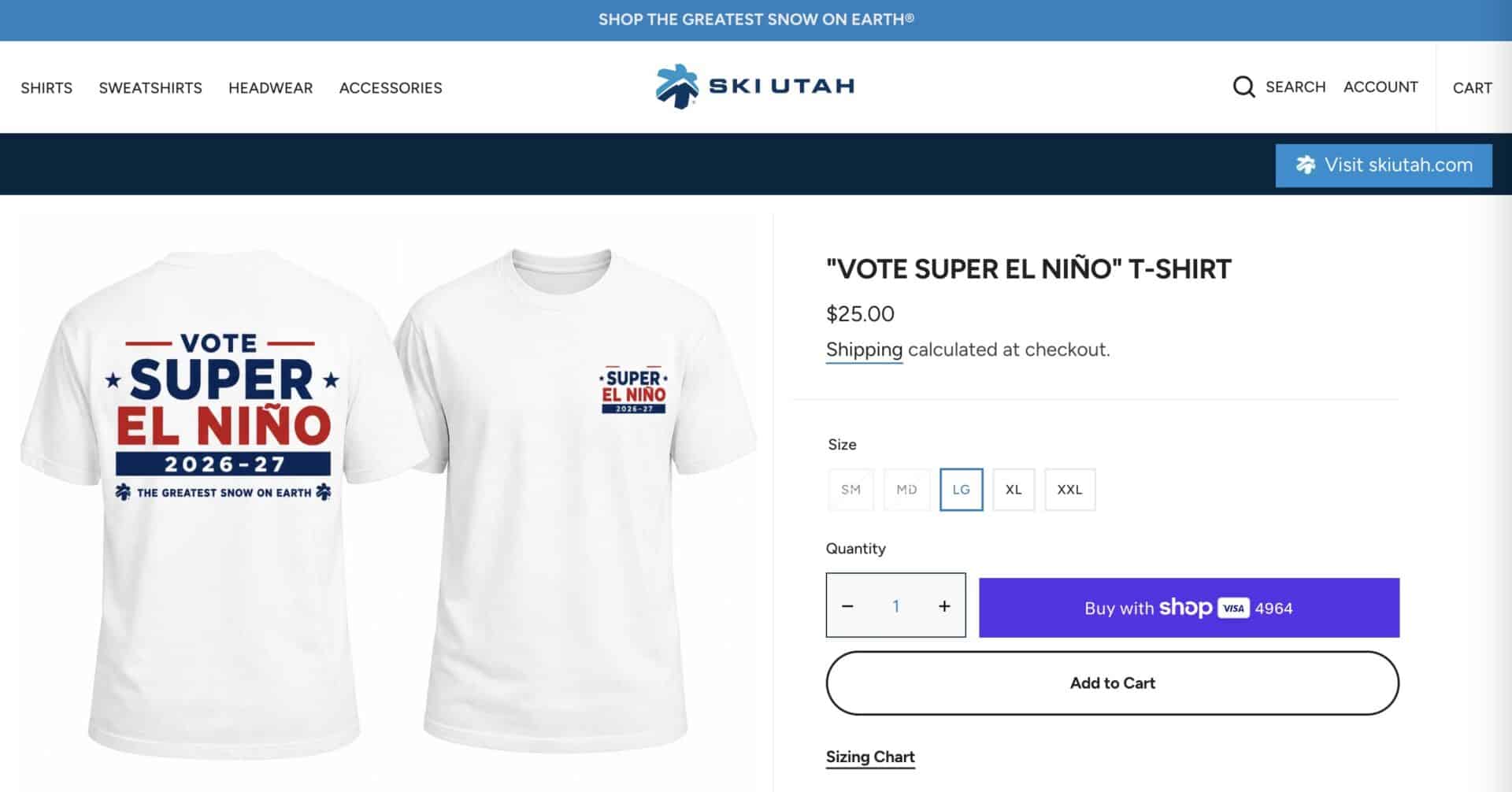
Ski Utah has rolled out a tongue-in-cheek “Vote Super El Niño” campaign ahead of the 2026-27 ski season, complete with campaign-style signs and merchandise. The organization’s official store is already selling “Vote Super El Niño” shirts, while lawn signs carrying the same message have begun appearing around Utah ski country.
The joke arrives at an understandable time.
Utah is coming off one of its poorest snow seasons on record, and NOAA now says the developing El Niño has a greater than 90% chance of becoming a very strong event this fall and winter.
Utah just endured a historically bad snow season
The 2025-26 winter was particularly rough in the Wasatch.
Alta Ski Area recorded just 321 inches of snow at its Collins Study Plot, making it the least-snowy season in the site’s 46-year record. That was only 58.6% of Alta’s 45-year average of 547.7 inches.
For comparison, Alta received 537.5 inches the previous winter and a record 903 inches during the 2022-23 season.
The lack of snow affected Utah’s ski industry statewide. Utah resorts recorded roughly 4.8 million skier visits during 2025-26, down 26.5% from 6.5 million the previous season, according to a Kem C. Gardner Policy Institute analysis previously covered in our breakdown of Utah’s skier-visit decline. Skier spending fell 17.8% to about $2.1 billion.
That makes any suggestion of a major snow winter especially appealing.
El Niño is getting very strong
Ski Utah was talking up the developing pattern well before launching its campaign.
In July, the Ski Utah published “El Niño is Back (and Supersized)”, looking at what the developing pattern could mean for Utah skiing. Ski Utah also noted an important piece of history: previous strong El Niño events have not consistently produced huge winters in the state.
NOAA’s latest numbers nevertheless show why this year’s event is attracting so much attention.
The Climate Prediction Center’s Sept. 10 ENSO discussion says El Niño is strengthening and gives it a greater than 90% chance of becoming a very strong event during fall and winter 2026-27.
For the October through December period, NOAA puts the probability of an El Niño exceeding the strength of previous events in its record dating to 1950 at 75%.
That’s an extraordinary forecast, but it does not mean Utah is guaranteed to get hammered with snow.
A “Super El Niño” doesn’t guarantee a super Utah winter
“Super El Niño” is not NOAA’s formal classification. NOAA categorizes the strongest events as “very strong,” based on sea-surface temperatures and other measurements across the tropical Pacific.
El Niño can alter the jet stream and influence temperature and precipitation patterns across North America, but the effects vary considerably by region.
NOAA specifically cautions that even during an El Niño event of this magnitude, the expected effects are more likely, not guaranteed.
Utah also does not have as strong or consistent an El Niño snowfall signal as parts of the Southwest.
Ski Utah itself pointed to that uncertainty in its July analysis. During the strong 2015-16 El Niño, for example, Utah’s winter was hardly legendary despite enormous preseason attention surrounding the developing climate pattern.
That makes the “Vote Super El Niño” campaign more expression of preseason hope than snowfall forecast.
After Alta’s least-snowy winter in 46 years and a statewide skier-visitation decline of more than 26%, Utah skiers probably won’t need much convincing to support the candidate.
