

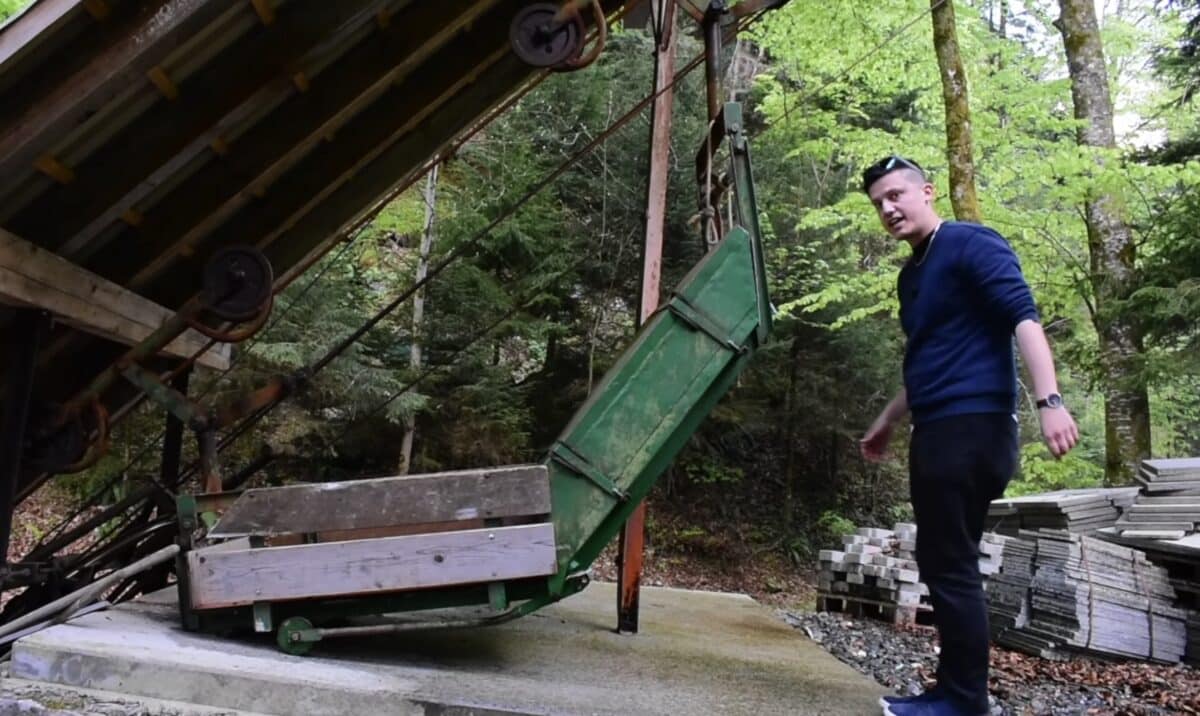
Tucked away in Switzerland’s scenic Engelberg Valley lies The Zingelbahn, an extraordinarily rare, privately owned cable car system that is too dangerous by modern standards for ferrying people uphill. The lightning fast rickety contraption was engineered in 1923 to connect the valley at Obermatt with the elevated pasture of Unter Zingel so farmers could haul supplies and agricultural goods up steep mountainsides. Today, alongside a sister line in Valais, it stands as one of only two operational, fully water-balanced suspended cable cars in the world.
The engineering behind the Zingelbahn relys entirely on gravity and water rather than electricity or motors. Suspended over a 2,559-foot-long steel cable with a steep 1,903-foot vertical rise, the system operates using two counter-balanced cabins equipped with 53-gallon water tanks.
At the upper station, a simple hose fills the top cabin’s tank until it is heavy enough to pull the bottom cabin upward. Upon reaching the bottom, the cabin hits a concrete buffer that automatically triggers a valve to release the water. Communication is equally low-tech: to signal the operator at the top station to send down a car, someone at the bottom hits the main cable with a heavy stick, sending vibrations up the line to ring a warning bell.
Operating at heights up to 650 feet above the ground, the Zingelbahn is unmonitored by speed-limiting electronic braking systems, allowing it to reach speeds exceeding 37 mph (fast enough that friction burns the cable and creates a distinct smell of burning wood). Though its open-air “Nieder-Schiffli” style carriages originally allowed for two passengers, the Zingelbahn lost its official passenger transport license in 1964 and now operates strictly for cargo. Managed today by the Bonta family, the line remains an extraordinary, enduring piece of mechanical history amidst the breathtaking Swiss landscape.
The Zingelbahn:
- Location: Runs between Obermatt (valley station at 670 m) and Unter Zingel (mountain station at 1,250 m) in Switzerland.
- How it works: It uses two open-air cabins with built-in water tanks (holding roughly 200 liters) on the back. Filling the tank at the top station causes that cabin to descend, pulling the lower, empty cabin up the steep slope.
- Speed: It can reach speeds up to 45–60 km/h (approx. 28–37 mph), making it one of the fastest and most unusual cable systems of its kind.
- Communication: Operators signal the top station by hitting the steel cable with a large stick, sending vibrations up a wire to ring a bell.
- Purpose: Built originally in 1923 (and updated in 1931), it is a private ropeway primarily used to transport material, supplies, and gear to the alpine pasture at Unter Zingel.
