

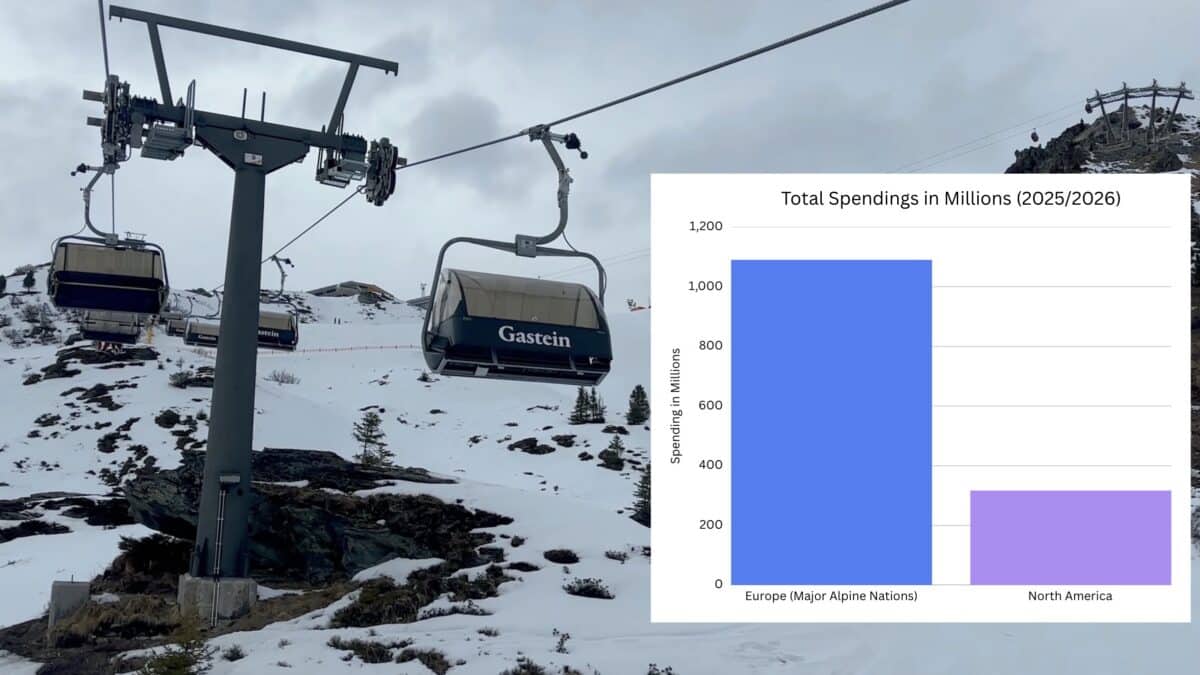
YouTuber SnowStash took a deep dive into the ski lift infrastructure between the Europe and North America, showing a striking gap in investment between the areas that goes far beyond corporate greed. The research presented in his video shows that the four major Alpine nations of Europe (Italy, France, Austria, and Switzerland) spent approximately $1.09 billion on new lift installations during the 2025/26 ski season, while the United States and Canada combined spent just $317 million.
The disparity in quality is just as notable. Europe installed 27 new 10-person gondolas and 12 new eight-seat high-speed chairs in that same season. North America installed four gondolas and zero high-speed eight-seat chairs. The most common North American installation was the fixed-grip quad, with 14 built, accounting for 28 percent of all regional installations.
According to SnowStash, Vail Resorts is the main driver of this gap on the North American side. In fiscal year 2025, Vail returned roughly $595 million to shareholders through buybacks and dividends while spending approximately $225 million on mountain capital expenditures. Private operators like Alterra, by contrast, invest an estimated 20 to 25 percent of revenue back into their mountains, closer to European norms.
The structural reasons run deeper than ownership, however. European resorts, particularly in Switzerland and Austria, benefit from community-based ownership models, long-term government concessions, and a century-plus tradition of year-round alpine tourism that justifies enormous capital outlays. Many Swiss gondolas are classified as public transport infrastructure and receive direct federal subsidies. North America has a few “public” gondolas and lifts, but these are few and far between, while transport lifts like the Matterhorn Alpine Crossing are fairly common throughout Europe.
Additionally in the United States, roughly 60 percent of ski terrain sits on Forest Service land under permits that have historically restricted non-ski summer operations, capping the year-round revenue potential that makes large lift investments financially viable abroad. That’s been changing in recent years, especially with help from the Ski Area Recreational Opportunity Enhancement Act of 2011 which encourages non-ski summer operations, but it’s a slow change.