

A long-standing theory about polar bears held that their hollow, transparent fur acted like fiber optic cables, funneling sunlight down to jet-black skin beneath, where it would be absorbed as heat. Columbia Sportswear VP of Innovation Haskell Beckham wanted to build a jacket around that concept, but there was a pretty major problem. The theory turned out to be false.
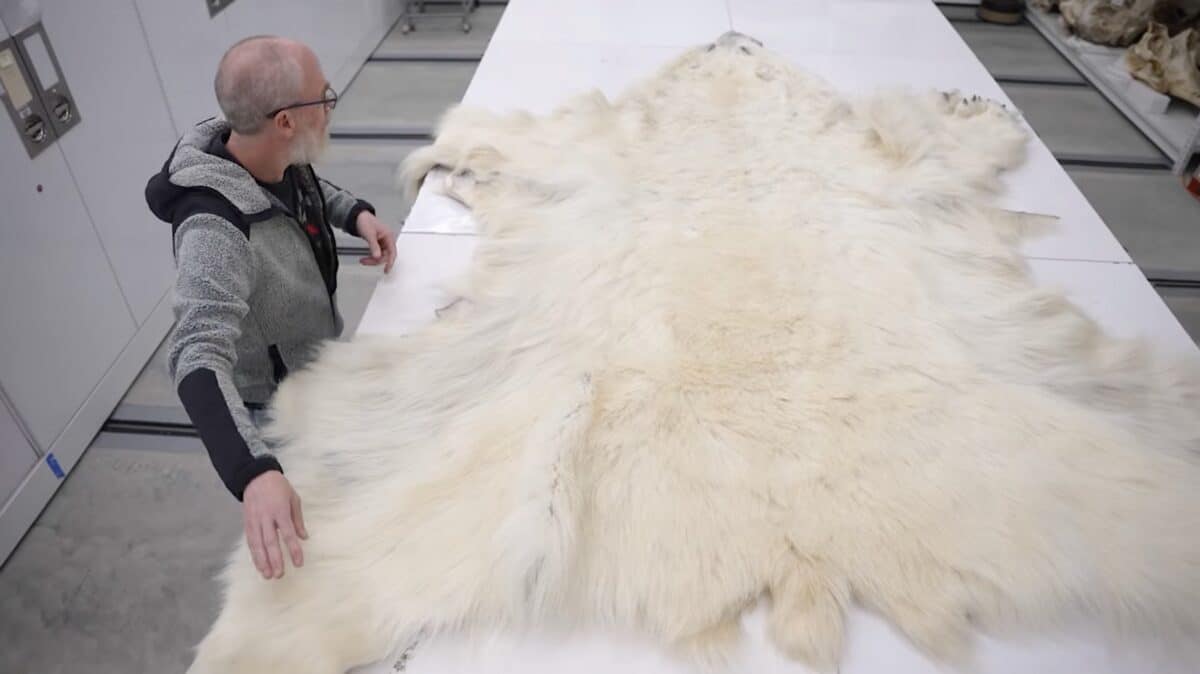
Beckham borrowed a polar bear pelt from the Burke Museum in Seattle to run a controlled experiment. Using a solar simulator, the same technology used in the solar panel industry, his team exposed the pelt to artificial sunlight while a heat flux sensor measured how much radiation actually reached the skin. The plate beneath the pelt was held at 32 degrees Celsius to replicate real mammal skin temperature.
The fur on most of the polar bear’s back proved too thick for sunlight to penetrate at all. The black skin plays no measurable role in warming the animal. If this were an episode of MythBusters, as the researchers put it, the verdict would be busted.
But the research was not wasted. By understanding exactly where the polar bear’s biology fell short of the theory, Beckham’s team figured out how to engineer a fabric that actually works on the principle the bear could not deliver. The key was building a shell material and insulation layers optimized to allow solar radiation to pass through, something the dense polar bear fur largely prevents.
To prove the design worked, researchers compared their new jacket material against a traditional black jacket under artificial sunlight. After 15 minutes, the polar bear inspired design was roughly 13 degrees Celsius warmer inside. Thermal imaging on a human subject confirmed the difference in real world conditions.
The resulting jacket, built on a debunked myth about an arctic predator, performed exactly the way scientists once believed polar bears did. Columbia Sportswear also published the findings in a peer-reviewed journal (which can be read here), an unusual step for an outdoor apparel company and a sign of how seriously the team took the science behind the product.