

The latest U.S. Drought Monitor report released this week shows drought conditions holding stubbornly across much of the country, with some regions seeing modest improvement while others continue to deteriorate.
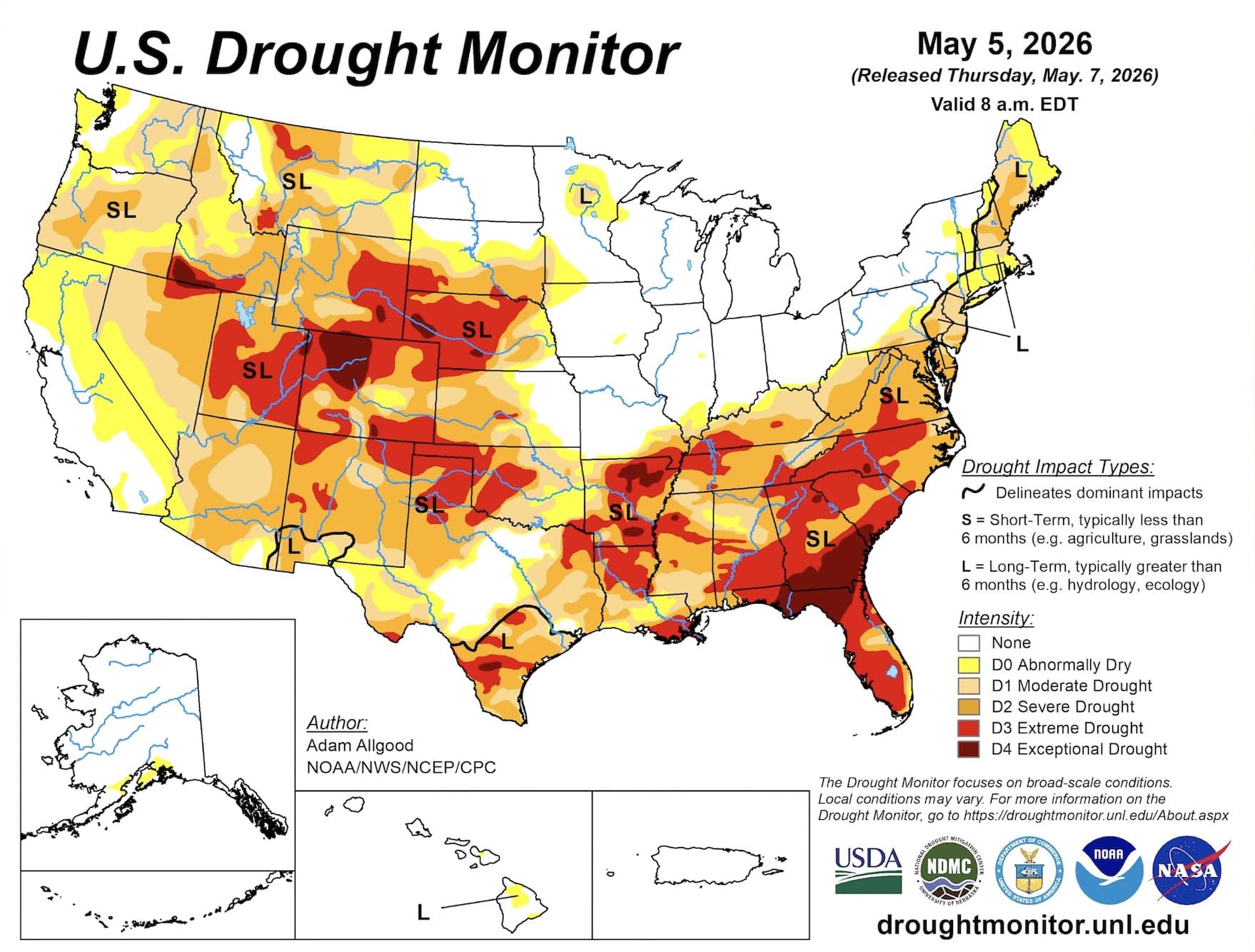
According to the report, 50.9% of the combined area of all 50 states and Puerto Rico is currently classified as moderate drought or worse, a slight improvement from 51.54% the prior week. Approximately 153.3 million people are living in drought-affected areas, down from roughly 155 million the week before.
Where It Rained
The most meaningful precipitation of the week fell across the South, where widespread soaking rains delivered a much-needed moisture boost to drought-affected communities. Conditions improved across portions of Texas, the lower Mississippi Valley, and the Tennessee Valley as a result. Lighter rainfall also fell across parts of the Northeast, helping slow advancement and improve conditions in Maine.
Where It Did Not
The relief was not universal. Across southeastern Alabama, Georgia, and northwestern Florida, soil moisture and stream flows remain extremely low and conditions are essentially unchanged. The Mid-Atlantic, Hudson Valley, and southeastern New England saw slight drought expansion after receiving lighter rainfall totals. Out West, hot and dry weather worsened conditions in Arizona and northwestern Washington, while late-season moisture in northern California did little to rescue an already meager snowpack.
Across the Plains, drought continued to expand, though cooler temperatures and dry weather allowed fieldwork to progress across the upper Midwest and Corn Belt.
Some Bright Spots
Hawaii registered a notable milestone this week, with the last area of a long-term moderate drought removed from the Big Island. In Alaska, abnormal dryness shrank in coverage following above-normal precipitation in parts of the state during April.
The U.S. Drought Monitor is produced every Thursday through a partnership between the National Drought Mitigation Center at the University of Nebraska-Lincoln, the USDA, NOAA, and NASA. Current maps and data are available at droughtmonitor.unl.edu.
