

There’s something profoundly satisfying about making a perfect turn on a snowboard. The board responds exactly how you want it to, your edge holds, and for a brief moment, everything feels effortless. Link a few of those turns together, and it’s easy to understand why people spend so much time, money and energy chasing that feeling.
But why does something as simple as sliding down a snowy hill feel so good? As it turns out, the answer may have quite a bit to do with how our brains process movement, balance, reward and attention.
Snowboarding engages several complex systems in the brain simultaneously, creating conditions that can make the experience unusually rewarding. Understanding how those systems work helps explain everything from the satisfaction of a perfectly carved turn to the almost irresistible urge to take one more run.
Your Brain Is Doing More Than You Realize
Even the simplest snowboard turn requires an impressive amount of coordination. Your brain is continuously interpreting the terrain, estimating speed, monitoring balance and adjusting the pressure applied through your feet. Most of this happens without conscious thought, particularly once you’ve become comfortable riding.
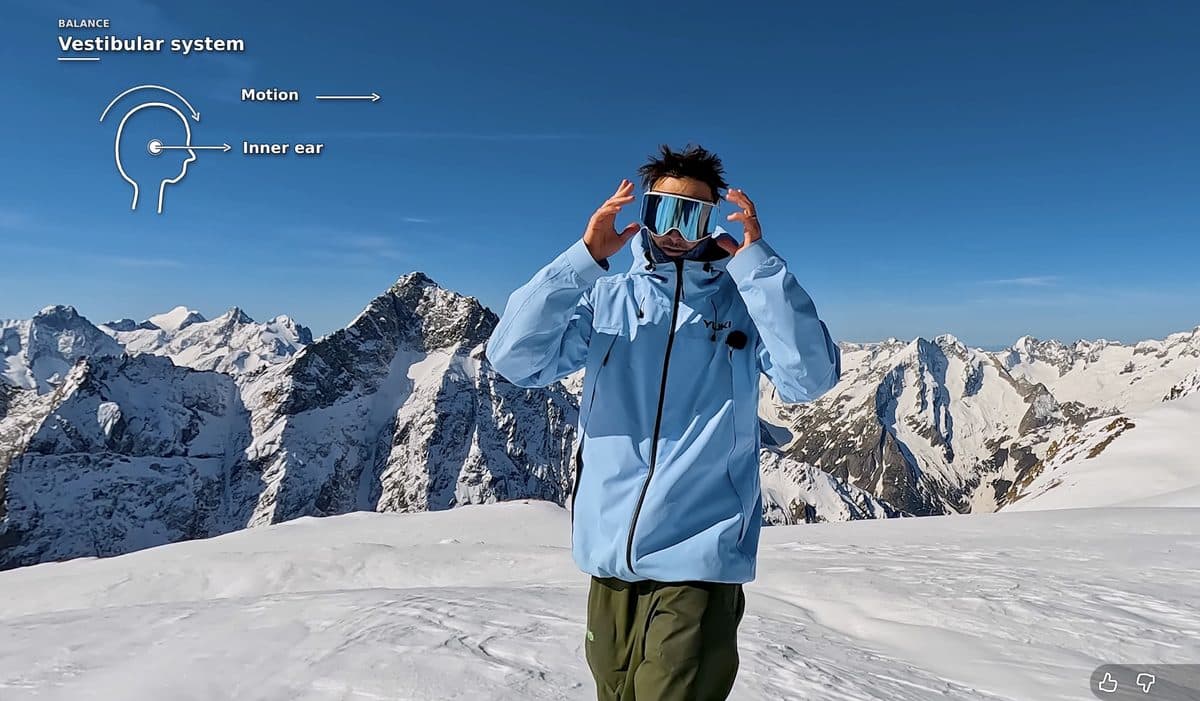
One of the primary systems responsible is the vestibular system, located in the inner ear. It helps detect movement, acceleration, rotation and changes in head position, giving the brain information it needs to maintain balance and spatial awareness.
Snowboarding places constant demands on this system. Unlike skiing, where your feet generally point in the direction of travel, snowboarders stand sideways and alternate between heel-side and toe-side turns. Each position requires a different combination of body movements, balance adjustments and muscle engagement.
Your brain also relies on proprioception, sometimes described as the body’s sixth sense. It’s what allows you to know where your arms and legs are without looking at them. When snowboarding, proprioceptive information helps your brain track everything from knee position to how much pressure you’re applying through the board.
There’s actual research supporting the importance of this process. A 2021 study published in the Journal of Science and Medicine in Sport examined proprioception among experienced skiers and snowboarders. Researchers found improvements in lower-limb proprioceptive ability among snowboarders following several weeks of regular time on the snow.
The more you ride, the more familiar these movements become. What initially requires intense concentration gradually becomes automatic, allowing you to make complicated adjustments without consciously thinking about each one.
Your Brain Learns to Predict Every Turn
Perhaps the most interesting part of snowboarding is that your brain isn’t simply reacting to what happens beneath your board. It’s constantly predicting what should happen next.
When you shift your weight toward your toes, your brain anticipates how the board will respond. When you lean into a carve, it predicts how much grip the edge should provide. If the snow suddenly changes from soft powder to hardpack, your nervous system has to recognize the difference and adjust.
Scientists call these predictions internal models, and they’re an important part of how people learn complex physical skills. Researchers at Johns Hopkins Medicine explain that repeated training helps the brain anticipate movement and update its expectations when something unexpected happens.
For snowboarders, every turn provides information that can improve the next one. As those predictions become more accurate, riding starts to feel less like a series of individual movements and more like one continuous motion.
That’s a big part of the satisfaction of becoming a better snowboarder. The board gradually begins to feel like an extension of your body, and movements that once seemed awkward become second nature.
Why a Perfect Turn Makes You Want Another
Another piece of the puzzle involves dopamine, a chemical messenger in the brain that plays an important role in motivation, learning and reward.
Dopamine is frequently described as a pleasure chemical, but that explanation misses much of what it actually does. One of its important functions involves helping the brain recognize outcomes that are better than expected and learn which actions are worth repeating.
Research into dopamine and reward prediction has shown that dopamine neurons can respond to differences between anticipated and actual rewards. This process helps reinforce successful behavior and contributes to learning.
Think about spending an entire morning trying to improve your carving technique. You make dozens of imperfect turns, occasionally catch an edge and struggle to get the timing right. Then, seemingly out of nowhere, everything comes together and you execute exactly the turn you’ve been working toward.
That unexpected success can be especially satisfying. Reward-learning mechanisms involving dopamine may help explain why accomplishing a difficult movement feels motivating and why you immediately want to attempt it again. However, researchers have not established that every successful snowboard turn produces a specific dopamine response.
It’s also part of what makes progression so enjoyable. Whether you’re learning your first linked turns, improving your switch riding or finally landing a trick, there’s always another challenge waiting.
Snowboarding Creates the Perfect Conditions for Flow
For many riders, the best part of snowboarding comes when they stop thinking about the mechanics altogether. Turns connect naturally, the terrain seems to dictate your movements, and the usual distractions of everyday life fade into the background.
Psychologists have a name for this experience: flow.
Flow describes a state of deep concentration in which someone becomes completely absorbed in an activity. It is often associated with a balance between challenge and ability, clear goals and immediate feedback.
A 2024 paper examining the neuroscience of flow describes how activities that are challenging without becoming overwhelming can encourage this experience. Researchers are still working to understand exactly what happens in the brain during flow, but the psychological characteristics are well established.
Snowboarding offers many of the conditions associated with flow. The task requires constant attention, your actions have immediate consequences, and the challenge changes continuously with the terrain.
When you’re linking turns down a mountain, there’s little opportunity to worry about unanswered emails, work deadlines or whatever else might be occupying your thoughts. Your attention is focused on the snow, your speed and where you’re going next.
That relationship between snowboarding and mental immersion has also been explored in snowboard films centered on the pursuit of flow, reflecting an experience that many riders recognize even without knowing the psychology behind it.
Being Outside Makes the Experience Even Better
Of course, none of this happens in isolation. Snowboarding also combines physical exercise with fresh air, changing scenery, natural light and the excitement of moving through a mountain environment.
There’s considerable sensory stimulation, but unlike scrolling through a phone or sitting in front of a computer, nearly everything you’re experiencing relates directly to what your body is doing.
You see the terrain approaching, feel the pressure of the snow against your edge and hear the sound of your board cutting across the surface. These sensations are connected to the same continuous activity, giving your brain a great deal to process while keeping your attention focused.
Being physically active outdoors may also contribute to improved mood and well-being, although researchers are still investigating how much additional benefit comes specifically from exercising in natural environments.
Add the rhythmic nature of linking turns, and the appeal becomes even easier to understand. Once you find a comfortable cadence, each movement sets up the next, creating a sensation of smooth, continuous motion.
Why We Keep Coming Back
Snowboarding has a way of being just difficult enough to remain interesting. No two turns are exactly alike, snow conditions are always changing, and even experienced riders have techniques they want to improve.
At its best, the sport combines balance, physical coordination, anticipation, immediate feedback and the satisfaction of learning something new. When those elements come together, the experience can become deeply absorbing.
The underlying neuroscience is still being studied, and there’s no single chemical or brain mechanism that fully explains why snowboarding feels so good. But the combination of skilled movement, rewarding progress, focused attention and time outdoors offers a pretty convincing explanation. With that said, get out there a rips some turns this winter. Woohoo!
