

You’ve probably seen some of the world’s most famous mountains without ever realizing it. One appears before Hollywood blockbusters, another spent decades on chocolate bar wrappers, and a Colorado peak is featured on one of America’s most recognizable beer cans.
Mountains have long been used to symbolize strength, adventure and achievement, making them popular choices for company logos and product packaging. Some brands have even built their identities around real peaks, turning natural landmarks into images recognized by millions of people who might not know where those mountains are located.
Here are five famous mountains and rock formations that have found their way into pop culture.
1. The Matterhorn, Switzerland and Italy: Toblerone Chocolate
The Matterhorn is one of the most recognizable mountains in the world, and for decades, its distinctive pyramid-shaped summit appeared on the packaging of Toblerone chocolate bars.
The 14,692-foot mountain sits on the border between Switzerland and Italy, rising above the Swiss resort town of Zermatt. Its dramatic silhouette became closely associated with Toblerone, whose triangular chocolate pieces resemble mountain peaks.
There was even a hidden detail in the original packaging. The illustration of the Matterhorn contained the silhouette of a bear, a reference to Bern, the Swiss city where Toblerone was founded in 1908.
However, the company removed the Matterhorn from its packaging in 2023 after shifting some chocolate production to Slovakia. Switzerland’s strict rules governing the use of national imagery meant the company could no longer use the famous mountain on the redesigned packaging.
The real Matterhorn remains as spectacular as ever, attracting climbers, skiers and photographers, including a filmmaker who recently flew a $10,000 drone to its summit.
2. Ben Lomond, Utah: Paramount Pictures
Anyone who has watched a Paramount Pictures movie is familiar with the snow-covered mountain surrounded by stars that appears at the beginning of the studio’s films.
The origins of that image date to the early days of Hollywood. According to Paramount’s official history, company founder William W. Hodkinson created the original logo in 1916, drawing inspiration from a mountain he remembered from his childhood in Utah.
Many historians believe that mountain was Ben Lomond, which rises above Ogden, Utah, a community surrounded by ski areas, including Snowbasin and Powder Mountain.
Local historian Charles Trentelman identified Ben Lomond as the inspiration, although Paramount’s own account does not specify which Utah peak Hodkinson remembered.
The logo has evolved considerably over the past century, but the basic image of a majestic mountain encircled by stars remains one of Hollywood’s most enduring symbols.
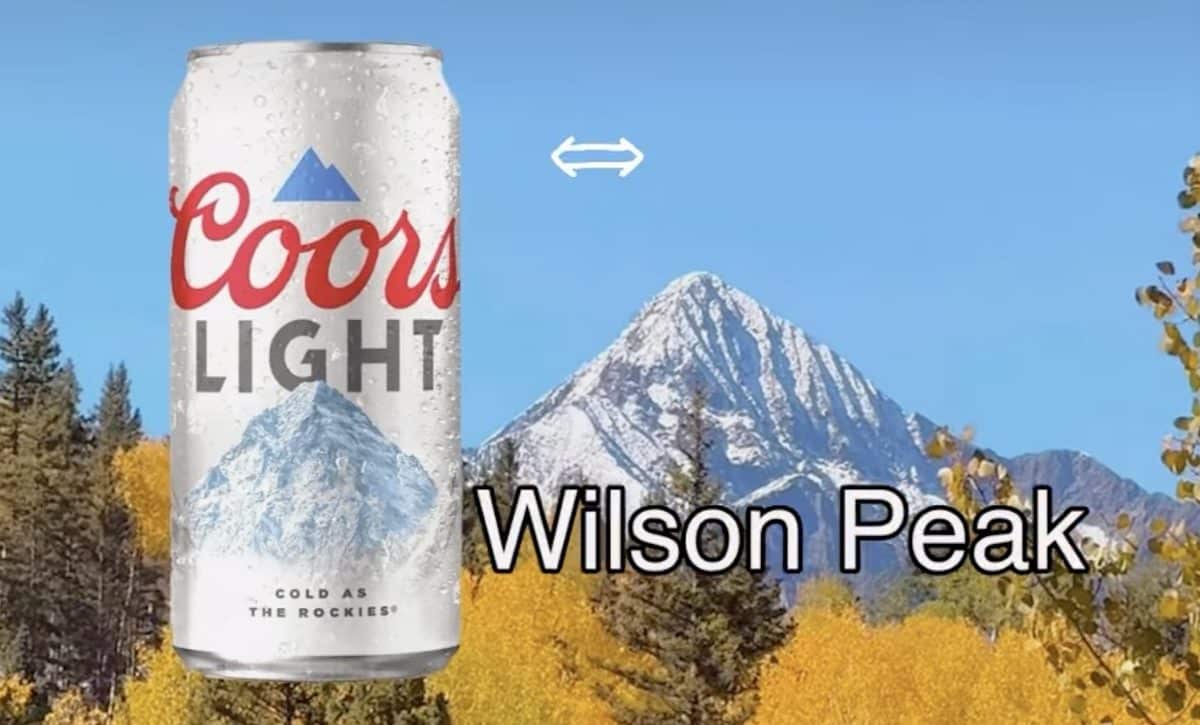
3. Wilson Peak, Colorado: Coors Light
Those rugged, snow-covered mountains on Coors Light cans aren’t just an imaginary section of the Rockies.
The prominent peak is Wilson Peak, a 14,023-foot mountain in Colorado’s San Juan Mountains near Telluride. The distinctive summit has appeared on Coors Light packaging for years, helping reinforce the beer company’s connection to its home state.
According to Visit Telluride, Wilson Peak is the mountain featured on the Coors Light can. The peak is a popular but challenging mountaineering destination, with routes involving exposed scrambling and steep terrain.
Coors Light has also incorporated the mountain imagery into its temperature-sensitive packaging. When the beer reaches a sufficiently cold temperature, the mountains on the can turn blue, a feature the company promotes as part of its Cold as the Rockies branding.
Wilson Peak has additional Hollywood connections. The mountain appeared in Quentin Tarantino’s 2015 film “The Hateful Eight” and has also been featured in Jeep advertisements.
4. Half Dome, California: The North Face
One of the outdoor industry’s most recognizable logos was inspired by a massive granite formation in Yosemite National Park.
The North Face’s familiar three curved lines represent the distinctive profile of Half Dome, the iconic rock formation that rises nearly 5,000 feet above Yosemite Valley.
The design captures the shape of Half Dome’s enormous rounded face, which has become synonymous with climbing and adventure in California’s Sierra Nevada.
The company acknowledges the Half Dome connection in its official history, describing the landmark as the inspiration for its iconic logo.
While millions of people encounter the design on jackets, backpacks and other outdoor gear, the real Half Dome remains one of Yosemite’s most famous destinations.
5. Mont Blanc, France and Italy: Montblanc Luxury Goods
Mont Blanc, the highest mountain in the Alps, has inspired a luxury brand whose products are found far from the ski slopes and mountaineering routes surrounding the peak.
German luxury manufacturer Montblanc, best known for its expensive writing instruments, adopted the mountain’s name in 1910 as a symbol of excellence and achievement.
The company’s familiar white six-pointed emblem also has a direct connection to the mountain.
According to Montblanc’s official history, the white symbol represents the six snow-covered glaciers of Mont Blanc. The emblem appears on the caps of its famous fountain pens and across the company’s luxury accessories.
The mountain itself rises approximately 15,767 feet above sea level and remains one of Europe’s most important mountaineering destinations.
