

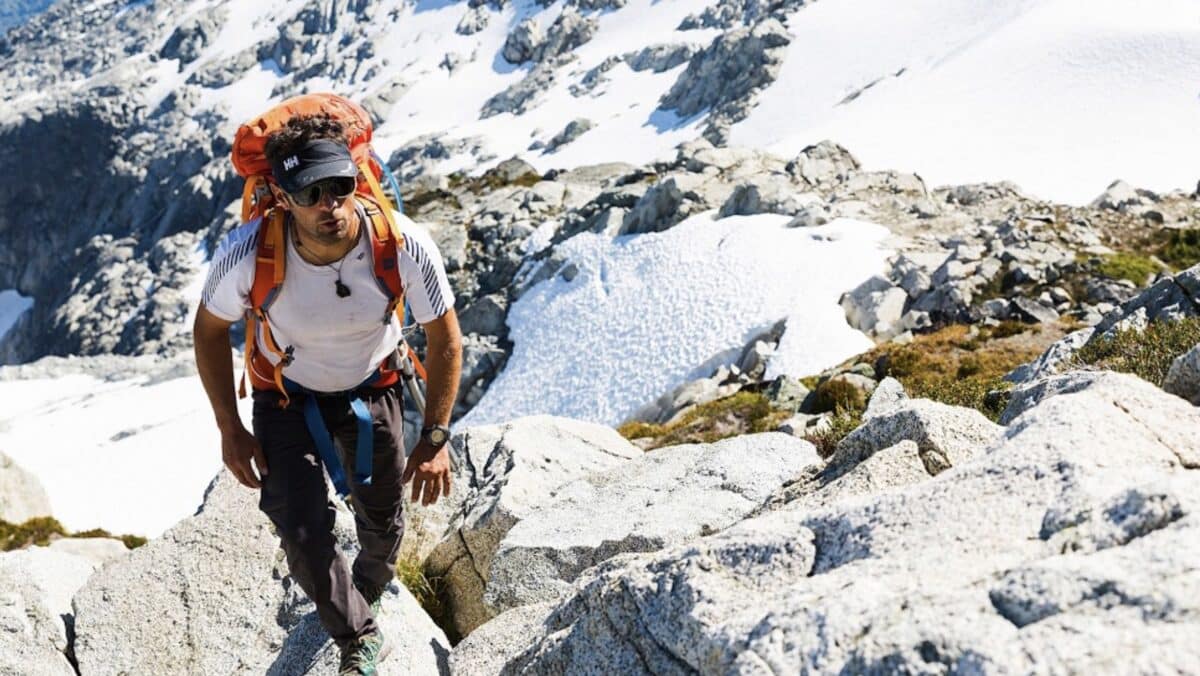
For professional mountain guide Jean-François “JF” Plouffe, decades spent skiing, climbing and guiding in serious terrain provided plenty of experience solving difficult problems in the mountains. His new short film focuses on a very different kind of challenge.
Midlife Crisis follows the Squamish, British Columbia-based guide through a period of major personal upheaval that included divorce, the loss of his family home and the end of a significant relationship. Rather than presenting the mountains as an easy solution, the film explores the slower process of rebuilding through skiing, climbing, conversations with friends, time with his children and a willingness to ask for help.
Filmed across British Columbia and Japan, the 15-minute film uses Plouffe’s life in the mountains as the setting for a broader discussion about mental health, relationships, identity and vulnerability.
A Mountain Guide Confronts A Different Kind Of Challenge
Plouffe has spent more than 25 years working as a mountain guide and instructor, with experience ranging from skiing and climbing to expeditions around the world. Helly Hansen, which has worked with Plouffe as one of its professional mountain guides, notes that his career has taken him from the Yukon to the Himalayas.
That background is an important part of Midlife Crisis, but the film deliberately turns away from the idea that experience in difficult mountain environments makes someone immune to struggles elsewhere in life. The story instead focuses on what happens when a person accustomed to being capable, independent and responsible for others reaches a point where those same instincts are no longer enough.
Plouffe said one of his goals with the project was to challenge the stigma surrounding mental health, particularly among men.
“The goal was to challenge the stigma surrounding mental health, particularly the pressure many men feel to remain strong, independent and silent.”
At the same time, Plouffe does not see the film as a story exclusively for men. The larger message is intended for anyone who has experienced loss, questioned their direction or struggled to regain a sense of stability when life changed unexpectedly.
The Mountains Are The Setting, Not The Solution
Skiing and climbing remain central to Midlife Crisis, but the film’s message extends well beyond outdoor sports. Plouffe’s time with his children, conversations with other people and willingness to acknowledge vulnerability are just as important to the story as the mountain footage.
Rather than offering a simple message that going outside can fix difficult periods in life, the film emphasizes connection, professional help, friends and family. Vancouver International Mountain Film Festival (VIMFF) describes the film as an examination of how depression and isolation can affect people who may otherwise appear happy and accomplished, while also emphasizing the role that support from friends, family, professionals and fellow mountain athletes can play when someone is struggling.
For Plouffe, the objective is not to present his own experience as a roadmap for everyone else. Instead, he hopes the film can provide a starting point for conversations that might otherwise never happen.
Taking The Conversation Beyond The Film
Plouffe plans to use Midlife Crisis as more than a standalone short film. The project is intended to support community screenings, film festival appearances, speaking engagements and partnerships with schools, workplaces and organizations, with the broader goal of creating environments where conversations about mental health, vulnerability and asking for help become easier to start.
The film is scheduled to appear at the Reel Minds Mental Health Film Festival in Miami on Oct. 10. Presented by NAMI Miami-Dade County on World Mental Health Day, the festival focuses on short films exploring mental health, resilience and recovery, followed by conversations involving filmmakers, mental-health professionals and community members.
Midlife Crisis is also part of the Vancouver International Mountain Film Festival’s 2026 Fall Series. VIMFF’s current program lists the film among its Canadian mental-health selections, with the festival’s in-person program running Nov. 13 through Nov. 22. Additional international festival screenings are expected to follow.
Adventure Doesn’t Always Mean Reaching The Summit
Plouffe’s previous film, Balancing Act, explored the challenge of combining fatherhood with a life built around mountain adventure. Midlife Crisis turns that perspective inward, using the same mountain environment to examine what happens when confidence, identity and direction are shaken by changes away from the climbing wall or ski line.
The skiing and climbing remain part of the story, but the traditional adventure-film objective of reaching a summit or completing a difficult line becomes secondary to a more personal question: what does moving forward look like when the direction is no longer obvious?
For Plouffe, part of the answer has been recognizing that resilience does not always mean handling everything alone. Sometimes moving forward means asking for help, reconnecting with the people around you and accepting that finding the next direction can be an adventure in itself.
