

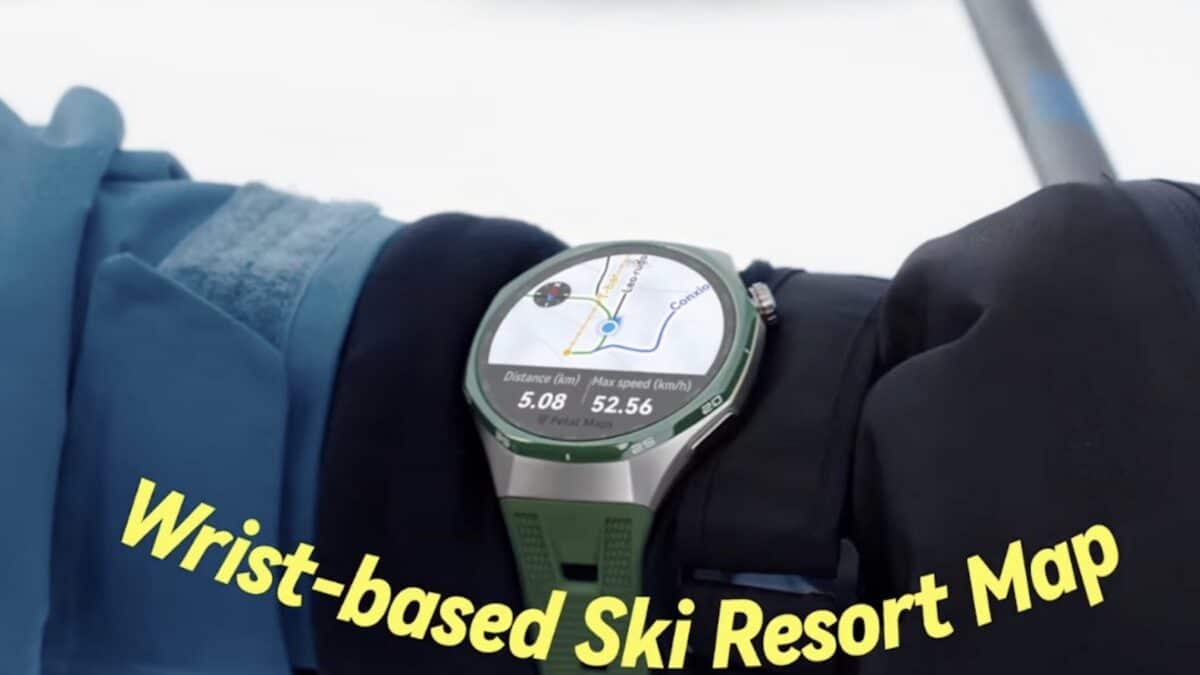
Huawei’s new WATCH GT 7 includes a surprisingly sophisticated set of features aimed directly at skiers and snowboarders, including downloadable resort maps, turn tracking, G-force measurements and automatic separation of skiing, lift and rest time.
The watch supports maps for more than 3,000 ski resorts across 59 countries. Huawei’s current database lists 3,171 resorts worldwide, including 531 in the United States and 173 in Canada.
That makes the WATCH GT 7 less like a traditional fitness watch with a generic ski mode and more like a combination of trail map, GPS tracker and performance analyzer.
More Than 3,000 Ski Resort Maps on Your Wrist
The most interesting feature for resort skiers is the built-in ski map support.
Users can download resort maps before heading to the mountain. Once stored on the watch, the maps can display trail names, difficulty ratings and lift stations directly on the watch face. Huawei says the system is designed to make unfamiliar ski areas easier to navigate without constantly pulling out a phone.
The supported-resort list is extensive.
Huawei currently lists 531 ski areas in the United States and 173 in Canada. Japan has 415 supported resorts, while Switzerland has 272, Austria 229, France 225 and Italy 150. The total currently stands at 3,171 resorts worldwide.
That kind of coverage could be especially useful for skiers traveling frequently or visiting large resorts where navigating interconnected lifts and terrain can become complicated.
It Tracks What Happens During Each Run
Huawei has also gone deeper than basic speed and vertical tracking.
During outdoor skiing, the WATCH GT 7 can record:
- Maximum speed
- Average slope angle
- Total vertical descent
- Number of runs
- Turn count
- Turn frequency
- Turn type
- Skiing route
- G-force through turns
- Skiing time
- Lift time
- Rest time
Huawei says the watch automatically separates skiing, lift rides and rest periods, allowing the resulting data to more accurately reflect actual time spent shredding.
Those distinctions are obviously handy for resort skiers as we spend a fair bit of time riding uphill, grabbing lunch and waiting for our slower friends to catch up…you know who you are.
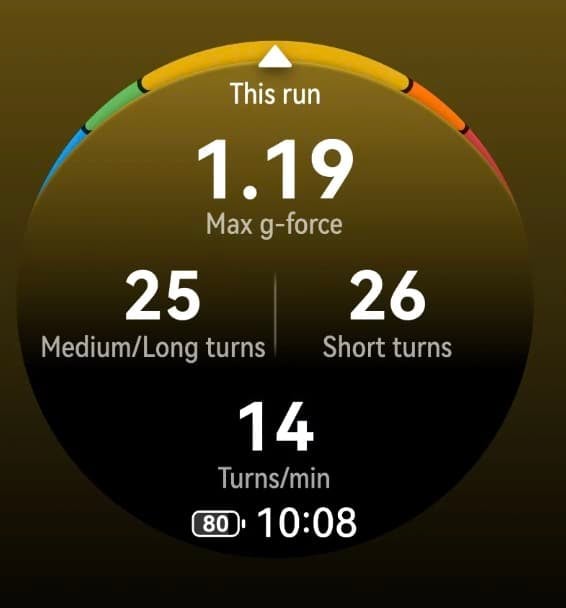
It Measures G-Force Through Turns
One of the more unusual features is G-force tracking.
Huawei describes the measurement as a way to quantify the acceleration and physical load experienced while turning. Higher G-force readings generally correspond with faster or tighter turns and a more dynamic skiing style.
The watch also tracks turn type, total turns and turn frequency, giving skiers a more detailed picture of how they moved through each run.
Whether recreational skiers need that much information is another question, but it is a level of ski-specific analysis rarely emphasized in mainstream smartwatches.
Huawei Claims Better GPS Tracking for Skiing
The WATCH GT 7 uses Huawei’s Sunflower Positioning System and AI-XDR algorithm for location tracking.
Huawei claims the new system delivers 20% greater route precision during high-speed snow sports compared with the previous generation. That is a manufacturer claim rather than an independent performance test, but accurate positioning is especially relevant for skiing because of rapid speed and directional changes, tree cover and mountainous terrain.
A more accurate GPS track could improve route maps, speed data, vertical calculations and the watch’s ability to distinguish individual runs.
Skiing and Snowboarding Modes
Huawei also includes dedicated outdoor and indoor snow-sports modes.
The indoor modes support both skiing and snowboarding and automatically record data including maximum speed, average incline, total descent and run count. Outdoor skiing adds the more advanced turn and mapping features.
After a session, the watch provides a run-by-run breakdown so users can review skiing performance afterward.
Battery Life Could Be Useful on Ski Trips
Battery life is another potentially useful feature for skiers traveling for several days.
The larger 46 mm WATCH GT 7 is rated for up to 21 days under light use and 12 days under typical use. The smaller 41 mm version is rated for up to 14 days under light use and seven days under typical conditions.
GPS-heavy ski tracking will consume more battery than ordinary use, so those figures should not be interpreted as skiing-specific battery life. Still, the advertised endurance could be useful for multi-day resort trips.
The Ski Features at a Glance
The WATCH GT 7’s most notable skiing and snowboarding features include more than 3,000 supported resort maps, offline trail navigation, trail names and difficulty ratings, lift locations, automatic run tracking, skiing versus lift-time separation, speed and vertical tracking, turn count and frequency, turn-type analysis, G-force measurements, route recording and dedicated indoor and outdoor snow-sports modes.
For resort skiers, the offline map function may ultimately be the standout feature. Being able to check a trail name, difficulty rating or lift connection by raising a wrist could be particularly useful at an unfamiliar mountain.
The more advanced performance data gives the WATCH GT 7 another dimension. Instead of simply recording where someone skied and how fast they went, Huawei is attempting to analyze how they actually moved through each run.
