
Every year, millions of visitors pass through America’s national parks in a hurry. They’re often chasing itineraries built from social media posts, rushing between viewpoints, and treating some of the most ecologically sensitive roads in the country like a throughway to the next highlight. Animals pay for that urgency with their lives. So do people.
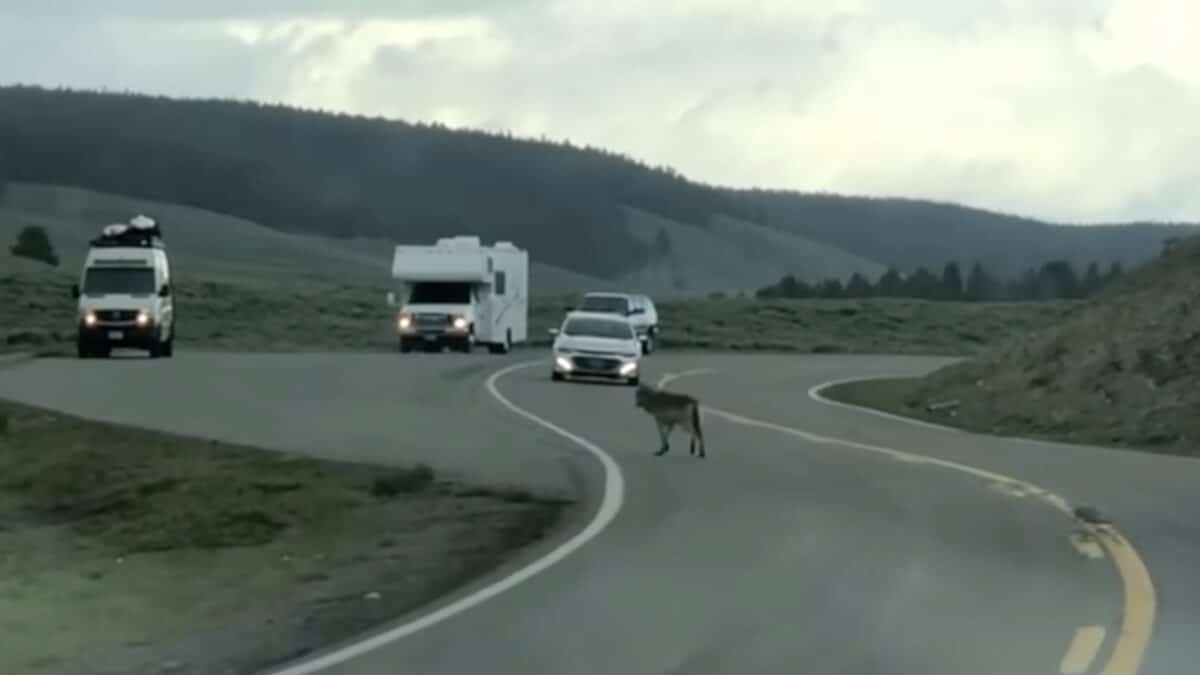
Motor vehicle crashes are the leading cause of unintentional fatalities in national parks. Hundreds of people die every single year on National Park Service roadways. For wildlife, the toll is staggering. Yellowstone and Grand Teton National Parks together record over 100 large animal deaths from vehicle collisions each year. In one especially bad year, Grand Teton alone lost five bears, two wolves, five moose, 48 elk, 41 deer, 17 bison, and six pronghorn to cars.
A wildlife filmmaker with At Home In Wild Spaces witnessed what one of those statistics looks like in person. Near Lewis Lake in Yellowstone, his family came upon a grizzly bear lying injured on the roadside, struck by a passing vehicle. The bear was still alive, rangers were called, and a search stretched across weeks, but whether the animal survived is still not known.
Collision rarely end cleanly, instead initiating a chain of suffering that can unfold over days in the backcountry, out of sight, beyond any help. Injuries that seem survivable to a human observer can be a death sentence for an animal that still has to hunt, avoid predators, and endure the elements.
Yellowstone’s chief bear biologist confirmed that the park loses a grizzly to a vehicle roughly once every three to four years. What makes the broader data harder to dismiss is that locals and out-of-state visitors are involved in collisions at nearly equal rates, even though locals represent a tiny fraction of overall park visitation. Familiarity breeds complacency and speed becomes habit, often forcing the animals to absorb the consequences.
National park roads demand something most drivers are not accustomed to giving: genuine patience. Lanes are narrow, curves are sharp, and speed limits are low for reasons that are not arbitrary. A collision with a 2,000-pound bison is mechanically equivalent to hitting another vehicle at speed. Smaller animals can clear a hood and come through a windshield.
Slow down and follow posted speed limits at all hours. Stay in your vehicle when traffic stops unexpectedly. Maintain 100 yards from bears and wolves, and 25 yards from all other large wildlife. Never feed animals from a vehicle window.
The parks belong to the animals that live in them. Driving through is a privilege, not a right, and it carries a responsibility that does not pause when the scenery gets good.