

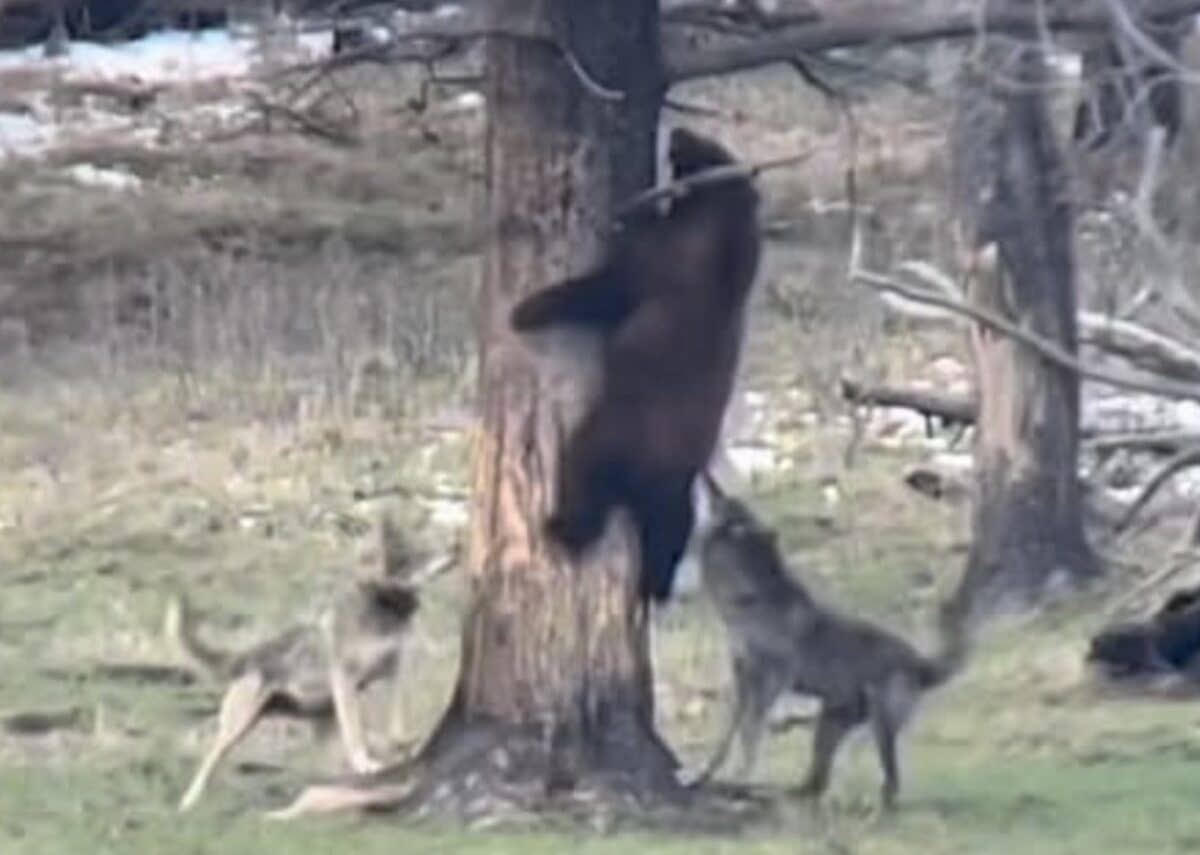
Yellowstone National Park — Wild scene from Yellowstone where a pair of opportunistic wolves decided to pick on a small black bear and steal its lunch. Wolf technician Taylor Rabe was observing one of her favorite wolves, 1228F, with her new mate from the Shrimp Lake Pack when they came upon the bear who was engrossed in munching away on a meal.
The wolves snuck up on the distracted bear and nipped at his backside scaring him off the food. The bear immediately employed it’s effective escape strategy, climbing a tree. While a pair of hungry wolves may dominate a small black bear on flat ground, the black bear had the advantage vertically.
Black bears and gray wolves in Yellowstone National Park share a complex relationship shaped by competition, opportunism and seasonal overlap. While wolves are dominant pack predators capable of killing large ungulates like elk, black bears are primarily omnivores that often scavenge wolf kills, especially in spring when emerging from hibernation with depleted fat reserves.
Research has shown that bears will displace wolves from carcasses in some cases, using their size and aggression to take over a food source, though large wolf packs can successfully defend their kills. At the same time, wolves indirectly benefit bears by increasing carrion availability across the landscape, creating a dynamic where competition and coexistence are closely linked.
Studies from Yellowstone’s wolf reintroduction era have also found that both species influence prey behavior and ecosystem processes in overlapping ways, highlighting how predator interactions, not just individual species, help shape the park’s ecological balance.
Fortunately, no wolves or bears were hurt in the above video but the bear’s ego may have taken a slight bruising. Learn more about safely observing wildlife in Yellowstone National Park below.
Wildlife encounters are a highlight of any trip to Yellowstone, but keeping a safe distance is critical for both visitors and animals:
- Stay at least 100 yards away from bears and wolves
- Stay at least 25 yards away from bison, elk and other wildlife
- Never approach or feed animals
- Carry bear spray and know how to use it
- Make noise while hiking to avoid surprising wildlife
- Keep pets secured and away from wildlife
- Use binoculars or zoom lenses for close views
- Obey all posted signs and closures

